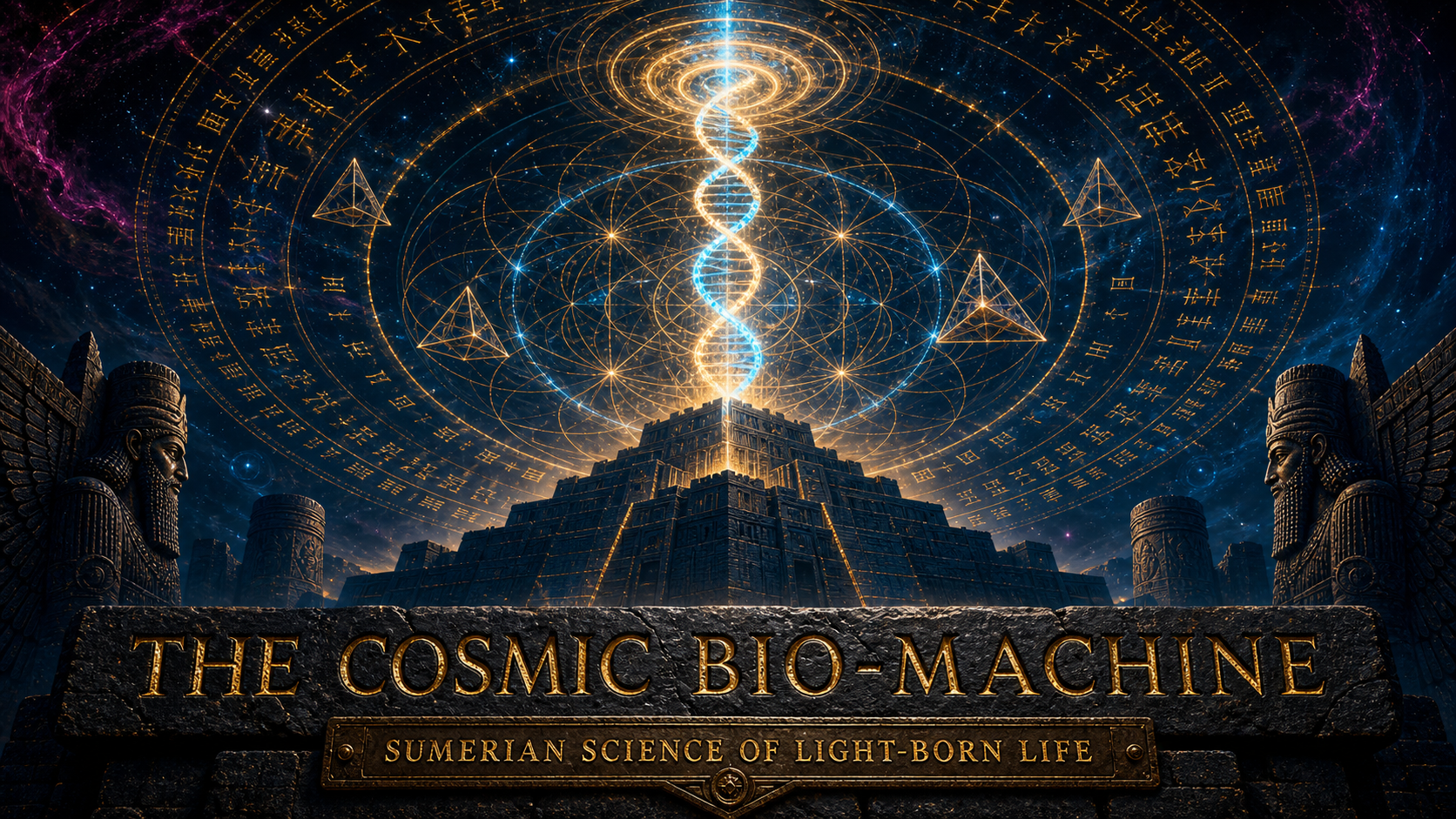
The Cosmic Bio-Machine: Dr. George Merkl and the Sumerian Science of Light-Born Life
Limited archive sale · 20% off every pack
20% Archive Sale
Deepen this scroll with the primary-source archive packs behind the Vault: grimoires, oracle systems, alchemy, tarot, sacred geometry, and manifestation libraries.
The Cosmic Bio-Machine: Dr. George Merkl and the Sumerian Science of Light-Born Life
Some books shout to be noticed. Others wait half-buried in the stacks, known only to the people who need them. Sumer-Tech: Cosmic Bio-Machine, the treatise of a San Diego researcher named Dr. George Merkl, belongs firmly to the second category; a surviving public scan preserves the title and 1995 attribution.[1] It is one of the strangest documents of the late twentieth century — a work that claims ancient Sumer preserved a science of building life from light, water, and geometry, and that the author personally recovered enough of it to grow amino acids and proteins in structured, "depolarized" water using nothing but coherent fields.[7]
This essay is neither an endorsement nor a debunking. It is a reading. The Vault's practice is to take unusual manuscripts seriously enough to map their internal logic — to ask what world-picture a text builds, which older traditions it inherits, and why it insists on the claims it makes. Read that way, Merkl's Cosmic Bio-Machine turns out to be one of the most complete modern expressions of a very old idea: that matter is frozen light, that life is organized by geometry rather than assembled by chance, and that the ancients encoded a real technology in myth because myth is how you carry dangerous knowledge across a dark age.
The same transmission is published as a paired study on Vault of Arcana and Universal Transmissions. The two pages are one article: move between them without losing the thread.
Who Was George Merkl?
Dr. George Merkl (1926–2000) was a Hungarian-born biophysicist and inventor who spent decades working in San Diego on problems at the edge of conventional science: electron microscopy, subluminal particles he called "sub-quarks," cold fusion, and the behavior of water near biological membranes. A biographical account describes his early life in Budapest and later work in physics and microbiology, while the wider claims about his career remain part of the Merkl literature rather than independently settled history.[2]
His masterwork, Sumer-Tech: Cosmic Bio-Machine, is not a lab report in the ordinary sense.[7] It is a synthesis: part microscopy atlas, part physics treatise, part meditation on Sumerian myth. In it, Merkl claimed to have rediscovered a "life science" embedded in Mesopotamian art and writing — evidence, he argued, that Sumerian civilization possessed (or received) a biotechnology of crystalline light, and that traces of it survive in cuneiform iconography: the rosettes, the wave-lines, the tree-of-life motifs, the gods holding cone-and-pan instruments that look suspiciously like optical apparatus.[7]
The claim sounds extravagant. But notice its shape. A lost civilization preserving advanced knowledge in symbolic form; a modern outsider recovering it through disciplined observation; life itself revealed as light organized by sacred pattern. This is the architecture of the prisca sapientia legend — the "ancient wisdom" narrative that runs from Hermes Trismegistus✦ through the alchemists to modern alternative science. Merkl did not invent the genre. What makes him worth reading is the strange specificity of his version: crystals grown in water, protein genesis under a microscope, and an entire physics of implosion offered as the mechanism behind the old symbols.
The Core Claim: Life Does Not Explode — It Implodes
The conceptual spine of the Cosmic Bio-Machine is a single inversion.[7] Mainstream thermodynamics describes the universe as running down: energy disperses, order decays, explosions are the default. Merkl asserts the opposite priority. For him, creation is implosion — the inward spiral, contraction toward a center along a geometric axis — and explosion is merely what happens when implosive structures fail.[7]
In his schema, an inward-falling vortex of coherent light compresses photons into electrons, electrons into protons, protons into the atomic nuclei of matter.[7] The "nuclear well" at the center of each such vortex is the seed-point of form. Around this point, waves interfere; where interference is stable and symmetric, matter persists; where it collapses, matter dissolves. Life is simply the most exquisite case of this general law: a standing wave maintained long enough to metabolize.[7]
Readers of Dan Winter will recognize the family resemblance immediately. Winter's implosion physics — phase conjugation, charge compression into the golden ratio, gravity as the result of coherence rather than a primitive force — circulates through the same underground of ideas represented in the Codex corpus. The shared intuition is old. The Hindu bindu, the point from which manifestation unfolds; the Hermetic doctrine that all things arise by "the operation of the Sun◈," a condensation of celestial fire; the Taoist Xuan Pin, the "mysterious female" gateway through which the ten thousand things enter the world — each tradition places a creative contraction at the origin of form. Merkl's contribution was to dress this ancient intuition in the lab coat of twentieth-century biophysics and claim he had photographed it happening in a dish of water. The correspondence✦ is interpretive, not a claim that the older traditions anticipated Merkl's experiments.
Life Crystals and Structured Water
The laboratory heart of the book is the life crystal. Merkl claimed that when water is carefully depolarized — stripped of its random molecular orientations, "structured" into a liquid crystal lattice — it becomes capable of hosting extraordinary processes. A surviving Merkl account describes the crystal as a tetrahedral, pyramid-like structure and attributes unusual changes in water to its geometry; those are the author's claims, not established biochemical results.[3] Under the right conditions of light and field, ordered crystalline forms appear in the water and act as scaffolds. Onto these scaffolds, he reported, amino acids self-assemble, then proteins, then RNA-like chains: genesis without genes, life organizing directly from resonant chemistry.
Three ideas carry the weight here:
- Water as memory medium. Not passive solvent but active participant — a liquid crystal able to hold patterns the way◈ a magnetic tape holds music. The structured-water lineage runs from Viktor Schauberger's living-water vortices through Masaru Emoto's ice crystals, and it remains scientifically contested: a review of animal studies notes that proposed treatments and durations vary, and that no consistent mechanism yet accounts for many claimed changes in water's physico-chemical properties.[4] But within Merkl's system it is load-bearing: if water cannot remember, the machine has no working fluid.[7]
- The crystal as blueprint. The life crystal does not merely catalyze reactions; it templates them. Its superlattice geometry determines which molecules can crystallize onto it, just as a die determines which coins can be struck. Form precedes organism.[7]
- Light as construction worker. Coherent photon beams do the assembly, guided by interference patterns — the "scrolls of light" discussed below. Energy is not burned but folded inward; construction is a kind of controlled collapse.[7]
Whatever one makes of the experimental claims — they were never replicated in mainstream literature, and skepticism is the correct default — the internal logic is elegant and complete. And it is striking how closely it rhymes with the older esoteric picture in which the astral body templates the physical, the etheric molds the material, and spirit is the scaffold on which flesh crystallizes. Rudolf Steiner's formative forces, described decades earlier in an entirely different vocabulary, are functionally identical to Merkl's templating crystals. The vocabulary changes; the diagram persists.
Scrolls of Light: Geometry as Genetic Script
Merkl's most poetic construct is also his most interesting. He describes photons spiraling inward along implosive paths, braiding into helical structures he calls scrolls of light — tightly wound beams whose interference patterns encode three-dimensional blueprints for organic form.[7] These scrolls condense into tetrahedral units; tetrahedra assemble into the superlattices of matter; and in living systems the scrolls wrap themselves around the DNA molecule, which Merkl reimagines not as a static codebook but as a holographic antenna — a receiver and transmitter of formative information.[7]
The image of a scroll unrolling is deliberate. In Merkl's reading, the genetic "text" is not read linearly like a sentence but unfolds spatially like a scroll held open to the light — and the light itself is part of the message. DNA, in this view, is less a program than an instrument: a string section waiting for the rest of the orchestra.
It would be easy to file this as pure fantasy until one notices how many independent traditions drew the same figure. The Kabbalistic Sefer Yetzirah describes creation proceeding through "carved letters" engraved in a divine breath. The Egyptian Book of the Dead equips the dead with spells that are literally called reru, "spells" or "utterances," understood as vibratory constructs that build a body of light (sah) for the soul. The Logos theology of John's Gospel opens with the Word becoming flesh — sound organizing substance. Merkl's scrolls of light are these doctrines rendered as a microscopy atlas: letters of light, engraved breath, word made flesh — now with photographs attached.
And there is a genuinely testable fragment buried inside the poetry. Biophysics has measured ultra-weak photon emission from living systems as a by-product of cellular metabolism, distinct from ordinary bioluminescence.[5] The older mitogenetic literature is even more instructive: a review concludes that the UV fraction of ultra-weak emission should be regarded as real while the proposed biological effects remain difficult to reproduce.[6] That gives Merkl a real neighboring phenomenon — light from living matter — without proving his stronger claims about DNA, coherent information, or protein genesis. The honest bridge is therefore narrower and more interesting than a triumph: his metaphor touches a measurable edge, but the machine remains unverified.
The Sumerian Layer: Why Blame the Sumerians?
Why did Merkl anchor this whole apparatus in Sumer rather than Egypt, India, or Atlantis? Partly biography — the Anunnaki-materials milieu he moved in (his circle overlapped with Zecharia Sitchin's readership) made Mesopotamia the natural setting. But there is a more careful answer available.
Sumer is where writing begins. The earliest texts we possess — administrative tablets, then hymns, then epics — come out of the Tigris-Euphrates delta. If any ancient people had wanted to encode a technology of light and form in durable symbolic media, Sumer is where such an encoding would have had to land first to enter history at all. Merkl's iconographic readings — the rosette as interference pattern, the wavy water-lines as structured flow, the god Enki flanked by flowing vases as the guardian of the living waters — are not persuasive as philology. But they are structurally meaningful: they identify Sumer as the place where the deep grammar of symbol and technology first became visible together.
Dan Winter's contribution to this thread is characteristically electric. In the Anunnaki-genesis materials represented in the Codex corpus, he suggests that Sumerian and Hebrew letterforms are themselves wave-geometries — "cookie-cutter" shapes that organize fields, so that shining coherent light through the letterforms produces microscopic structures resembling those seen in living cells. The alphabet, in this reading, is not merely a notation for speech but a library of compressed field operations: letters as lenses, words as machines. This is a corpus-level interpretation, not philological evidence. However one grades the science, the underlying insight is authentically esoteric and authentically old: form is operative. The shape you make shapes what flows through you. This is the principle behind the yantra, the sigil✦, the seal, the mandala — and, if you follow the thread far enough, behind the temple itself.
The Machine as Temple, the Body as Reactor
Toward the end of the treatise, the hardware falls away and the real subject stands up. Merkl's cosmic bio-machine — vortex dishes, incubator chambers, life-crystal reactors — is finally revealed as a description of something you are wearing.[7] The dual dishes become the sympathetic and parasympathetic polarities of the nervous system. The incubator becomes the cerebrospinal fluid bathing the brain in structured water. The scrolls of light become the coherent biofields measured (however faintly) leaking from every dividing cell. The Chondriana, his hypothetical primordial cell-ancestors, become the inner alchemists still at work in your mitochondria, keeping the flame.[7]
This is the oldest move in esoteric literature: as above, so below, scaled down to the body. The temple is the body; the temple apparatus is the glandular-brain complex; the ritual is breathing and attention. What distinguishes Merkl's version is that it arrives dressed as engineering, with diagrams and patent numbers, in the same century that produced the microscope photographs he believed proved it. Ancient yoga described the spine as Mount Meru and the awakened force as a coiled serpent rising through seven gates. Merkl describes the same topography as a vertical implosion column — a vortex axis running up the body's center, drawing charge into coherence. The maps differ in decoration and agree in geography.
How to Read a Book Like This
The Vault's editorial position on works like the Cosmic Bio-Machine is neither belief nor mockery but disciplined reading. Three practices apply:
- Separate the layers. Experimental claims (structured water genesis), theoretical framework (implosion cosmology), historical narrative (Sumerian transmission), and symbolic interpretation (iconographic readings) are four different kinds of assertion stacked in one manuscript. Each deserves its own verdict; collapsing them into a single true/false flattens the text.
- Honor the lineage. Merkl is a node, not an origin. His ideas descend from Schauberger's vortices and Gurwitsch's rays, run parallel to Winter's phase conjugation and Steiner's etheric anatomy, and echo doctrines old as the Pyramid Texts. Reading him alongside the corpus — which is exactly what our archives enable — turns a crank document into a crossroads.
- Keep the testable fragments. Ultra-weak photon emission is measurable, but its biological role remains under-researched and disputed.[5][6] Structured-water experiments are a legitimate research subject, not a blank cheque for every memory-of-water claim; the review literature does not supply a single settled mechanism.[4] Cold fusion remains contested but not forgotten. A manuscript can fail wholesale and still donate working parts.
The honest line: no credible replication of Merkl's protein-genesis experiments exists in mainstream literature, and his physics contradicts standard models at many points. Treat the Cosmic Bio-Machine as a speculative cosmology of unusual completeness — a modern grail romance with micrographs instead of illustrations — and it repays attention. Treat it as settled fact and it misleads. The discipline is the practice.
Why This Manuscript Matters Now
Two reasons, one cultural and one personal.
Culturally: the implosion worldview Merkl channeled has quietly become one of the dominant metaphors of the alternative-science generation. Fractal cosmology, toroidal field diagrams, "coherence" as a spiritual-technical ideal — these now circulate far beyond their original circles, shaping how a whole cohort imagines biology and consciousness. Understanding where this picture came from — its genuine insights, its characteristic exaggerations, its Sumerian costume — is a kind of literacy for our moment.
Personally: because the deepest promise of the book is not about water or ancient astronauts. It is the claim that you are a standing wave worth maintaining. That coherence is not a metaphor but a physical condition you can approach or lose. That attention, emotion, and structure participate in a single economy of charge. Whether or not a single experiment survives scrutiny, that invitation — to live as a being whose business is the refinement of inner order — is the perennial teaching wearing yet another mask. The masks keep changing. The face underneath keeps smiling.
Sources
[1] Sumer-Tech: Cosmic Bio-Machine primary scan, George Merkl (1995) — the surviving public scan establishes the manuscript and its attribution; it does not independently validate the experiments described in it.
[2] Biography: George Merkl, PhD — a sympathetic secondary account used only for biographical context; it should not be read as independent corroboration.
[3] Life Crystals and Chondriana — a transcription of Merkl's life-crystal claims, useful for reporting his vocabulary and geometry, not for treating those claims as established science.
[4] The Effects of Structured Water on Animals — review context for what structured-water research does and does not establish.
[5] Ultra-weak Photon Emission — A Brief Review — review context for measurable ultra-weak emission from living systems.
[6] Revisiting the Mitogenetic Effect of Ultra-weak Photon Emission — review of the historical claims and the reproducibility problem.
[7] file:///home/prime/.openclaw/workspace/memory/01-Projects/UT-website/library/Sumer-Tech%20Cosmic%20Bio%20Machine%20by%20Dr.%20George%20Merkl%20Summary.txt — Internal Codex digest: chapter map and Merkl vocabulary. This is an interpretive research aid, not independent scientific validation.
Continue the Study in the Vault
If this transmission opened a door, the Vault keeps the corridor lit. The Sacred Geometry Master Collection gathers 639 files of the geometric language Merkl's scrolls speak — mandalas, vectors, and constructions for study or studio use. For the wider ancient context of Sumer, Egypt, and the transmission-of-knowledge question, the Ancient Egypt Mega Pack and Ancient Egypt Mysteries & Sacred Traditions Archive cover the neighboring civilizations in depth. To trace the prisca sapientia thread from Hermes onward, begin with the Hermetic Alchemy Master Archive; and when you want everything under one roof, the Library of Alexandria holds the full 123GB vault.
Read the paired transmission side on Universal Transmissions.
Explore Related Scrolls
Continue the Inquiry
✦ Discuss this in the Agora →Join seekers in the Vault's forum — human + AI dialogue on this tradition
✦ Continue This Inquiry ✦
This inquiry doesn't have to end here. Bring your questions, reflections, or practice to the Oracle — and continue in dialogue.
Stay attuned — subscribe to The Transmission
✦ FURTHER TRANSMISSIONS ✦
Enjoyed this transmission? Subscribe for more from the threshold.
Want to go deeper with others? Discuss this essay in the Agora →
Deepen this study · 20% archive sale
Shop the Archives
Continue the thread with the primary source vaults behind the Scroll.
Sacred Geometry Master Collection | 639 Files | EPS AI SVG Png Jpg | Mandalas, Symbols & Golden Mean | Digital Download
$10.39$12.99· View →
Ancient Egypt Mega Pack | 1500+ Rare Books & Manuscripts | 8GB Digital Library + BONUS African Spirituality + Kemetic Archive
$23.99$29.99· View →
Ancient Egypt Mysteries & Sacred Traditions Archive | 854 Files | Egyptology, Hieroglyphs, Temples and Ancient History | Digital Download
$9.59$11.99· View →✦ FURTHER TRANSMISSIONS ✦
Enjoyed this transmission? Subscribe for more from the threshold.