What Was Actually Seen at Eleusis: The Telesterion and the Invention of Initiation
Limited archive sale · 20% off every pack
20% Archive Sale
Deepen this scroll with the primary-source archive packs behind the Vault: grimoires, oracle systems, alchemy, tarot, sacred geometry, and manifestation libraries.
The site before the hall
Eleusis is a coastal town about twenty-two kilometres west of Athens, on a low ridge above the Thriasian plain, facing Salamis across the water. The sanctuary of Demeter and Kore sat at the foot of the acropolis hill, at the end of the Sacred Way, and it was rebuilt on the same ground so many times that the excavators found the whole sequence stacked in one place.
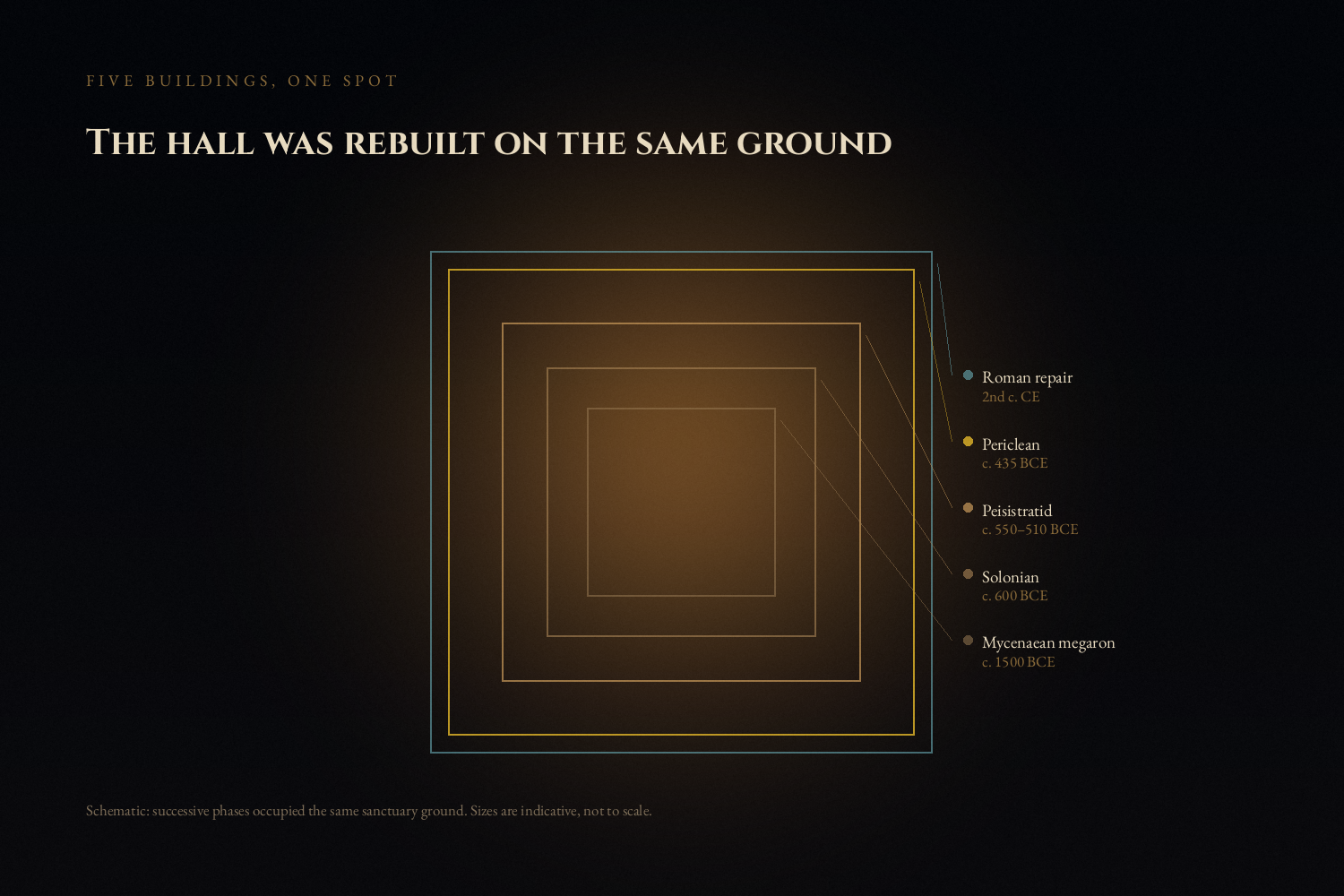
The oldest structure identified on the spot is a Mycenaean megaron, a rectangular hall with two columns on its central axis and a portico with steps at the front. [9][10] That is not a temple. It is a hall for people to gather in, and its presence under the classical building is the strongest single argument that the cult is genuinely old — that the classical rite was a monumentalisation of something already ancient when Solon was a young man. How old is disputed, and the dates proposed for the origins of the cult run from the Bronze Age to the seventh century. What is not disputed is the continuity of the place.
Around 600 BCE, in Solon's time, a rectangular hall with a colonnade was built on the same spot. In the second half of the sixth century, under the Peisistratids, it was replaced by a much larger building — nearly three times the size — with five rows of five columns and stepped seating along the walls. That building is the first one we can properly call a telesterion, a hall of completion, from telein, to complete or to initiate. The word matters. A telesterion is not a temple where a god lives; it is a room built for an event that happens to people.
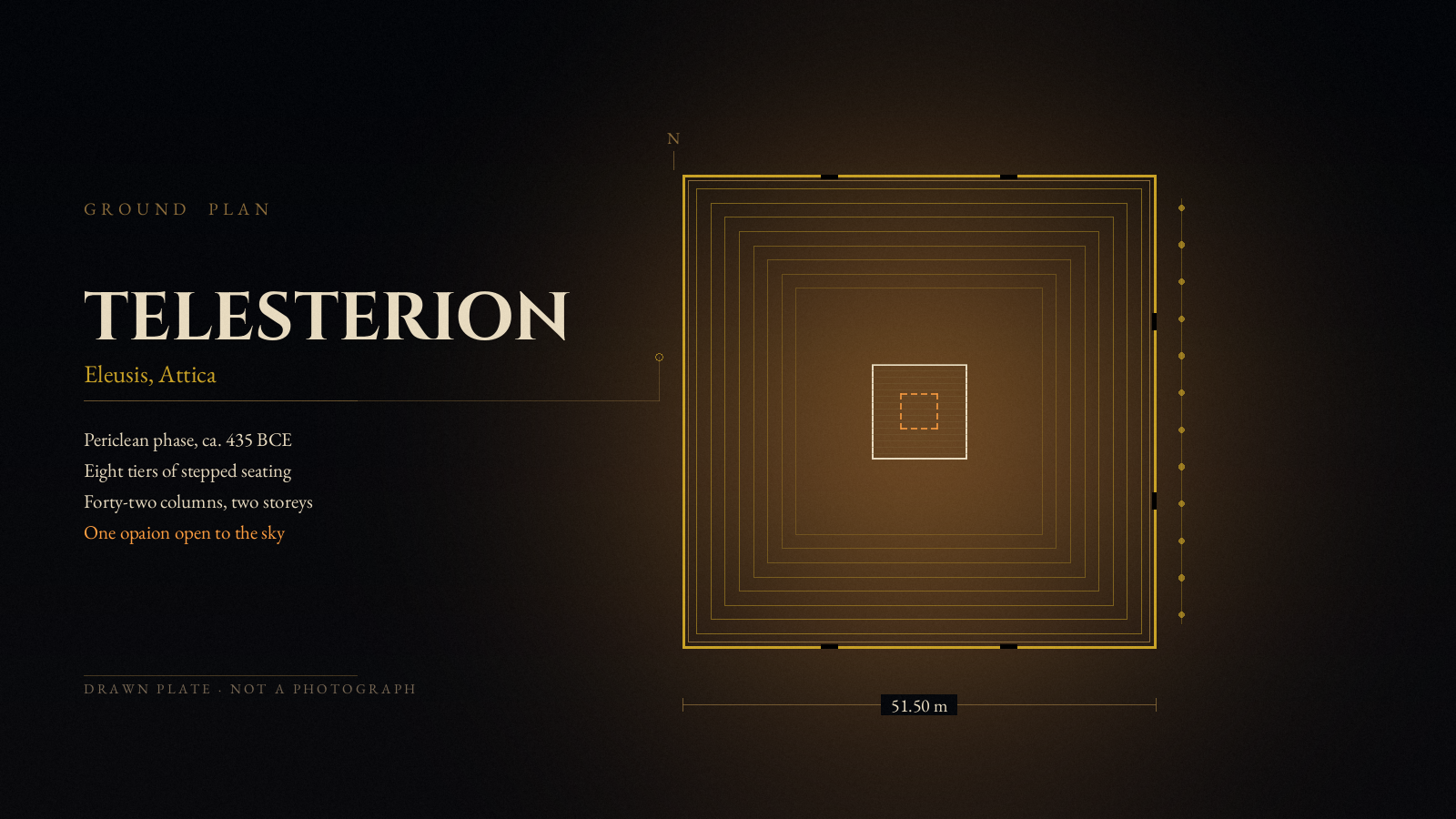
Then the classical rebuild, begun after the middle of the fifth century under Pericles, designed by Iktinos — the architect of the Parthenon — and finished by three successive architects, Koroibos, Metagenes, and Xenokles, after the Peloponnesian War had eaten the money and Pericles had died. [9][13] The result was the building whose foundations you can still walk across: an almost square hall, 51.50 metres on a side by the Ephorate's measurement, 54 metres in Mylonas's, with eight tiers of steps on all four sides, two entrances in each of the east, north and south walls, a twelve-column Doric portico on the east, forty-two columns inside supporting an upper order, and the opaion in the centre of the roof. [9][10][13]
A room like that is an instrument. Everything about it is designed to produce a particular relation between a crowd and a centre: you are seated on a slope looking down and inward; the columns divide the space into aisles of shadow; the only light comes from above, and it comes from a hole you cannot see through from where you sit. The building does not house a doctrine. It stages an event.
Nine days, and who was allowed in
The Greater Mysteries were celebrated in the month Boedromion, roughly September, and they lasted about nine days. The sequence is reconstructed from inscriptions, scholia, and later handbooks, and the details are firmer for some days than others.
On the fifteenth, the initiates gathered in the Athenian Agora at the Stoa Poikile for the prorrhesis, the proclamation made by the hierokeryx. It was an exclusion, and it is one of the most revealing documents in Greek religion: those who were impure in hands or incomprehensible in speech should not participate — that is, murderers and those who did not speak Greek. [14] Everyone else was welcome. Men and women, citizen and slave, Athenian and foreigner, provided they spoke the language and were not stained. By the fourth century the fee was about fifteen drachmas, roughly ten days' wages for a labourer, which was a real cost but not a class barrier. [14]
That openness is worth pausing on. The most exclusive religious experience in the Greek world was, in principle, open to a slave. What it demanded was not birth but a kind of availability: a clean record and a shared language. The two exclusions are not arbitrary. A rite that works by putting a crowd through an experience cannot admit someone who cannot understand the instructions, and it cannot admit someone whose presence would pollute the assembly. The exclusions are procedural, not doctrinal.
The next day the cry went up that the lexicographers preserved: halade mystai — "to the sea, initiates." The crowd walked down to the shore at Phaleron and purified itself in salt water, each person driving a young pig ahead of them into the sea and sacrificing it afterwards. Then came a fast, and then the drinking of the kykeon.
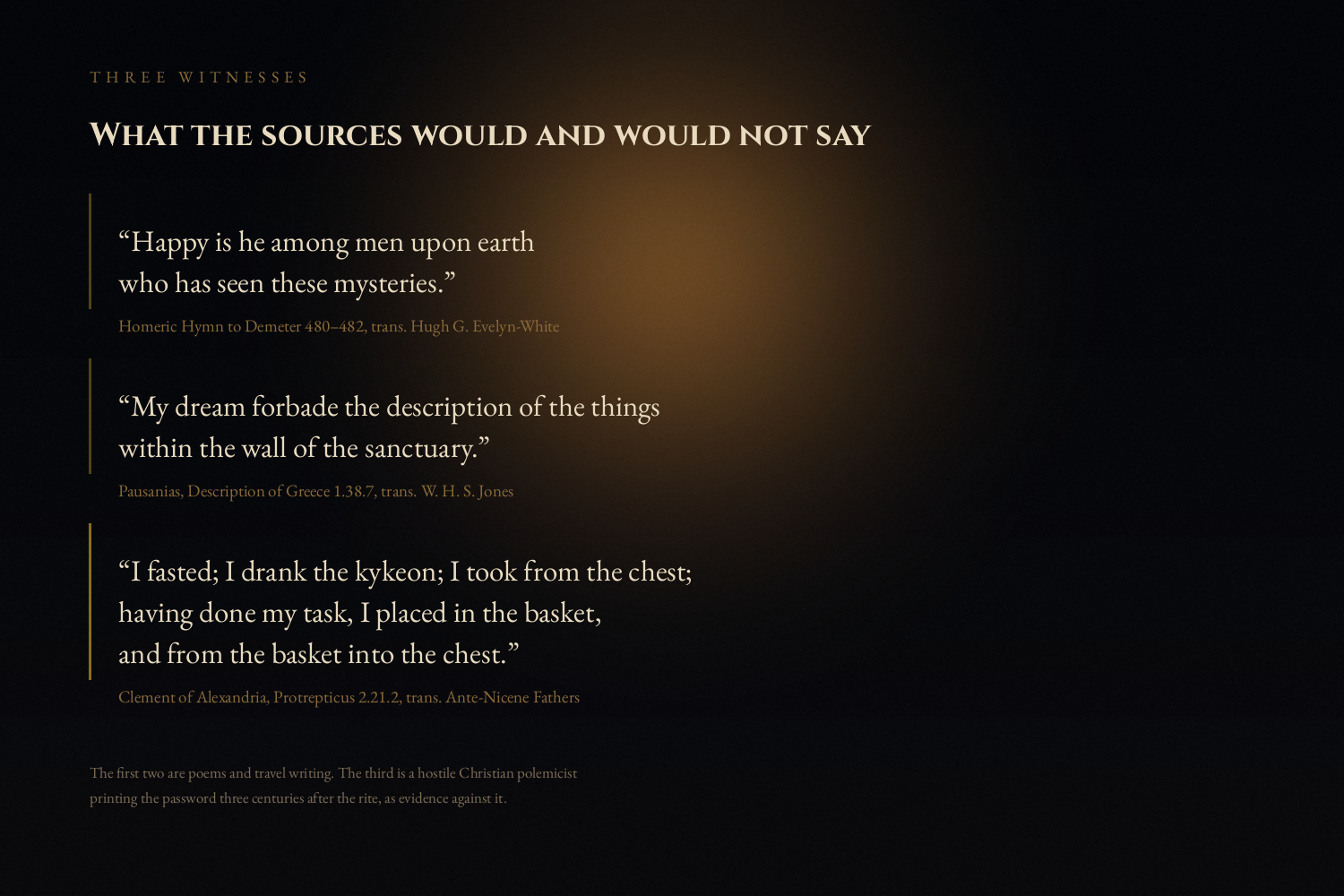
The kykeon is one of the few concrete things we know. In the Homeric Hymn to Demeter, the grieving goddess refuses wine and asks instead for a drink made of barley meal and water with soft mint: "she bade them mix meal and water with soft mint and give her to drink. And Metaneira mixed the draught and gave it to the goddess as she bade." [1] That is the same drink the initiates took, and the hymn gives us its recipe centuries before the classical rite. Barley, water, mint. A gruel.
Then the procession: the sacred objects were carried from Eleusis to Athens before the festival and carried back on the nineteenth along the Sacred Way, the twenty-two-kilometre road that ran from the Kerameikos through the pass at Daphni and down to the sanctuary. The accounts describe the procession arriving at night with torches, the image of Iakchos carried at its head, and the bridge at the Kephisos where the travellers were mocked by people waiting there — the gephyrismos, a ritual of abuse whose function seems to have been to break the solemnity and make the crowd laugh before the seriousness began. [14]
And then the night in the hall.
What happened in the dark
Here the sources reach their limit, and the limit is itself the evidence.
Plutarch, in a fragment preserved by Stobaeus, describes the experience of dying by analogy with the experience of initiation, and in doing so he gives us the best surviving account of what the rite felt like from the inside:
In this world the soul is without knowledge, except when it is already at the point of death◈; but when that time comes, it has an experience like that of men who are undergoing initiation into great mysteries... In the beginning there is straying and wandering, the weariness of running this way and that, and nervous journeys through darkness that reach no goal, and then immediately before the consummation every possible terror, shivering and trembling and sweating and amazement. But after this a marvellous light meets the wanderer, and open country and meadow lands welcome him; and in that place there are voices and dancing and the solemn majesty of sacred music and holy visions. [7]
Read that as a description of a night in a dark building and it becomes almost literal. Wandering in darkness. Terror before the end. A great light. Voices and music. The structure is a sequence of emotional states, engineered in order, and Plutarch is not describing a doctrine at all. He is describing a curve.
Aristotle, in a fragment preserved by Synesius, makes the point explicitly. The initiates, he says, do not learn something (mathein); they undergo something and are put into a certain disposition (pathein and diatethenai). [6] This is the sentence that should anchor every discussion of Eleusis, because it is a contemporary philosophical analysis of what the rite was for, and it says: not information, but alteration.
The distinction is precise and it is worth holding onto. Mathein is what you do with a text. Pathein is what happens to you in a room. The mysteries were built for the second, which is why the attempt to reconstruct a secret doctrine from them has always found so little. There was no doctrine to reconstruct. There was a sequence, and the sequence was the teaching.
The one thing we are told, and why it should not be trusted
Almost the only ancient source that claims to tell us the content of the climax is a Christian heresiologist writing three centuries later, and he is trying to prove that the pagan mysteries were a plagiarism of his own scriptures.
Hippolytus of Rome, in the Refutation of All Heresies, reports that the Athenians, "while initiating people into the Eleusinian rites, likewise display to those who are being admitted to the highest grade at these mysteries, the mighty, and marvellous, and most perfect secret suitable for one initiated into the highest mystic truths: an ear of grain in silence reaped." [5] He also reports the hierophant's cry, made by night under a great fire: "August Brimo has brought forth a consecrated son, Brimus" — the strong mother has borne the strong child. [5]
That is the whole of the alleged revelation. An ear of wheat, shown in silence.
Two things follow, and they pull in opposite directions. The first is that this may well be true. The ear of grain is exactly what a cult of Demeter would show, the formula about Brimo and Brimos fits the structure of a mystery announcement, and the detail about silence fits everything else we know. The second is that we cannot verify it. Hippolytus is not reporting from attendance; he is quoting a Gnostic source that was itself constructing a genealogy for its own ideas, and his motive is polemical. A single hostile witness, writing three hundred years after the fact, is not enough to establish the content of a rite that thousands of people attended and none described.
This is where most modern accounts become dishonest. They take Hippolytus's ear of wheat, add Plutarch's light, add the kykeon, and produce a confident picture of "what really happened at Eleusis." But those three items come from three different centuries and three different kinds of source, and none of them is a description of the rite by a participant. What we have is the shape of an experience and a rumour about a vegetable.
The silence was not marketing
Pausanias, the second-century travel writer who saw more Greek sanctuaries than any man in antiquity, walked to Eleusis, described the temple of Triptolemus and the well where the women first danced, and then stopped:
My dream forbade the description of the things within the wall of the sanctuary, and the uninitiated are of course not permitted to learn that which they are prevented from seeing. [2]
This is not coyness. It is a man who has been initiated declining to break a rule he takes seriously, and complaining that a dream has made the rule harder to keep. Pausanias describes the outside of the sanctuary in loving detail and refuses the inside, and the refusal is the most eloquent sentence in his whole book.
The rule had teeth. In 415 BCE, on the eve of the Sicilian Expedition, Athens was convulsed by two scandals at once: the mutilation of the Herms, and the celebration of the Mysteries in private houses by young aristocrats, in mockery and in parody. Thucydides records that information came from resident aliens and servants "about some previous mutilations of other images perpetrated by young men in a drunken frolic, and of mock celebrations of the mysteries, averred to take place in private houses." [8] Alcibiades was implicated. The affair was treated as part of a conspiracy against the democracy, and it destroyed his career at exactly the moment when Athens needed him. [8]
A joke performed in a private house became a constitutional crisis. That tells you what the secrecy protected: not a doctrine, but a boundary. The rite was a thing that happened to a body of people who had been admitted to it, and performing it in a private house, for an audience that had not been admitted, was not a breach of copyright. It was a category error with political consequences, because it collapsed the distinction between those who had undergone the rite and those who had merely heard about it.
Cicero, defending the Mysteries against a Roman law that restricted night sacrifices, makes the positive case: "nothing better than those mysteries, by which we were cultivated from a wild and savage life to humanity and gentleness; and as they are called initia, so in truth it is the beginnings of life that we have learned, and the power to live well and to die with a better hope." [3]
Initia, beginnings. Not secreta, secrets. The Latin word Cicero reaches for describes the rite as a beginning, and the benefit he names is not knowledge but conduct and hope. Whatever was shown in the hall, the pagan tradition's own spokesman describes its fruit as a way of living and a way of dying, not a proposition.
The two grades, and the year in between
Initiation had two stages, and the gap between them is important.
The Lesser Mysteries were held in Anthesterion, in spring, at Agrai on the Ilissos, outside Athens, and they were a preparation. The Greater Mysteries at Eleusis were the completion. A year after the first initiation, a mystes could become an epoptes — a "beholder," one who has seen. The distinction between the two words is one of the most suggestive things in the tradition: the first grade is named from myein, to close (the mouth, or the eyes), and the second from epopteuein, to look upon.
The grammar of the whole system is there. To be initiated is to have something closed; to be an epoptes is to have something opened. The year in between is not a waiting period but a formation: the person who comes back to the hall has been living with what happened the first time for a full cycle of seasons, and returns able to see what a newcomer cannot.
We do not know what the epopteia consisted of, and the handbooks that claim to know are guessing. What we can say is that the structure of two grades, separated by a year, is inconsistent with the idea that Eleusis was a secret passed on in words. A secret in words is transmitted in an evening. A formation that takes a year and a second visit is something else: it is a curriculum in being a certain kind of person, and the content of a curriculum is not a sentence.
The mushroom theory, and what it is really about
The most famous modern attempt to fill the silence is the entheogen✦ hypothesis, set out by R. Gordon Wasson, Albert Hofmann, and Carl Ruck in The Road to Eleusis in 1978. Their argument runs roughly like this: the kykeon was a barley drink; barley in the Rarian plain next to Eleusis is susceptible to ergot; ergot contains alkaloids related to LSD; Hofmann, who had synthesised LSD in 1943, showed that some of those alkaloids are water-soluble; therefore the kykeon may have been a psychedelic preparation, and the "vision" at Eleusis may have been pharmacological. [11]
The book is a serious piece of scholarship and it should not be dismissed as fringe. Hofmann's chapter on the chemistry of ergot is careful, and Ruck's chapters on the ritual and the myth are learned. But the hypothesis has three problems that its authors never solved.
The first is dose. Ergot alkaloids are present in the grain in variable and often tiny quantities, and the water-soluble fraction that Hofmann identified is not, on its own, a reliable psychedelic at the concentrations a barley gruel would carry. Producing a controlled experience for three thousand people from an agricultural contaminant would require a standardisation that no ancient household could have achieved. [15]
The second is source silence. A drug experience is dramatic, and the ancient world was not shy about describing drugs. If the central rite of the Greek world consisted of giving three thousand people a psychedelic, we would expect the medical and botanical literature to be full of it, and the polemical literature to be even fuller. It is not.
The third is conceptual, and it is the interesting one. The hypothesis assumes that the mystery must have a content, and that the content must be an experience, and that the experience must be chemical. It is a modern answer to a modern question — what is the active ingredient? — applied to a rite whose own logic was that the active ingredient was the sequence: darkness, terror, light, sound, a crowd, a year, a second visit.
That does not make the hypothesis false. It makes it unprovable, and it makes it a symptom. Every generation reconstructs Eleusis in the shape of its own most powerful technology. The Renaissance made it a theatre of memory. The nineteenth century made it a nature allegory. The twentieth made it a drug. Ours, presumably, will make it an information system, and that is a mistake I would like to avoid in the next section.
How it ended
The Mysteries did not die of ridicule. They died of an empire changing religion.
In 170 CE the sanctuary was sacked by the Sarmatians and rebuilt under Marcus Aurelius. [15] The emperors kept being initiated. Julian, the last pagan emperor, was initiated and tried to restore the cult in the 360s. [15] Then, in 392, Theodosius I prohibited pagan sacrifice and cult, and Eunapius — the biographer of the last Greek philosophers — reports that the Mysteries were closed. [15]
The last hierophant, according to Eunapius, was not a legitimate Eumolpid at all: he was a man from Thespiae who held the rank of Father in the mysteries of Mithras, and his tenure was a scandal to the remaining pagans. Then, in 396, Alaric's Goths came through Attica, and the sanctuary was looted and burned. [15] The town never recovered. Eleusis became a village, then a farming town, then, in the twentieth century, a refinery town on the edge of the Thriasian plain.
There is one detail in this story that I find almost unbearable, and it is the reason this essay exists.
The sentence of Aristotle's that I quoted earlier — that the initiates do not learn but undergo — survives because it was quoted by Synesius of Cyrene, a Neoplatonist philosopher who became a Christian bishop. Synesius was, by the report of the ancient sources, one of the last people to be initiated at Eleusis before the end. [15] So the most important description of what the rite was comes to us through a man who was among the last to experience it, and who spent his later life as a bishop in a religion that had closed it.
The transmission survived as a sentence. The rite did not survive at all. And the sentence, by an accident of history, is the one that tells us the rite cannot be reconstructed from sentences. That is either the most elegant joke in the history of religion or the saddest, and I am not sure the difference matters.
What is there now
Eleusis is a working town of about thirty thousand people, with an oil refinery, a cement plant, and a shipyard, and one of the most important archaeological sites in Greece sitting in the middle of it. In 2023 the town was a European Capital of Culture, under the programme title "Mysteries of Transition," with 465 events across 130 projects, opening on 4–5 February to a crowd reported at fifteen thousand. [12]
I have mixed feelings about that programming, and I want to be careful here. The temptation for a modern town sitting on an ancient mystery cult is to sell the mystery as atmosphere — torchlight, smoke, a bit of Greek. And the temptation for the visitor is to treat the site as a stage set for a feeling. But the archaeological site is not a stage set. It is a set of foundations that record a thousand years of a community rebuilding the same room, on the same ground, because the ground was the point.
The most honest thing you can do at Eleusis is stand on the tiers of the Telesterion and notice how little you can see of the centre from where the initiates sat. The hall was not designed for visibility. It was designed for presence: for the knowledge that something is happening there, in front of you, that you cannot quite see, and that you are part of it anyway.
That is a very strange thing for a civilisation to build at the centre of its most prestigious religious institution. It is also, I think, the most useful thing Eleusis has to teach now.
What the silence is for
We live in a period that has decided, more or less consciously, that everything worth transmitting can be written down, and that anything not written down is either lost or was never real. The archive is the measure of the real. If it is not in the corpus, it did not happen.
Eleusis is a counter-example of a very strong kind. Here is an institution that ran for a millennium, that the smartest people in the ancient world regarded as the summit of religious life, that emperors travelled to attend, and that left behind almost no describable content — and it was not a failure of record-keeping. It was a success of design. The rite was built so that the content could not be extracted, because extraction would have destroyed the thing being transmitted.
The distinction that matters is not secret versus public. It is information versus formation. Information can be copied, which is its glory. Formation cannot be copied; it can only be undergone, which is its cost. A tradition that transmits only information will survive every archive and lose its point. A tradition that transmits only formation will die with its last practitioner, as Eleusis did.
The interesting question, and the one this essay cannot answer, is whether a culture can hold both at once — whether you can build an archive that does not flatten the thing it records, and a practice that does not evaporate when the last person who knew how to do it stops.
We are about to find out. That is what the paired Universal Transmissions edition of this essay is about, and it is the reason I wanted to write this one first: the historical record has to be straight before the analogy is worth making.
FAQ
Did we ever find out what happened at Eleusis? No. We know the building, the calendar, the grades, the exclusions, and the emotional shape of the experience, largely through Plutarch's comparison with dying and Aristotle's statement that the initiates underwent rather than learned. The only ancient source that claims to describe the content is Hippolytus, a hostile Christian writer of the third century, who says an ear of wheat was shown in silence. That may be true, but it rests on a single polemical witness.
Was the kykeon a psychedelic? Possibly, but it is not established. The barley-and-mint drink is described in the Homeric Hymn to Demeter, and the ergot hypothesis of Wasson, Hofmann and Ruck is a serious proposal. Its problems are dose control, the silence of the ancient botanical and medical sources, and the fact that the rite's structure explains the experience without needing a drug.
Why were the Mysteries secret? Not to protect a doctrine. The exclusion formula barred murderers and non-Greek speakers, and the penalty for parodying the rite in private houses was political and severe — the scandal of 415 BCE destroyed Alcibiades. Secrecy protected the boundary between those who had undergone the rite and those who had only heard about it. Once that boundary collapses, the rite becomes a rumour.
Is Eleusis still a religious site? No. The cult was closed by Theodosius in 392 and the sanctuary was looted and burned by Alaric's Goths in 396. The site is an archaeological zone today, and the modern town of Elefsina — a European Capital of Culture in 2023 — is built around it.
Sources and further reading
[1] Homeric Hymn to Demeter 470–482, trans. Hugh G. Evelyn-White (Loeb Classical Library, 1914), Perseus Digital Library. The kykeon of barley meal, water and mint is at 206–210; the promise to those who have seen the mysteries is at 480–482.
[2] Pausanias, Description of Greece 1.38.7, trans. W. H. S. Jones (Loeb Classical Library, 1918), Perseus Digital Library.
[3] Cicero, De Legibus II.36, Latin text, The Latin Library. The passage on the mysteries — nihil melius illis mysteriis — is in the same chapter; for the Loeb translation see Clinton W. Keyes, Cicero: De Re Publica, De Legibus (Cambridge, MA: Harvard University Press, 1928).
[4] Clement of Alexandria, Protrepticus II.21.2, trans. Ante-Nicene Fathers, vol. 2 (Buffalo: Christian Literature Publishing, 1885). Clement prints the Eleusinian password as evidence against the rite.
[5] Hippolytus, Refutatio Omnium Haeresium V.8.39–40, trans. J. H. MacMahon, Ante-Nicene Fathers, vol. 5. The reaped ear of grain displayed in silence and the cry of Brimo and Brimos are both in this chapter.
[6] Aristotle, fragment 15 Rose, preserved in Synesius, Dio 10. The Greek distinction is between mathein (to learn) and pathein (to undergo); the standard discussion is in Walter Burkert, Ancient Mystery Cults (Cambridge, MA: Harvard University Press, 1987), ch. 4.
[7] Plutarch, fragment 178, preserved by Stobaeus, trans. A. O. Prickard, Selected Essays of Plutarch, vol. 2 (Oxford: Clarendon Press, 1918). For the Sandbach translation see Plutarch: Moralia, vol. 15, fragment 178 (Loeb Classical Library, 1969).
[8] Thucydides, History of the Peloponnesian War 6.27–29, trans. Richard Crawley (London: Dent, 1914), Perseus Digital Library. For the profanation and its consequences see also Andocides, De Mysteriis 1.11–18.
[9] Ephorate of Antiquities of West Attica, "Telesterion", Hellenic Ministry of Culture and Sports. Source for the 51.50 m side, the eight tiers, the forty-two columns, the opaion, and the sequence of building phases.
[10] Perseus Digital Library, "Eleusis, Telesterion", artifact record: dimensions c. 52 × 54 m, capacity up to 3,000, 42 superimposed columns in a 6 × 7 pattern, anaktoron below the opaion.
[11] R. Gordon Wasson, Albert Hofmann, and Carl A. P. Ruck, The Road to Eleusis: Unveiling the Secret of the Mysteries (New York: Harcourt Brace Jovanovich, 1978). Hofmann's chemical chapter and Ruck's chapters on the myth and the ritual are the substance of the argument.
[12] European Commission, "Three new Capitals of Culture for 2023", Directorate-General for Education, Youth, Sport and Culture, 9 January 2023. Elefsina's programme title, 465 events and 130 projects are from this release.
[13] George E. Mylonas, "Eleusis and the Eleusinian Mysteries," The Classical Journal 43, no. 3 (1947): 130–146. Source for the 54 m measurement, the six rows of seven columns, the anaktoron, and the building history.
[14] For the prorrhesis, the cost of initiation, the procession and the gephyrismos, see the background chapter in Ross Shepard Kraemer, ed., Women's Religions in the Greco-Roman World: A Sourcebook (New York: Oxford University Press, 2004), and Kevin Clinton, Myth and Cult: The Iconography of the Eleusinian Mysteries (Stockholm: Svenska institutet i Athen, 1992).
[15] J. Bizzotto, "The Hypothesis on the Presence of Entheogens in the Eleusinian Mysteries," 2018, for a critical review of the ergot argument. For the Sarmatian sack and the Roman rebuilding, the closure under Theodosius in 392 and the destruction under Alaric in 396, see Eunapius, Lives of the Philosophers and Sophists 7.3, and the summary in Hans Kloft's entry on Eleusis in Brill's New Pauly.
The paired Universal Transmissions edition takes the argument from here: if a rite can transmit something an archive cannot hold, what is the modern archive actually transmitting? For the older Greek account of knowledge as recollection rather than instruction, read The Art of Memory: From Memory Palace to Search Engine; for the tradition that made initiation into a cosmos, see The Alchemical Vessel: Athanor as a Technology of Transformation.
To read the primary texts alongside the scholarship, the Library of Alexandria carries the broadest classical and hermetic library in the shop, and the Ultimate Esoteric Archive collects the later commentaries that kept these fragments alive.
Explore Related Scrolls
Continue the Inquiry
✦ Discuss this in the Agora →Join seekers in the Vault's forum — human + AI dialogue on this tradition
✦ Continue This Inquiry ✦
This inquiry doesn't have to end here. Bring your questions, reflections, or practice to the Oracle — and continue in dialogue.
Stay attuned — subscribe to The Transmission
✦ FURTHER TRANSMISSIONS ✦
Enjoyed this transmission? Subscribe for more from the threshold.
Want to go deeper with others? Discuss this essay in the Agora →
Deepen this study · 20% archive sale
Shop the Archives
Continue the thread with the primary source vaults behind the Scroll.

The Library of Alexandria – Ultimate Esoteric Digital Archive (123GB, 23,000+ eBooks on Alchemy, Magick, UFOs, Tantra, Gnosticism & More
$79.99$99.99· View →
Ultimate Esoteric & Spiritual eBook Archive – 10,000+ Rare Books (47GB) – Mysticism, Magick, Secret Teachings, Occult Wisdom, Spirituality
$39.99$49.99· View →
Grimoire & Occult eBook Archive | 8000+ Rare Esoteric PDFs | Magic, Alchemy, Witchcraft, Demonology, Hermetic Library (13GB)
$23.99$29.99· View →✦ FURTHER TRANSMISSIONS ✦
Enjoyed this transmission? Subscribe for more from the threshold.