The Alphabet Was Invented Once
Limited archive sale · 20% off every pack
20% Archive Sale
Deepen this scroll with the primary-source archive packs behind the Vault: grimoires, oracle systems, alchemy, tarot, sacred geometry, and manifestation libraries.
The real history, the turquoise mine, and what the mystics did with it afterward
Almost every alphabet on Earth right now — the one this sentence is written in, the Greek letters used in mathematics, the Cyrillic used across Russia and the Balkans, the Hebrew and Arabic scripts, most of the alphabets of South and Southeast Asia — descends from a single common ancestor, invented exactly once, by a small, specific, historically locatable group of people, at a known place, within a window of a couple of centuries. That's not an exaggeration for effect. It's the actual, mainstream, well-evidenced position of historical linguistics, and it's a far stranger fact than most people who use an alphabet every day have ever been told.
This essay tells that real story first, because it's genuinely remarkable on its own and deserves to be known as history before it gets touched by anything else. Then it does something the corpus of esoteric material this piece draws from insists on doing anyway: it shows you what later mystics, working from a much older intuition that letters were never just arbitrary marks, tried to do with that same historical mystery — and it's honest, the whole way through, about which parts of that second half are solid ground and which parts are somebody's genuinely fascinating, entirely unproven guess.
Where Did the Alphabet Actually Come From?
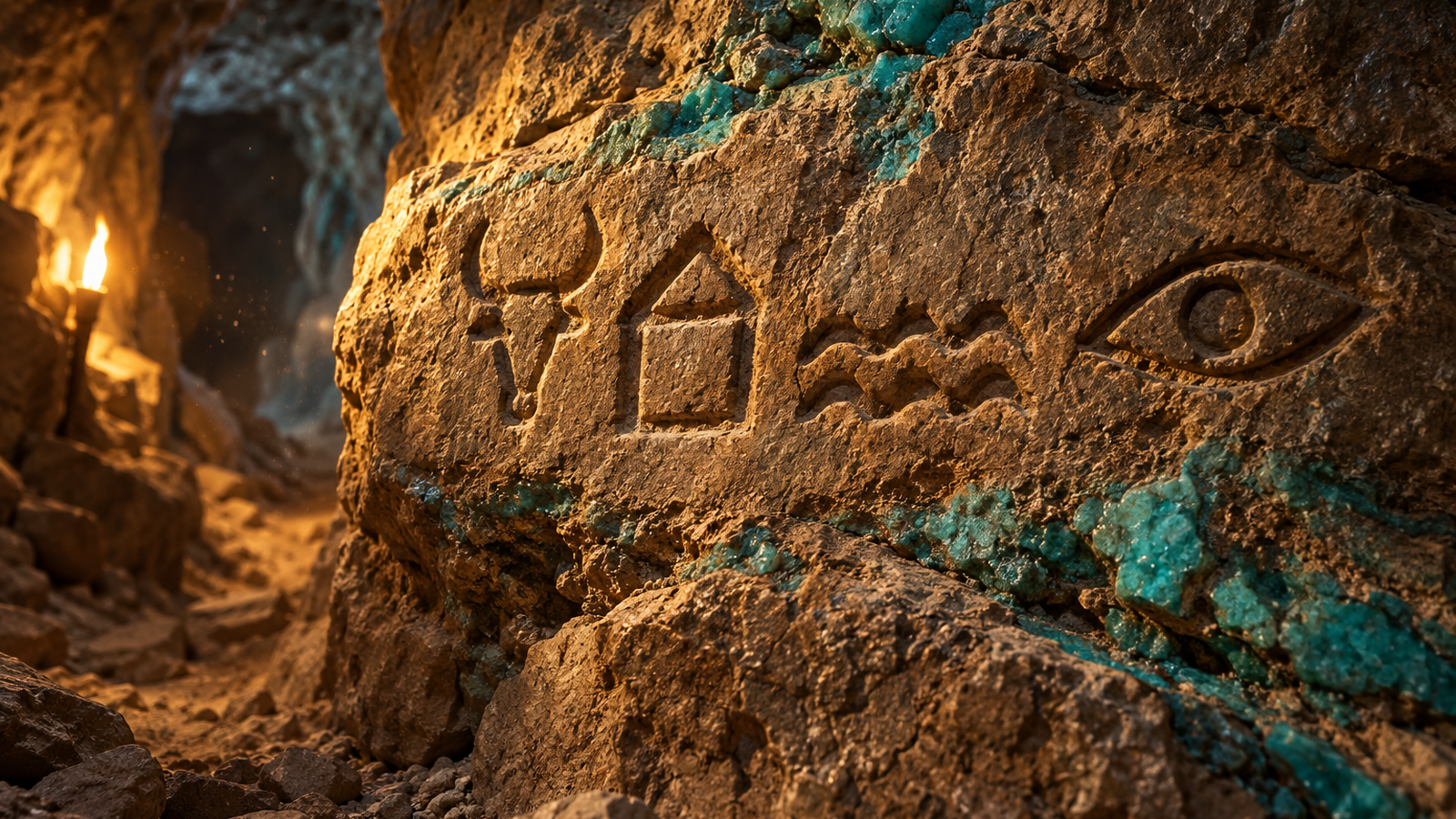
In the early 1900s, the British Egyptologist W.M. Flinders Petrie was excavating at Serabit el-Khadim, a remote turquoise-mining site in the Sinai Peninsula that Egyptian expeditions had worked, on and off, since at least 2800 BCE, with especially intense activity during the Middle Kingdom's 12th Dynasty. Around 1904 and 1905, he found something odd carved into the rock: short inscriptions, using a small number of simplified, pictorial signs, that clearly weren't standard Egyptian hieroglyphics, but that also clearly borrowed from them. One especially important piece, a small red sandstone sphinx now in the British Museum, was inscribed twice — once in ordinary hieroglyphs, and once in this stranger, simpler script.
It took over a decade for anyone to actually read the second inscription. In 1916, the Egyptologist Alan Gardiner worked out that it said b'lt — ba'alat, "the Lady" — a title of the goddess Hathor, who the temple at the site was dedicated to. That single successful decipherment cracked open the whole system, because it revealed the specific trick the inscription's authors had used, a trick with a name: acrophony. Take an Egyptian hieroglyphic sign — say, the sign for a house — and instead of keeping its Egyptian sound, assign it the first sound of the word for "house" in your own language instead. The workers at Serabit el-Khadim spoke a West Semitic language, not Egyptian, and the word for house in that language began with the sound b. So the house-sign became, simply, the letter B — no longer standing for a whole word, standing for nothing but a single sound, extracted and reused. Do that consistently, across a couple dozen signs, and you don't have a simplified form of hieroglyphics anymore. You have something categorically new: an alphabet, in the strict technical sense — a small set of signs, each one representing a single speech-sound rather than a whole word or syllable.
A second site sharpened the picture further. In 1994 and 1995, the archaeologists John and Deborah Darnell, surveying ancient desert caravan routes west of Luxor, found short alphabetic inscriptions at a place called Wadi el-Hol, published in 1999 and dated to roughly 1800 to 1900 BCE — putting them in the same narrow window as Serabit el-Khadim, and possibly slightly earlier. The people who made these signs, in both places, weren't priests, scribes, or royal officials. All the evidence points to laborers — Semitic-speaking miners and travelers working within an Egyptian administrative system that never fully bothered to teach them the empire's own famously difficult, thousand-sign writing system, so they built their own out of the twenty or so hieroglyphic pieces they had regular contact with, repurposed to carry sounds from a language the empire's own scribes didn't speak.
The same trick that turned an Egyptian house-sign into the letter B did the same thing across the rest of the borrowed set. The Egyptian hieroglyph for an ox's head became the letter aleph, because the West Semitic word for ox began with that sound — and if you've ever wondered why the capital letter A, rotated upside down, still faintly resembles a horned animal's head, that's not a coincidence dreamed up centuries later; it's the actual fossil of the original picture, worn down by three and a half thousand years of continuous copying but never quite erased. A wavy line meaning water became mem, the ancestor of our M, because the word for water started with that sound. Sign by sign, an entire functioning writing system for one language was assembled out of pictures borrowed from a completely different one, simply by throwing away everything except the first sound of each picture's name in the borrower's own tongue.
What Happened After That One Invention
From that narrow window, in that specific place, among people who almost certainly never thought of themselves as inventing anything historic, the idea spread. It became Proto-Canaanite, and then Phoenician, the trading script of a seafaring Mediterranean civilization with every incentive to carry a compact, easily learned writing system to every port it touched. From Phoenician, one branch became Greek — and, crucially, the Greeks added vowels, since their language couldn't be read reliably with consonants alone the way◈ Semitic languages generally can — and Greek gave rise to Latin, the alphabet this sentence is written in, and to Cyrillic. Another branch of Phoenician became Aramaic, the great administrative script of the Near East for a thousand years, and Aramaic gave rise to Hebrew, to Arabic, and, carried east along trade routes, to the Brahmi script that eventually produced most of the writing systems of India and Southeast Asia.
Writing itself, as a general concept — marks that carry meaning — was invented independently several times in human history: in Mesopotamia, in Egypt, in China, in Mesoamerica, each civilization arriving at its own system without contact with the others. The alphabet, specifically — the idea of a small, closed set of signs each representing one sound rather than one word or syllable — appears, on the current archaeological evidence, to have been invented exactly once, by people history never bothered to record the names of, solving an immediate practical problem in a turquoise mine, with no idea they were building the ancestor of nearly every writing system that would ever be used by more than a small regional population again.
The Older, Stranger Claim Sitting Underneath All of This
Long before anyone had excavated Serabit el-Khadim, a much older Jewish mystical tradition had already made a claim about the alphabet that has nothing to do with acrophony or turquoise mines, and everything to do with a different kind of question: not where the letters came from historically, but what they actually are. The Sefer Yetzirah, the Book of Creation, states its position on the twenty-two Hebrew letters directly: "Twenty-two foundation letters: He placed them in a circle... He directed them with the twelve constellations." Not twenty-two arbitrary marks that happened to get assigned to sounds. Twenty-two foundational elements, arranged deliberately, and tied — explicitly, in the text's own words — to the zodiac.
That line is also the epigraph a 2009 paper in Sino-Platonic Papers — an academic series run out of the University of Pennsylvania's Department of East Asian Languages and Civilizations, whose own editorial preface openly states it exists specifically to publish "unconventional or controversial" research that a more conservative journal wouldn't touch — chose to open with. The paper, by the researcher Brian Pellar, takes the Sefer Yetzirah's zodiacal claim and tries to test it directly: does the shape and sequence of the earliest alphabetic letters actually correspond to the shape and sequence of the constellations along the path the sun◈ and moon◈ travel through the sky?
His proposed starting point is the pairing of aleph and beth — the first two letters of the alphabet across nearly every version of it, Hebrew, Phoenician, Proto-Sinaitic alike — which he argues combine, in outline, to form the constellation Taurus, the bull, sitting at what was the spring equinox point in the era these letters were taking shape. From there he traces a proposed sequence running forward and backward through the zodiac — Aries, Pisces, Gemini, Cancer, and on — matched against specific letter-pairs and their traditional pictographic meanings, and backs the claim with a genuinely wide-ranging set of comparative evidence: a sky chart from the tomb of the Egyptian official Senemut, Mesopotamian cylinder seals depicting the same zodiacal sequence, a European carved stag bone dated to roughly 3800 BCE, and a zodiac from the Karanovo culture in the Balkans dated to around 4800 BCE. He's not the first to propose a correlation of this kind — he explicitly builds on earlier work by the sinologist Hugh Moran in the 1950s, who correlated the Hebrew letters with Chinese lunar-calendar signs, and by the Semiticist Cyrus Gordon in the 1990s, who found similar correspondences between the Ugaritic alphabet and a thirty-day lunar zodiac.
Is Any of This Actually Established?
It's important to be direct about where this leaves us, because the two halves of this essay are not standing on the same ground, and pretending otherwise would be the exact move this whole publication tries not to make.
The Serabit el-Khadim and Wadi el-Hol story — Egyptian hieroglyphic signs, repurposed acrophonically by Semitic-speaking laborers sometime around 1900 to 1700 BCE, giving rise to essentially every alphabet in use on Earth today — is the accepted mainstream position in historical linguistics and Egyptology, resting on decipherable inscriptions, dated archaeological strata, and more than a century of cross-checked scholarship since Gardiner's 1916 breakthrough. You can disagree with details of the dating or the exact mechanism, and specialists do, but the broad shape of the story is about as solid as ancient history gets.
The zodiacal correlation theory is a different kind of claim entirely, and its own home journal says so about itself: this is explicitly published as unconventional, minority-position research, not as an established finding the field has accepted. That doesn't make it worthless — Pellar is working with real comparative material, citing real prior scholars, and the Sefer Yetzirah's own zodiacal claim is a genuine, ancient textual fact regardless of whether Pellar's specific letter-by-constellation matches turn out to hold up. But "the alphabet's letter-shapes and sequence encode the zodiac" and "the alphabet was invented by miners repurposing hieroglyphs" are not two versions of the same settled fact. One is the history. The other is a serious person's attempt, working in an openly speculative register, to find out whether an ancient mystical claim about that history might be pointing at something real.
A Modern Version of the Same Instinct
The same impulse — the sense that the alphabet's actual letter-forms are hiding a structure too precise to be accidental — shows up again in an entirely different, contemporary body of work: Stan Tenen's The Alphabet That Changed the World, published by North Atlantic Books, which argues that the Hebrew letter-forms in Genesis 1:1 encode a topological and geometric model, one Tenen ties to hand gestures, hypersphere models, and what he calls the "Meru hypothesis," developed over decades through his own Meru Foundation. Like Pellar's paper, this is serious, sustained, technically ambitious work, sitting entirely outside mainstream Egyptology or historical linguistics, making a claim about hidden geometric intention behind the alphabet's forms that would need independent, skeptical verification to be treated as established fact rather than as one researcher's carefully built case.
What's actually interesting here isn't whether Tenen or Pellar have it exactly right. It's that this specific intuition — that the alphabet is not an arbitrary historical accident, that its shapes and sequence are doing more work than merely encoding sound — keeps getting rediscovered, independently, by people working centuries and disciplines apart: the anonymous compilers of the Sefer Yetzirah, a mid-century sinologist correlating letters with Chinese calendar signs, a Sino-Platonic Papers researcher matching letter-pairs to constellations, an American researcher building geometric models out of the Book of Genesis. None of that makes any specific version of the claim true. It does make the claim itself a real, recurring feature of how people have related to the alphabet for a very long time — not a modern invention, and not obviously going away.
Frequently Asked Questions
Where does the alphabet actually come from?
The earliest known alphabetic writing is the Proto-Sinaitic script, found at Serabit el-Khadim in the Sinai Peninsula and at Wadi el-Hol in Egypt, dated to roughly 1900–1700 BCE. It was created by Semitic-speaking laborers who adapted a small number of Egyptian hieroglyphic signs, assigning each one the first sound of their own word for the pictured object — a technique called acrophony — rather than the Egyptian sound or meaning.
Was the alphabet really invented only once?
As far as the archaeological evidence currently shows, yes, in the specific sense that matters: writing in general was invented independently several times across different civilizations, but the alphabet — a small, closed set of signs each representing a single sound — appears once, in the Sinai/Egypt region in the early second millennium BCE, and nearly every alphabet used in the world today, including Latin, Greek, Cyrillic, Hebrew, Arabic, and the Brahmic scripts of South and Southeast Asia, descends from that single origin through Phoenician and its successors.
Who first deciphered Proto-Sinaitic script?
The Egyptologist Alan Gardiner deciphered the key inscription — on a sphinx found by Flinders Petrie at Serabit el-Khadim — in 1916, reading the word ba'alat, "the Lady," a title of the goddess Hathor. That decipherment established the acrophonic principle underlying the whole script.
Is there real evidence connecting the alphabet's letters to the zodiac?
This is a minority, actively speculative position, not an accepted finding in mainstream linguistics or Egyptology. It originates in the Sefer Yetzirah's own claim that the twenty-two Hebrew letters were arranged in a circle and directed by the twelve constellations, and has been pursued in modern academic work — notably a 2009 paper in the deliberately unconventional journal Sino-Platonic Papers — using comparative evidence from ancient sky charts and calendar systems. It should be understood as a serious but unproven hypothesis, clearly distinct from the well-established acrophonic origin story.
What does "acrophony" mean?
Acrophony is the practice of taking a symbol that originally represented a whole word or object and reassigning it to represent only the first sound of that word, discarding the rest of the original meaning. It's the specific technique that turned a small set of borrowed Egyptian hieroglyphic signs into the world's first alphabet.
The people who actually built the first alphabet, standing in a Sinai turquoise mine roughly thirty-eight centuries ago, almost certainly weren't thinking about constellations, geometry, or the far future of the thing they were making. They needed to write words in their own language using signs they had at hand, and they solved that problem so well that the solution outlived every empire that has existed since.
It's worth sitting, for a moment, with just how unbroken that inheritance actually is. Every character in this sentence is a direct, uninterrupted descendant of a mark cut into rock by an anonymous miner in the Sinai desert around 1800 BCE — carried forward through Phoenician traders, Greek grammarians, Roman engravers, medieval scribes, movable type, typewriters, and now the Unicode standard that assigns every letter you're reading a specific numeric code so it can be rendered identically on any screen on Earth. The mechanism changed almost beyond recognition. The lineage never broke once. Everything this essay has traced after that founding moment — the zodiac, the hypersphere, the circle of letters directing constellations — is what later minds, working from a much older and never fully answered suspicion that language is not an accident, went looking for underneath a story that was already, on its own terms, strange enough to deserve the attention.
Explore Related Scrolls
Continue the Inquiry
✦ Discuss this in the Agora →Join seekers in the Vault's forum — human + AI dialogue on this tradition
✦ Continue This Inquiry ✦
This inquiry doesn't have to end here. Bring your questions, reflections, or practice to the Oracle — and continue in dialogue.
Stay attuned — subscribe to The Transmission
✦ FURTHER TRANSMISSIONS ✦
Enjoyed this transmission? Subscribe for more from the threshold.
Want to go deeper with others? Discuss this essay in the Agora →
Deepen this study · 20% archive sale
Shop the Archives
Continue the thread with the primary source vaults behind the Scroll.
Ancient Egypt Mega Pack | 1500+ Rare Books & Manuscripts | 8GB Digital Library + BONUS African Spirituality + Kemetic Archive
$23.99$29.99· View →
Ancient Egypt Mysteries & Sacred Traditions Archive | 854 Files | Egyptology, Hieroglyphs, Temples and Ancient History | Digital Download
$9.59$11.99· View →
Jesus Myth Theory Archive + 71 Book Scholar Pack | Acharya S, Richard Carrier, Bart Ehrman, Biblical Criticism
$4.79$5.99· View →✦ FURTHER TRANSMISSIONS ✦
Enjoyed this transmission? Subscribe for more from the threshold.