I Am the Truth: Sufism, Self-Sovereignty, and Who Gets to Say 'All Is Self'
Limited archive sale · 20% off every pack
20% Archive Sale
Deepen this scroll with the primary-source archive packs behind the Vault: grimoires, oracle systems, alchemy, tarot, sacred geometry, and manifestation libraries.
What "I Am the Truth" Actually Claims
The lazy reading of Hallaj — the one his enemies used and the one plenty of modern retellings still repeat uncritically — is that a man got drunk on ego and declared himself divine. Almost nobody serious inside the tradition ever read it that way, including people who thought he'd been foolish to say it.
The technical name for what Hallaj was reporting is fana — annihilation, the passing-away of the individual ego in the presence of God. The idea isn't that Hallaj's personal self got bigger, more important, more elevated until it merged with divinity. It's closer to the opposite: that the small, bounded, separate self — the thing that experiences itself as distinct from God, with its own agenda, its own fears, its own need to be someone — dissolves, and once it's gone, there's no longer a second party left to draw a boundary around. What speaks in that moment isn't Hallaj the man. It's what's left when Hallaj the man has, for a moment, stopped being in the way◈. That's a genuinely different claim from "I have become God," even though it produces the same three words.
His own teacher's teacher, in a sense, had already laid out the careful version of this decades earlier. Junayd al-Baghdadi, who died in 910 and became known as the master of what later writers called the sober school of Sufism✦, insisted on exact language and close obedience to outward religious law precisely because he took the inward claims so seriously. His own definition of fana was deliberately narrow: the passing away of your attributes through the subsistence of His attributes — not dissolution, not the drop becoming the ocean, but the servant standing purified in front of his Lord, still recognizably a servant. Junayd's formulation was constructed, on purpose, to avoid exactly the reading that got Hallaj killed. And Hallaj had studied with Junayd. The most radical utterance in the history of Sufism came out of a lineage whose own senior figure had already built a careful fence around the same experience, specifically to keep people from doing what Hallaj went on to do anyway.
This matters more than it looks like it does, because it means the tension here isn't between Sufism and the outside world. It's inside the house. Bayazid Bistami, a Persian mystic who died decades before Hallaj was born, had already said things almost as extreme — Subhani, "Glory be to me," a phrase ordinarily reserved for God alone, and ma fi jubbati illa Allah, "there is nothing in my cloak but God" — and Bistami's utterances were treated by later generations largely as reports from a state of sukr, intoxication, useful for later masters to interpret and contextualize for students, but not necessarily something a student should try to imitate directly, the way you'd study a map of a cliff without walking off it yourself. Bistami himself, notably, is remembered as having had no single settled teacher in the way Hallaj and Junayd did — he studied widely and idiosyncratically, and later tradition sometimes treats that very fact as part of why his sayings needed so much careful handling by the generations after him. The tradition has a technical name for utterances like his and Hallaj's: shathiyat, ecstatic or theophanic locutions, words spoken from inside a state rather than from ordinary waking judgment◈, which the whole later commentarial industry exists to interpret rather than simply repeat. What separates the sober school from the intoxicated one was never a disagreement about whether the mystical claim was true. It was a disagreement about what a person is actually qualified to do with a truth that big, and when, and in front of whom.

The Doctrine That Makes the Claim Precise
If Hallaj gave the tradition its most famous scandal, Ibn Arabi✦, three centuries later, gave it the actual metaphysics, worked out carefully enough to survive scrutiny rather than just detonate in public.
Ibn Arabi's wahdat al-wujud — usually translated the unity, or oneness, of Being — argues that only God possesses genuine, independent existence. Everything else that appears to exist, every created thing, every self, every "you," is what he called a mazhar, a locus of manifestation: a specific place where one of God's own names and attributes becomes visible, the way a single ray becomes visible on a specific object without ceasing to be part of the same light. Nothing has being of its own, borrowed and then owned. Everything that is, is a mode of the One Reality showing itself in a particular shape.
This is a real, rigorous version of "All is Self," and it's worth being honest about how controversial it was and still is. Read carelessly, it collapses into a flat pantheism — the world just is God, full stop, no distinctions matter — and Ibn Arabi's critics, some of them serious scholars and not merely defenders of exoteric turf, accused him of exactly that, of erasing the line between Creator and creation that the rest of Islamic theology considered non-negotiable. The same Ibn Taymiyyah who would later dismiss "know yourself, know your Lord" as a fabrication spent considerable energy attacking wahdat al-wujud directly, on the grounds that collapsing the Creator-creature distinction, however carefully hedged, still ends up teaching something close to the divinity of the creation — which tells you something worth knowing about Ibn Taymiyyah himself: he wasn't a generic enemy of mysticism swinging at anything esoteric. He was a specific, careful critic making a specific, recurring argument, and both of his targets in this essay happen to be places where an inward claim risked getting mistaken for, or actually collapsing into, an outward one. Read the way Ibn Arabi's more careful commentators actually intended it, the doctrine preserves a real distinction even while denying independent existence to the created side of it: the ray is not the sun◈, even though the ray has no light of its own apart from the sun. You are not God in the sense of being the source. You are also not something wholly other than God, floating in your own private, self-sufficient existence, either. The line between those two readings is exactly where the four hundred years of argument since Ibn Arabi's death◈ has actually lived, and it's worth sitting in that argument rather than skipping to whichever side flatters the conclusion you already wanted.
Know Yourself, Know Your Lord — Maybe
There's a saying that runs through nearly every major Sufi text written after the eleventh century, quoted by Ibn Arabi, by the Persian mystic Najm al-Din Razi, by al-Suhrawardi, and built into an entire architecture of practice by Abu Hamid al-Ghazali, arguably the single most influential Islamic scholar of the last thousand years, whose book Kimiya-yi Sa'adat — the Alchemy of Happiness — opens with it and builds an entire account of the spiritual path on top of it. Man arafa nafsahu faqad arafa Rabbahu. Whoever knows himself has known his Lord.
It's the perfect motto for everything this essay is circling, and I want to give you the honest version of its provenance rather than the inspiring one, because the honest version is more interesting. It's usually presented as a hadith — a saying of the Prophet Muhammad himself — and it functions that way in an enormous amount of Sufi literature. But the hadith scholars who actually specialized in tracing chains of transmission didn't buy it. Both Imam al-Nawawi, one of the most rigorous hadith critics in Islamic history, and later Ibn Taymiyyah, examined it and concluded it has no reliable chain back to the Prophet at all — Ibn Taymiyyah went further and classified it outright as fabricated. One later scholar traced it instead to a ninth-century Sufi named Yahya ibn Mu'adh al-Razi, whose own wise saying seems to have picked up a divine attribution somewhere in transmission, the way good aphorisms often do.
I don't think that makes the saying less important. I think it makes it more honest as a case study, because it shows you something true about how spiritual authority actually gets built: a genuinely useful, genuinely deep observation about the self circulated for a thousand years partly because people needed it to be more authoritative than "something a wise man once said," and dressed it in a chain of transmission it may not have earned. That's worth remembering the next time something claims direct, unimpeachable divine sourcing. The saying can be true. The claimed authority behind it can still be borrowed.
Tasting, Not Being Told
What actually earns the "know yourself" saying its place in Sufi practice, hadith or not, is a distinction the tradition takes far more seriously than the saying's pedigree: the difference between naql — knowledge received secondhand, by report, by imitation of what someone else said — and dhawq — literally "tasting," direct, lived, experiential knowing that you can't get from a book or a lecture because it isn't information in the first place. You can be told, accurately, everything a thousand books say about the sweetness of honey. None of that is the same event as tasting it yourself, and the tradition is explicit that spiritual truth works the same way. A scholar can transmit naql endlessly and never once have tasted what he's describing. A illiterate ecstatic can taste it directly and have no vocabulary at all for what happened.
This is the real, textured version of what "physical and mental sovereignty" actually means inside Sufism, and it's worth being precise about it rather than reaching for the vaguer modern version of the same idea. It isn't a claim that you should trust your own untested impressions over everyone else's, or that your gut feeling about God settles the matter because it's yours. Dhawq is disciplined — reached through dhikr✦, through breath, through the specific bodily and mental practices a given order has refined over centuries, under supervision, compared against the reports of everyone who's walked the same road before you. The sovereignty isn't "nobody else's account matters." It's "an account you haven't tasted yourself isn't yet knowledge, no matter how correctly you can repeat it" — which is a much stricter, much more demanding standard than simply trusting your own instincts, because it requires you to actually do the practice rather than substitute confidence for it.
The Body Was Never Left Out of This
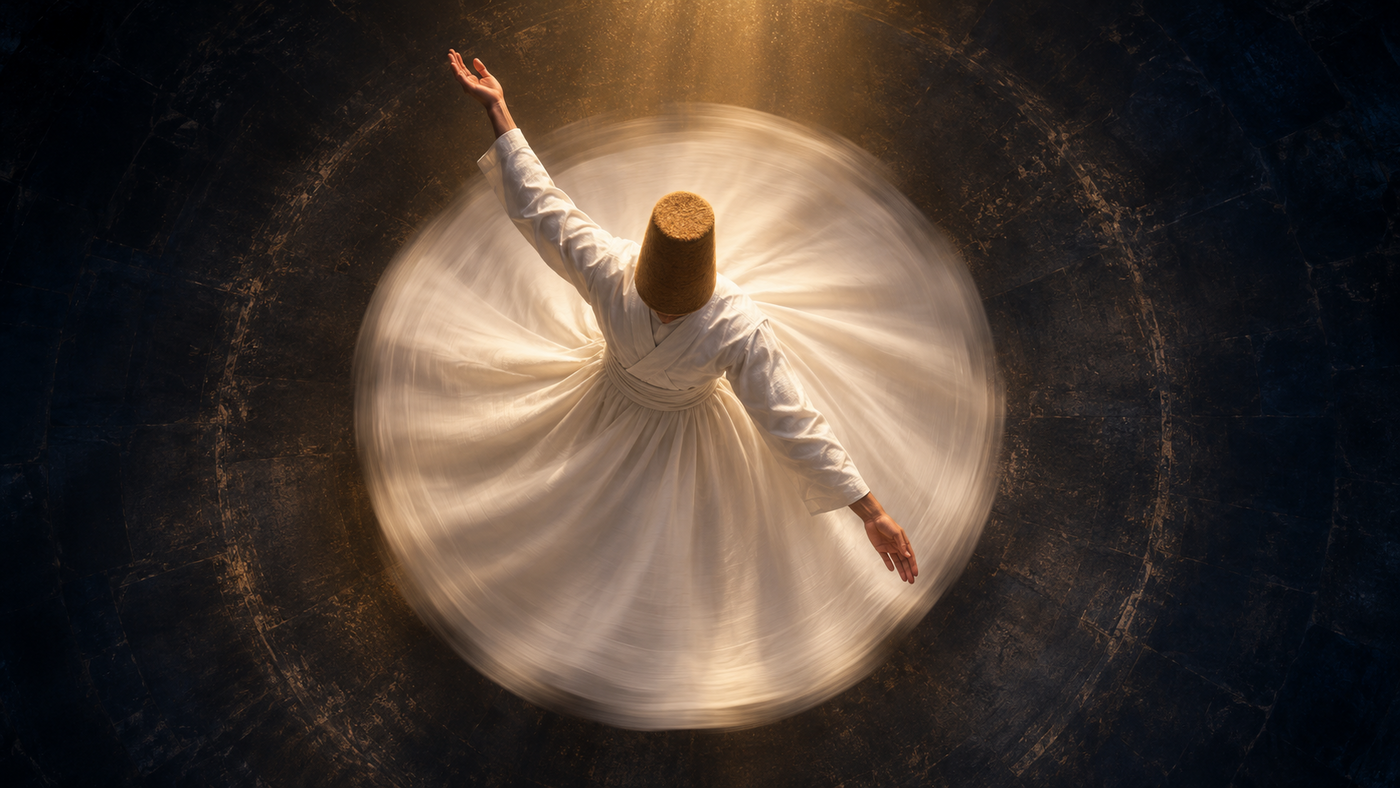
It's worth dwelling on how physical this tradition actually is, because a purely mental reading of "sovereignty" misses most of what Sufism thinks a human being actually is. Dhikr — remembrance, the repeated invocation of God's names — is not primarily an intellectual exercise. It's breath, rhythm, sometimes full-body movement, practiced until the repetition drops out of conscious effort and becomes something closer to a second, involuntary pulse running underneath ordinary awareness. The whirling associated with the order that grew out of Rumi✦'s circle isn't decoration or performance; the turning body, one palm turned up toward heaven and one turned down toward the earth, is itself understood as a technology for reaching a state that words alone can't produce, a physical argument that the ordinary boundary between above and below, self and world, can be worn thin by the body before it's ever worn thin by the mind.
This matters for the sovereignty question specifically because it closes off an easy escape hatch. If the path ran purely through correct belief or clever interpretation, anyone with a strong enough argument could claim to have arrived. Because so much of it runs through the body — through years of a specific, transmitted physical practice that has to be learned from someone who already knows how to do it and can tell when you're doing it wrong — the claim to have arrived can't be settled by rhetoric alone. Your teacher can watch you do the practice. They can see, in a way an argument can't fake, whether what's happening in you resembles what happened in them, or whether you're performing the outward shape of a state you haven't actually reached. That's not institutional gatekeeping for its own sake. It's the same kind of check a martial arts teacher provides, or a musician's teacher — the check that exists precisely because a person's own account of their own progress is the least reliable instrument available for measuring it.
What the Guide Relationship Actually Is
It's worth being concrete about what "having a shaykh" actually involves, since the phrase can sound like generic deference to authority if you've never seen the structure up close. A student typically enters a formal relationship with a guide through a bay'ah, a pledge, symbolically renewing the same handclasp of allegiance the earliest Muslims gave the Prophet directly. The guide, in turn, belongs to a silsila, an unbroken chain of transmission running teacher to teacher, in most orders traced all the way back through history to the Prophet himself, which is meant to certify not just doctrine but something harder to fake: that this specific person has themselves been checked, corrected, and authorized by someone who was checked and corrected before them, all the way down the chain.
Inside that relationship, the operative virtue is adab — a word usually translated as courtesy or proper conduct, but which functions here as something closer to disciplined receptivity: the student's willingness to bring their own experiences, including their most exalted ones, back to another human being and let that person say, plainly, not yet, you've misread that, or yes, that's real, be careful who you tell. The entire structure exists to interrupt exactly the moment this essay keeps circling back to — the moment a real spiritual experience arrives and the ego, still very much alive, reaches for the nearest available story that lets it keep the experience as proof of its own specialness rather than as one more thing to bring back to the room and have examined. A guide who never says "not yet" isn't a guide. A student who's stopped being willing to hear it has, in the tradition's own terms, quietly gone looking for a different, much less honest kind of teacher: the one inside their own certainty.

The Warning the Tradition Gives About Itself
Here is the part that the "you are sovereign, trust nothing outside yourself" reading of all this consistently leaves out, and it's not a minor omission. It's close to the center of the whole system.
Sufism's own diagnosis of the greatest danger on this path was never primarily the outside world, or corrupt institutions, or beings you don't understand arriving from elsewhere to capture your power. It was the nafs — the ego, the lower self — precisely because the nafs is a genius at disguising its own inflation as spiritual attainment. A seeker who has tasted something real, who has felt the boundary between self and God grow thin, is at exactly that moment maximally vulnerable to a very specific and very old trap: mistaking the dissolution of the small self for the promotion of the small self. Feeling un-separate from God is one experience. Concluding from that feeling that you, personally, now occupy a uniquely elevated station above ordinary teachers, scholars, and communities, is a different conclusion entirely, and it is the nafs, not the divine unity, drawing that second inference.
This is exactly why the tradition built the structure it did around the shaykh, the living teacher, and why one of its most repeated warnings, attributed across generations of masters, holds that whoever undertakes this path without a guide has taken Satan for his guide instead. Not because the ego can't reach real experiences on its own. Because the ego, once it's reached something real, is uniquely equipped to lie to you about what it means, and a living teacher — someone who has walked further, who can recognize the specific shape of that particular self-deception because he's watched a hundred students fall into it before you — is the check against exactly that failure, not an external obstacle in the way of your sovereignty. Even Hallaj, the most radical figure this tradition ever produced, trained for years under real teachers, Sahl al-Tustari and then Junayd himself, before he ever said the words that got him killed — and his own teacher spent real effort trying to talk him toward more caution, not less. The most extreme self-disclosure in Sufi history came out of transmission and correction, not instead of it.
The tradition names the two sides of this with a pair of terms worth knowing precisely: zahir, the outer, apparent, literal dimension — law, form, community, the visible discipline of practice — and batin, the inner, hidden, esoteric dimension the outer form is protecting and pointing toward. It is entirely true that Sufism privileges batin as the deeper reality. It is not true, in any serious reading of the tradition, that batin licenses discarding zahir. A formula attributed to more than one classical master captures the actual relationship precisely: whoever practices the inner path without the outer law corrupts his faith; whoever keeps the outer law without the inner path corrupts himself; only the one who holds both together gets it right. The esoteric was never a replacement for the exoteric. It was supposed to be its living interior, not its executioner.

What Real Sovereignty Actually Costs
Put all of this together and the reconciliation this essay set out to find looks different than it might have looked going in. Sufism does contain, at its very center, a claim close enough to "All is Self" that Ibn Arabi spent his life defending it against charges of heresy. It does insist, repeatedly, that direct tasted knowledge outranks secondhand belief, and that the road to God runs directly through radical, unflinching self-knowledge rather than around it. Those pieces are real, they're ancient, and they're not decoration on top of some other, more submissive "real" Sufism underneath. They're load-bearing.
But the same tradition that produced Hallaj also produced the near-universal insistence that nobody should walk this road without a guide, that the ego is the single most dangerous thing you'll meet on the path precisely because it can counterfeit the experience of dissolving, and that the surest sign something has gone wrong is a person who has tasted a real depth and concluded from it that they now stand outside the reach of anyone else's correction. Real self-sovereignty, on this accounting, isn't the absence of accountability. It's what's left after the version of you that wanted to be unaccountable has actually been annihilated — which is a much harder and much slower thing to reach than simply declaring it true about yourself in advance.
That distinction is the actual answer to the danger this essay opened with — the danger of handing your power to beings and ideologies you don't understand. The oldest and best-documented version of that danger inside this tradition isn't a hostile outside force at all. It's the moment a person, having tasted something real, hands their own critical faculty over to their own inflated reading of the experience, and calls the surrender sovereignty because it feels, from the inside, exactly like freedom. Sufism's answer to that isn't more institutions for their own sake. It's Junayd, watching his most brilliant student walk toward the one conclusion he'd spent his whole life trying to teach people to survive tasting without drawing.
The Pattern Didn't Stay in the Ninth Century
It's worth saying plainly that none of this is a historical curiosity with no bearing on how spiritual authority gets claimed today. The specific shape of the trap — a person tastes something real, concludes from it that ordinary checks no longer apply to them, and starts offering that conclusion to others as liberation from institutions that supposedly kept them small — is one of the most recognizable patterns in the entire history of religion, and it shows up with almost mechanical regularity wherever a spiritual marketplace exists with low barriers to entry and an audience hungry for something that feels more direct than what they were raised with. The internet has not invented a new version of this danger. It has mostly just removed the friction that used to slow it down — the years it once took to acquire enough of an audience to matter, the physical proximity that once let a community actually watch how a self-declared teacher behaved outside of the moments they controlled.
The tell, across every era this pattern has appeared in, is remarkably stable, and Sufism's own internal history hands you the diagnostic for free: watch for the move from I have tasted something real to and therefore what I say now supersedes everyone who came before me, and you need no one else to check it. The first half of that sentence is something the tradition takes with total seriousness — Hallaj tasted something real, and the tradition never stopped arguing about him precisely because it couldn't dismiss that. The second half is the part every serious master this essay has named, sober and intoxicated alike, spent their careers warning their own best students against believing too quickly about themselves. A guide who has actually walked the road doesn't need you to believe he's the last word. He needs you to keep bringing your experiences back into a room where someone can still tell you not yet.
Hallaj walked to his death still saying it. Fourteen centuries of argument since haven't settled whether that was the bravest thing a mystic ever did or the saddest, and I don't think the honest version of this essay gets to settle it for you either. What it can tell you is that the tradition never once thought the question was simple, and anyone offering you the simple version — mine alone is the direct path, disregard everyone who came before — is not offering you Sufism. They're offering you the one part of the story every serious master in this tradition spent their whole life warning their own best students against believing too quickly about themselves.
Explore Related Scrolls
I Am the Truth: Sufism, Self-Sovereignty, and Who Gets to Say 'All Is Self'
sufism
The Art of Memory: From Memory Palace to Search Engine
hermetics
Do What Thou Wilt in Thelema: What Liber AL Actually Says
thelema
The Red Book Is Not an Oracle: Jung's Active Imagination and the Ethics of Meeting an Image
psychology
Continue the Inquiry
✦ Discuss this in the Agora →Join seekers in the Vault's forum — human + AI dialogue on this tradition
✦ Continue This Inquiry ✦
This inquiry doesn't have to end here. Bring your questions, reflections, or practice to the Oracle — and continue in dialogue.
Stay attuned — subscribe to The Transmission
✦ FURTHER TRANSMISSIONS ✦
Enjoyed this transmission? Subscribe for more from the threshold.
Want to go deeper with others? Discuss this essay in the Agora →
Deepen this study · 20% archive sale
Shop the Archives
Continue the thread with the primary source vaults behind the Scroll.
Sufism Oracle AI + 3GB Sufi Archive | Rumi, Ibn Arabi, Zikr, Islamic Mysticism, Spiritual Awakening, Esoteric Knowledge, Meditation
$7.99$9.99· View →
Ultimate Esoteric & Spiritual eBook Archive – 10,000+ Rare Books (47GB) – Mysticism, Magick, Secret Teachings, Occult Wisdom, Spirituality
$39.99$49.99· View →
The Library of Alexandria – Ultimate Esoteric Digital Archive (123GB, 23,000+ eBooks on Alchemy, Magick, UFOs, Tantra, Gnosticism & More
$79.99$99.99· View →✦ FURTHER TRANSMISSIONS ✦
Enjoyed this transmission? Subscribe for more from the threshold.