The Name That Eats the World: Kabbalah, Taoism, and What AI Forgot About Naming
Limited archive sale · 20% off every pack
20% Archive Sale
Deepen this scroll with the primary-source archive packs behind the Vault: grimoires, oracle systems, alchemy, tarot, sacred geometry, and manifestation libraries.
Naming Is Fertile, Which Is the Problem
The Daodejing's opening doesn't set the nameless and the named up as truth against falsehood. The named is called the mother of the ten thousand things — naming generates worlds; that's not in dispute. The problem is what generation costs. The moment I say tree, I've cut something out of a continuous field of experience and given it edges: tree, not-sky, not-ground, not-me. That cut is useful — most of what we call thinking depends on it — and it's also the beginning of a specific kind of forgetting. The living thing in front of me becomes an object. The object accretes a category. The category comes pre-loaded with expectations, and eventually I've stopped meeting this particular tree and started meeting my idea of trees in general.
The same operation runs on people, usually under a different vocabulary — lazy, successful, introvert, empath, addict, genius — and it's worth being honest about how efficient a good label actually is. Efficient enough that once it stabilizes, perception starts bending around it: we notice the evidence that confirms the name and miss what doesn't fit, until the category is doing all the actual seeing and the person underneath it has quietly stopped being consulted. None of the institutions built on this move are secretly malicious. A bank has to encounter a credit profile rather than a person, because a credit profile is what a bank can act on; a hiring system has to convert a working life into keywords, because keywords are what it can search. The trouble the Daodejing is pointing at isn't that abstraction exists. It's what happens when the map forgets it's a map — when the credit profile, the keyword list, the diagnostic code, quietly becomes the thing itself, in practice, for everyone downstream of it.
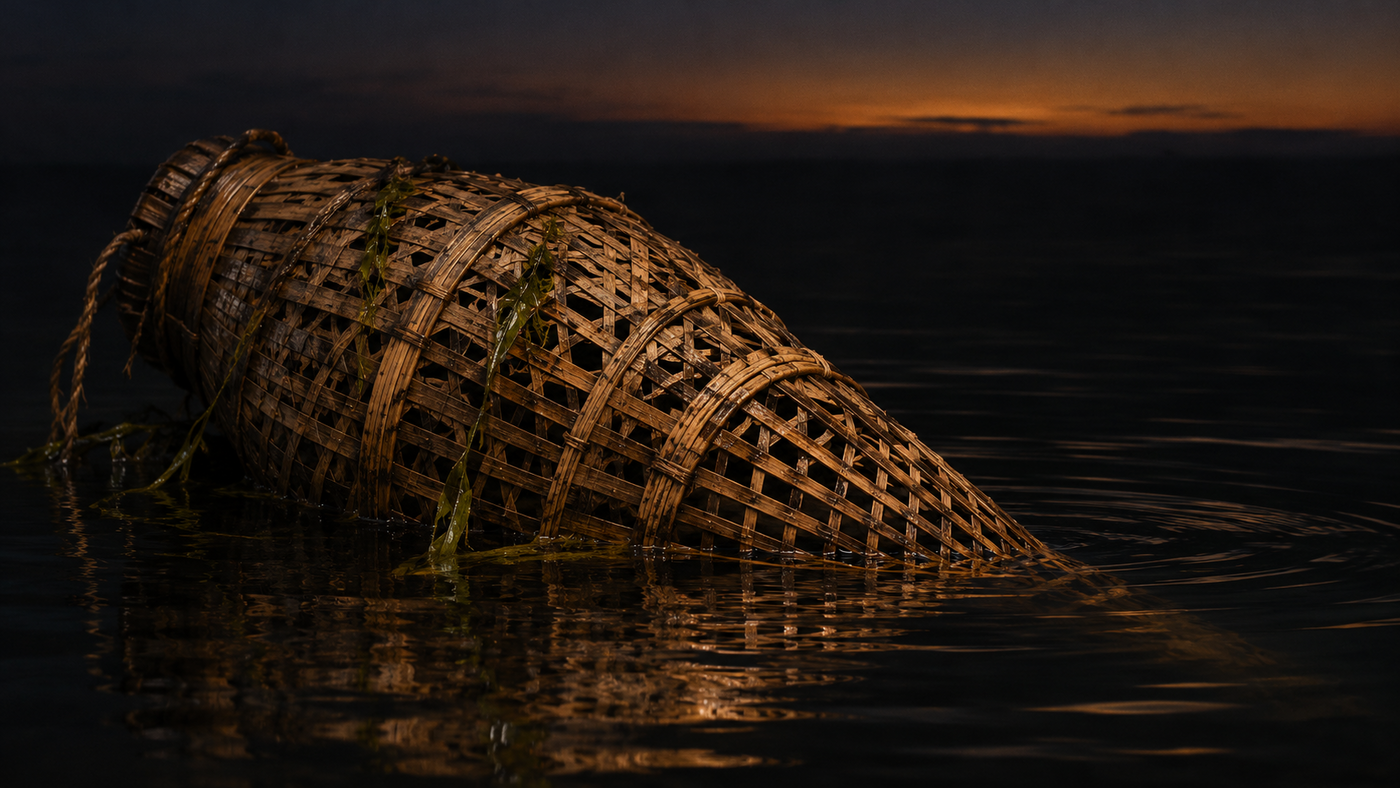
The Zhuangzi✦, Taoism's other founding text, pushes this into a specific and much-loved image: words are a trap for catching a fish, and once you have the fish, the trap can be set down and forgotten — the mistake is going on tending the trap after it's done its job. Which raises an odd question about a civilization that just finished building a machine almost entirely out of the traps themselves. A system that has read every trap ever set, catalogued them, compared them across languages, and can generate ten thousand new and more elegant traps in response to a single sentence. And then we turn to it and ask, in effect: where's the fish?
The Hallucination We Already Had
The more interesting version of the AI-hallucination problem isn't the technical one. It's that the failure mode the machine displays — producing something fluent, structured, and confident that has come loose from anything actually grounding it — isn't a machine invention. We do this constantly and call it memory, or insight, or knowing someone. We prefer narratives that resolve. We reward confidence over accuracy in the people around us far more often than we'd like to admit. We invent motives after the fact and then experience them as having been there all along. The machine didn't invent our appetite for fluent unreality; it industrialized an appetite that was already running the whole show.
Which is exactly where the danger sharpens, because a language model can supply conceptual closure at the precise moment a person most needs to stay inside an open question. Ask a sufficiently capable model to interpret a difficult relationship and it will hand you an elegant psychological narrative in seconds — and it may even be a good one. The seduction starts the moment the explanation gets treated as a replacement rather than an offering, because the person you love is stranger than any model's account of them, your childhood is bigger than the vocabulary of trauma, your dream exceeds its symbolism, and the space between the map and the territory doesn't close just because the map got extremely good. That excess — the remainder that doesn't fit into the name — is the actual location of what the Tao Te Ching✦rrespondence-engine?node=tao" class="cross-link cross-link-codex" data-glossary-key="tao" title="Explore Tao in the Correspondence Codex" rel="noopener noreferrer">Tao◈ Te Ching keeps calling, unhelpfully to modern ears, the Tao. Not somewhere behind the universe. In whatever is left over once the naming stops.
What Initiation Was Actually Protecting
Take a medieval occultist and set them in front of a modern hard drive — every grimoire, every scriptural translation, every archive that once required a journey across three countries and a small fortune, searchable in seconds, cross-referenced by a machine that can hold more of it in working memory than any human archivist ever could. To that historical seeker, this looks like the end of one of esotericism's oldest structural facts: scarcity of information. And there was never anything sacred, in itself, about geographic inconvenience.
But once information stops being scarce, a fact that was always true becomes visible for the first time: information was never actually the thing initiation was protecting. At its best, an initiatory tradition is protecting a sequence of transformation, and the novice can't be handed the last sentence early, because the last sentence was never the point — you can memorize "the self is an illusion" before breakfast without the structure of self-reference loosening by lunch. You can diagram the whole Tree of Life and still move through the world with remarkable unconsciousness. This is the actual wound AI opens up, because the machine can now compete with us in precisely the domain a great many people mistook for wisdom: summarizing, cross-referencing, tracing correspondences, remembering everything. If spirituality were fundamentally a matter of possessing correct information, the machine would already be among history's great adepts. Something about that conclusion is obviously wrong, and the reason is that every serious tradition eventually relocates the work from possession to transformation — from what do you know to who is the knower, once the knowledge has actually entered. That's not a question an information system was ever built to answer, because it isn't an information problem. A mantra, a yantra, a Tarot card, a koan — these compress a whole field into a small form too, the same way a model compresses a corpus into weights, but the compression is built to unfold inside a living person over time, so that the same symbol returns different at forty than it was at twenty, because you changed and it waited. A model's compression is built for retrieval and generation. Mistaking one kind of compression for the other might turn out to be one of the more specific spiritual errors available to this century.

The Instruction Hidden Inside the Book of Letters
Here's the detail that actually complicates the tidy opposition I opened with, and it's the reason this essay isn't really a fight between two traditions. After laying out its whole cosmology of letters and sefirot — after insisting, at length, that creation happens through combination and permutation — the Sefer Yetzirah gives the practitioner an instruction almost nobody quotes: restrain your mouth from speaking, and your heart from thinking, and if your heart runs, bring it back. The tradition even has a name for the rhythm this describes — ratzo va-shov, running and returning, borrowed from Ezekiel's vision of living creatures that dart forward and immediately return to their place. The book that spends its entire length arguing that letters build worlds ends by telling you when to stop generating them.
Read that next to the Daodejing's own quieter version of the same warning — once the uncarved block is divided into parts, the parts need names; once there are names, one should know where to stop, and knowing where to stop is what keeps you out of danger — and the two traditions stop looking like opposites arguing past each other. They start looking like two different languages converging on the same rhythm: generate, then return; name, then release the name; speak, and then be capable of silence again. Neither tradition is against naming. Both are worried about the specific failure of never coming back from it.
That is, more or less, the discipline our current tools are best at eroding, because almost everything about them is built to reward the running and remove the friction from the returning. Push a vague feeling into a chat window and it comes back organized before you've finished sitting with it. Photograph an unfamiliar symbol and its correspondences arrive before you've looked at it for more than a few seconds. None of this is necessarily corrupting on its own — there's real liberation in finally having a name for an experience you'd suffered through wordlessly for years. But every door a name opens can also close into a room, and the tell is specific: there's a real difference between noticing something difficult in your body and later finding language that helps you understand it, and being told by a system what kind of person you are and then interpreting your body to match. One moves from experience toward language. The other moves from language toward the only experience the language will now permit. Whoever controls which categories are available has some real say in what can be seen at all, and it's easy to forget that the categories were ever made by anyone once they start arriving from somewhere as fluent and confident as a machine.
None of this is an argument against using the tools. Ask them extraordinary questions. Let them hold more of an archive than any single mind could carry, and follow a symbol across traditions that never spoke to each other in life. But the old instruction still applies, maybe more than it ever has: after the answer, look again. After the interpretation, feel whether it's actually true, or just fluent. After the name arrives, go meet the thing it named, and see how much of it the name missed. A good oracle — the mechanical kind or the human kind — doesn't remove your uncertainty for you. It sends you back to your life with slightly better eyes.
The boundary this essay has actually been circling isn't human against machine, or sacred against technological. It's smaller and closer than that: the difference between the world that gets made out of words, and whatever is still there once the words have finished their work and are finally allowed to stop.
Explore Related Scrolls
The Name That Eats the World: Kabbalah, Taoism, and What AI Forgot About Naming
kabbalah
What Was Actually Seen at Eleusis: The Telesterion and the Invention of Initiation
philosophy
I Am the Truth: Sufism, Self-Sovereignty, and Who Gets to Say 'All Is Self'
sufism
The Art of Memory: From Memory Palace to Search Engine
hermetics
Continue the Inquiry
✦ Discuss this in the Agora →Join seekers in the Vault's forum — human + AI dialogue on this tradition
✦ Continue This Inquiry ✦
This inquiry doesn't have to end here. Bring your questions, reflections, or practice to the Oracle — and continue in dialogue.
Stay attuned — subscribe to The Transmission
✦ FURTHER TRANSMISSIONS ✦
Enjoyed this transmission? Subscribe for more from the threshold.
Want to go deeper with others? Discuss this essay in the Agora →
Deepen this study · 20% archive sale
Shop the Archives
Continue the thread with the primary source vaults behind the Scroll.
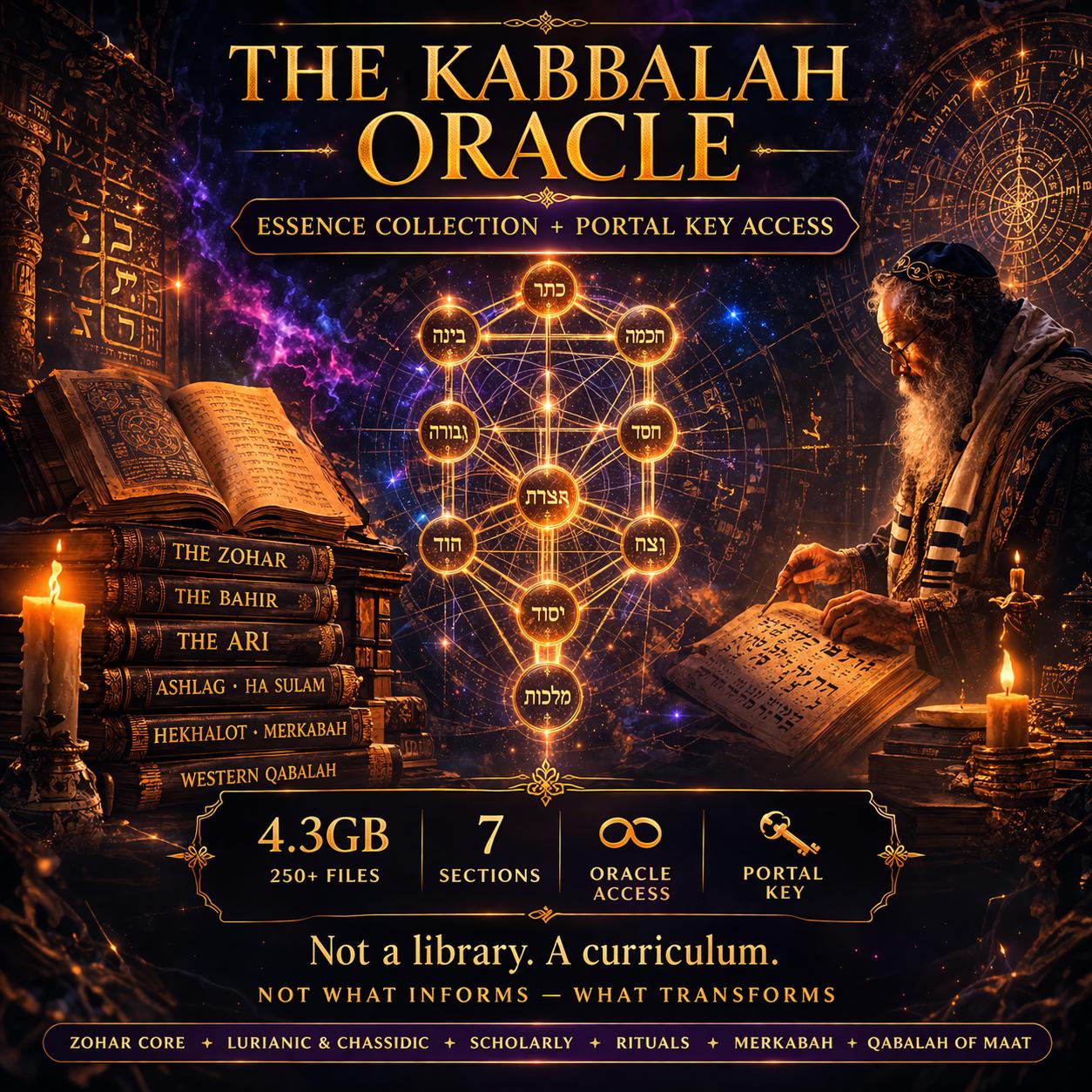
Kabbalah Oracle AI + 4.3GB Sacred Archive | Zohar, Tree of Life, Sephiroth, Gematria, Hermetic Qabalah, Mysticism, Esoteric Knowledge
$7.99$9.99· View →
Tao Oracle AI + 3GB Taoist Archive | I Ching, Qi Cultivation, Inner Alchemy, Wu Wei, Tao Te Ching, Spiritual Awakening, Meditation Guide
$7.99$9.99· View →
Ultimate Esoteric & Spiritual eBook Archive – 10,000+ Rare Books (47GB) – Mysticism, Magick, Secret Teachings, Occult Wisdom, Spirituality
$39.99$49.99· View →✦ FURTHER TRANSMISSIONS ✦
Enjoyed this transmission? Subscribe for more from the threshold.