The Shape Before the World
Limited archive sale · 20% off every pack
20% Archive Sale
Deepen this scroll with the primary-source archive packs behind the Vault: grimoires, oracle systems, alchemy, tarot, sacred geometry, and manifestation libraries.
A symbolic order before the world
The Sefer Yetzirah, usually translated as the Book of Formation, presents creation through ten sefirot and twenty-two Hebrew letters.[1] It describes the letters not merely as labels attached to finished objects but as elements in a combinatorial account of formation.[1] Its date and setting remain debated: it is securely attested in medieval Jewish intellectual life, while scholarly proposals for its composition range across late antiquity and the early Middle Ages.[1]
That distinction matters.[1] We can describe the text’s architecture without pretending scholars have settled its origin or that a single modern reading exhausts it.[1] The opening movement gives sustained attention to the ten sefirot; the work then turns to the letters, their classes, and their permutations.[1] The sequence invites a reader to imagine an ordering principle before a populated world.[1] It does not give a physicist’s account of matter, nor does its literary structure demonstrate that Hebrew letters are physical building blocks.[1]
The most careful way to read the claim is as a cosmology and a discipline of interpretation: the world is intelligible because it is articulated.[1] In the text’s own symbolic grammar, number and letter are not decorative accessories added after creation.[1] They belong to the account of how creation is ordered.[1] A reader can take that proposition seriously on its own terms without converting it into a claim about particles, fields, or experimental physics.[1]
For a source-led study of the letter-and-number tradition, the Kabbalah archive gathers material that can be read alongside the primary text; it is a research collection, not evidence that the text’s cosmology is a modern scientific theory.

Mind, world, and the path back
A related but distinct sequence appears in the Corpus Hermeticum✦.[2] One English translation states the order this way: “First, God; Secondly, the World; Thirdly, Man. The World for Man, Man for God.”[2] The world is not presented as an ultimate, self-sufficient container.[2] It is situated between a divine source and a human capacity to recognize that source.[2] The line is theological and philosophical, not a technical model of cosmogenesis.[2]
The Hermetic writings survive in a long and complicated textual history; modern readers should distinguish the late-antique Greek works from later translations, Renaissance interpretations, and contemporary uses of “Hermeticism.”[10][2] The older English wording quoted above is useful as a translation, not as a claim that every edition uses the same phrasing.[10][2] The point here is the ordered relationship among source, cosmos, and human knower.[10][2]
The Picatrix, a medieval work of astral magic with a philosophical frame, offers a different register for a similar descent.[3] Its opening discussion says that created things receive “truth and unity, generation and corruption” from the One, and that the One alone comprehends their order and relation.[3] In this text, the language of unity belongs to a cosmology of dependence and hierarchy.[3] It is not interchangeable with the Sefer Yetzirah’s letters or the Hermetic dialogues’ account of mind.[3]
Nor should these texts be presented as six isolated discoveries that never touched.[2][3][10] Traditions develop through translation, commentary, shared philosophical vocabularies, and argument.[2][3][10] “Convergence” is safest as a reader’s comparison: several sources place an intelligible or spiritual order upstream of visible things.[2][3][10] It is not proof that every author arrived there independently, or that each meant the same thing by the order they described.[2][3][10]

When stone is read as a diagram
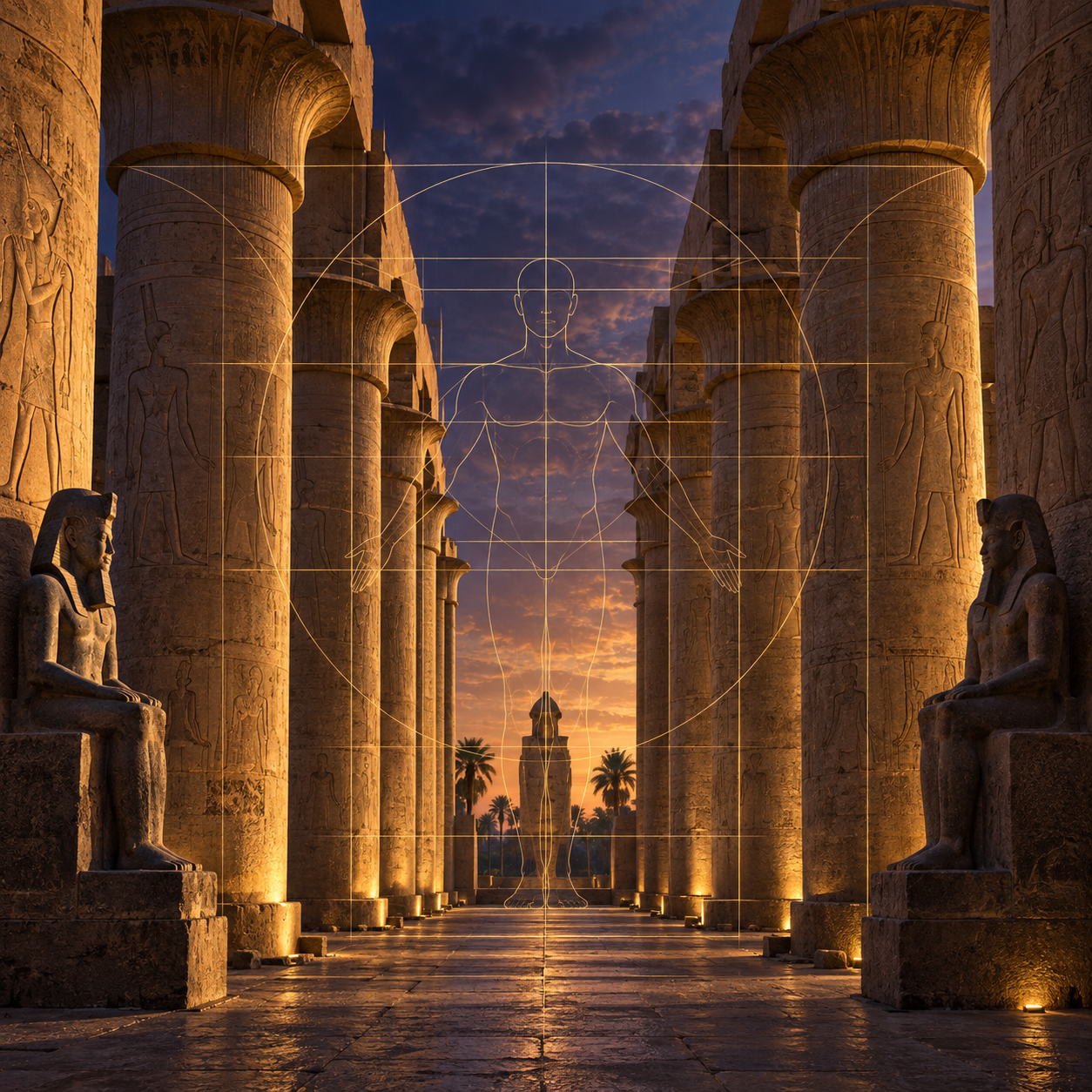
Schwaller de Lubicz’s The Temple in Man carries the question from text to architecture.[4] He argued that the Temple of Luxor’s proportions expressed a conception of the human being and a sacred order, rather than serving only practical or decorative purposes.[4] The book appeared in 1949; its translator’s foreword describes the controversy its thesis provoked among Egyptologists.[4]
That history is not a verdict that Schwaller proved his interpretation.[4] His reading remains his reading: a bold symbolic account that asks us to see architecture as a way of making a prior proportion visible.[4] The responsible distinction is between a measured building, which can be examined, and the historical intention or metaphysical meaning assigned to it, which requires its own evidence.[4] A temple can be approached as engineering, ritual space, political monument, or symbolic body; one category should not silently stand in for all the others.[4]
The useful comparison is therefore modest.[1][4] A text can make order legible through a sequence of letters; a building can make proportion legible through space.[1][4] Both invite the reader to look for a structure that is not reducible to the material object, while leaving open whether the proposed structure is historical fact, theological interpretation, or later reconstruction.[1][4]
The visible pattern on the plate
Hans Jenny’s Cymatics brings a more directly observable process into the conversation.[5] In experiments described in his work, vibration✦ applied to a plate or fluid medium organizes powder and liquid into visible patterns.[5] Change the frequency, material, or conditions, and the pattern changes.[5] Jenny’s book documented such forms photographically; its first volume appeared in 1967, with a second volume following later.[5]
Here the order of events is experimentally accessible: a physical setup is driven; the medium responds; a pattern becomes visible.[5] The geometry is not hidden inside the powder waiting to be decoded as a message.[5] It arises through the interaction of vibration, material, boundaries, and conditions.[5] A stable setup can produce repeatable forms; that fact is already remarkable without claiming that the forms encode a universal alphabet or prove that matter itself is downstream of a nonphysical mind.[5]
This is where the comparison with the Sefer Yetzirah is suggestive and where it must stop.[1][5] Both can be read as placing an ordering process before visible form.[1][5] But a vibrating plate demonstrates a particular physical mechanism.[1][5] The Sefer Yetzirah offers a symbolic theology of creation.[1][5] One does not experimentally validate the other.[1][5] The analogy helps us notice a shared shape of explanation—input, ordering, appearance—while the difference in method tells us what conclusions each can support.[1][5]
The practical lesson is to keep three questions separate: What does the source claim? What does the experiment show? What interpretation are we adding when we place them side by side? That separation does not drain the comparison of meaning. It makes the meaning more exact.

A visionary cosmology, not a physics result
Walter Russell belongs in the story because he states the priority claim in unusually direct language, and because his evidentiary status makes a useful contrast.[6][12] In The Universal One, Russell writes, “Matter is light. Nothing is which is not light.”[6] His book describes a universe generated through the action of a universal Mind.[6] The surviving edition carries a 1926 copyright notice, while its preface gives a slightly different publication history.[6]
Russell was an artist, sculptor, and architect who turned to speculative cosmology; his own institution presents his work across art, philosophy, and education.[12] His account should be read as a metaphysical system and a historical document, not as a tested physics theory or as a precursor that anticipated contemporary particle physics.[6][12] The fact that two accounts use words such as “light,” “motion,” or “mind” does not make their mechanisms equivalent.[6] Russell’s confidence is part of the text; it is not a substitute for measurement, mathematical derivation, or successful prediction.[6]
That makes his work a valuable boundary case.[6] A recurring intuition can be culturally and philosophically significant even when a particular explanation does not survive scientific standards.[6] Respecting the intuition does not require endorsing the mechanism.[6]
Geometry without ordinary spacetime
The modern physics comparison is narrower than the popular shorthand “physics has proved spacetime is an illusion.”[11] In 2013, Nima Arkani-Hamed and Jaroslav Trnka introduced the amplituhedron as a geometric way to represent scattering amplitudes in planar N = 4 supersymmetric Yang–Mills theory.[11] Their paper proposes that locality and unitarity—features usually built into the conventional formulation—can emerge from positive geometry in that mathematical setting.[11]
A companion research program connects scattering amplitudes to the positive Grassmannian and on-shell diagrams, highly structured mathematical objects used to organize calculations.[7] The achievement is not that a geometric solid has replaced spacetime for every physical process.[7] It is that, in a specific theory and regime, a geometric formulation reveals structure that is obscured in standard diagrammatic calculations.[7] The amplituhedron is a technical construction with precise definitions; it is not a generic symbol for “the universe is geometry.”[11][7]
Arkani-Hamed’s Cornell lecture series included a talk titled “Space-time is doomed. What replaces it?”[8] The title captures the ambition of a research program, not a settled experimental result.[8][11] The paper’s stated scope—planar N = 4 supersymmetric Yang–Mills—is narrower than the full Standard Model and the observed universe.[11] The work is mathematically serious and influential; its larger ontological implications remain questions, not an experimentally confirmed conclusion.[11]
The resemblance to older cosmologies is real at the level of form: a description that begins from a mathematical structure can make familiar spatial or causal features appear derivative.[1][11] But there is a decisive difference in what “prior” means.[1][11] In the amplituhedron work, it means a mathematical representation from which certain scattering quantities can be calculated.[1][11] In the Sefer Yetzirah, it means a sacred account of creation through number and letter.[1][11] Similar grammar does not equal shared substance.[1][11]

A proposed geometry of experience
A second modern comparison comes from the study of experience rather than particle scattering.[9] The Qualia Research Institute’s 2016 essay “The Hyperbolic Geometry of DMT✦ Experiences” proposes that some reported DMT experiences may be modeled as hyperbolic or hyperbolic-like in their subjective spatial structure.[9] The authors describe synthesizing anonymous first-person reports and user-submitted accounts; this is a phenomenological proposal, not a controlled clinical study establishing the geometry of the brain or the external world.[9]
That proposal is interesting because it asks whether ordinary Euclidean space is the right descriptive framework for certain reports.[9][11] But it does not connect those reports to the amplituhedron, and it does not establish that an altered experience reveals a deeper objective layer of reality.[9][11] One concerns a mathematical framework for scattering amplitudes in a specified physical theory; the other is an interpretive model of reported experience.[9][11] Setting them beside each other can sharpen a question about geometry’s explanatory role, but it cannot erase the distance between their evidence.[9][11]
This is also why the phrase “spacetime is not fundamental” needs a subject and a scope.[9][11] Is it a claim about a particular calculation, a proposed theory of quantum gravity, a phenomenological description, or a spiritual cosmology?[9][11] Without that qualifier, the same phrase can make unrelated arguments sound like one discovery.[9][11]

What the comparison can—and cannot—say
Across these sources, a recurring pattern comes into view: visible form is treated not as the whole story but as the expression of an ordering process.[1][2][3] In one text that process is articulated through letters and numbers; in another it is Mind; in a medieval cosmology it is the One; in a temple it is proposed as proportion; on Jenny’s plate it is a physical vibration; in Russell’s book it is a metaphysical light; in amplituhedron research it is positive geometry; in the DMT essay it is a proposed geometry of experience.[1][2][3]
The list is not a chain of evidence.[5][11] Its members do not all speak about the same object, use the same method, or meet the same standard of verification.[5][11] The plate experiment can test how a specified vibration shapes a specified medium.[5][11] A mathematical paper can be assessed for derivation and eventual relevance to physical measurements.[5][11] A historical text can be interpreted in its textual context.[5][11] A metaphysical work can be studied as a worldview.[5][11] A phenomenological model can be tested against better-designed reports and experiments.[5][11] None of these methods can simply be substituted for another.[5][11]
So what does the convergence license?[1][5][11] Not the claim that physics has confirmed Kabbalah, that cymatics proves a cosmic alphabet, or that a psychedelic experience reveals the amplituhedron.[1][5][11] It licenses a narrower and more durable curiosity: why do very different thinkers keep reaching for an order that precedes the forms we encounter?[1][5][11] What does each tradition mean by “prior,” and what evidence—textual, experimental, mathematical, or experiential—could actually support that meaning?[1][5][11]
Those questions are worth following precisely because the answers may diverge. The mystic’s letter, the physicist’s geometric object, and the powder’s resonance pattern can each change how we picture the relation between form and source without collapsing into a single theory. Read the sources closely, track where interpretation begins, and let analogy open the inquiry rather than close it.
If you want to pursue one of these correspondences as a question rather than accept it as a conclusion, bring a source-specific prompt to the Universal Transmissions Oracle. For focused source trails, see VOA’s Cymatics and the Language of Form: When Vibration Learns to Spell and The Amplituhedron and the Flower of Life: When Physicists Redrew Sacred Geometry. The UT Journal also has separate studies of Sefer Yetzirah, the Corpus Hermeticum, the Picatrix, Cymatics, and Walter Russell. Treat each as a distinct interpretive essay; here, the shared question is what “prior order” means in each source.
Sources
[1] https://www.pennpress.org/9780812249903/sefer-yeirah-and-its-contexts [2] https://hermetics.net/media-library/hermetic/corpus-hermetica/the-first-book [3] https://www.renaissanceastrology.com/blackbookextract.pdf [4] https://archive.org/stream/TheTempleInMan_201709/The%20temple%20in%20man_djvu.txt [5] https://archive.org/download/hans-jenny-cymatics/Hans%20Jenny%20-%20Cymatics.pdf [6] https://archive.org/stream/the-universal-one-1926-walter-russell/TheUniversalOne1926WalterRussell_djvu.txt [7] https://arxiv.org/abs/1212.5605 [8] https://www.cornell.edu/video/nima-arkani-hamed-spacetime-is-doomed [9] https://qri.org/blog/hyperbolic-geometry-dmt [10] https://www.cambridge.org/core/books/hermetica/A2779DE70B173114CC8669BEB3CF507D [11] https://arxiv.org/abs/1312.2007 [12] https://www.philosophy.org/founders/walter-bowman-russell
Explore Related Scrolls
The Shape Before the World
philosophy
The Book of Thoth Was Not a Secret: How Egyptian Knowledge Trained the Scribe
kemet
The Fasting of the Heart: Zhuangzi's Attention Practice for an Overloaded Age
taoism
Metatron's Cube and the Tree of Life: When Kabbalah and Geometry Share One Blueprint
sacred-geometry
Continue the Inquiry
✦ Discuss this in the Agora →Join seekers in the Vault's forum — human + AI dialogue on this tradition
✦ Continue This Inquiry ✦
This inquiry doesn't have to end here. Bring your questions, reflections, or practice to the Oracle — and continue in dialogue.
Stay attuned — subscribe to The Transmission
✦ FURTHER TRANSMISSIONS ✦
Enjoyed this transmission? Subscribe for more from the threshold.
Want to go deeper with others? Discuss this essay in the Agora →
Deepen this study · 20% archive sale
Shop the Archives
Continue the thread with the primary source vaults behind the Scroll.
Correspondence Codex Companion PDF, 20 Printable Occult Reference Pages, Esoteric Cheat Sheet, Tarot Astrology Alchemy Sacred Geometry
$8.89$11.11· View →
Kabbalah (Qabalah) Archive 22GB | 750+ eBooks & Manscripts, Texts + 125h Video Courses + Audio Meditations | Rare Occult Esoteric Library
$31.99$39.99· View →✦ FURTHER TRANSMISSIONS ✦
Enjoyed this transmission? Subscribe for more from the threshold.