As Above, So Below: The Sufi Mirror and the Hermetic Principle — Two Traditions, One Alchemy
Limited archive sale · 20% off every pack
20% Archive Sale
Deepen this scroll with the primary-source archive packs behind the Vault: grimoires, oracle systems, alchemy, tarot, sacred geometry, and manifestation libraries.
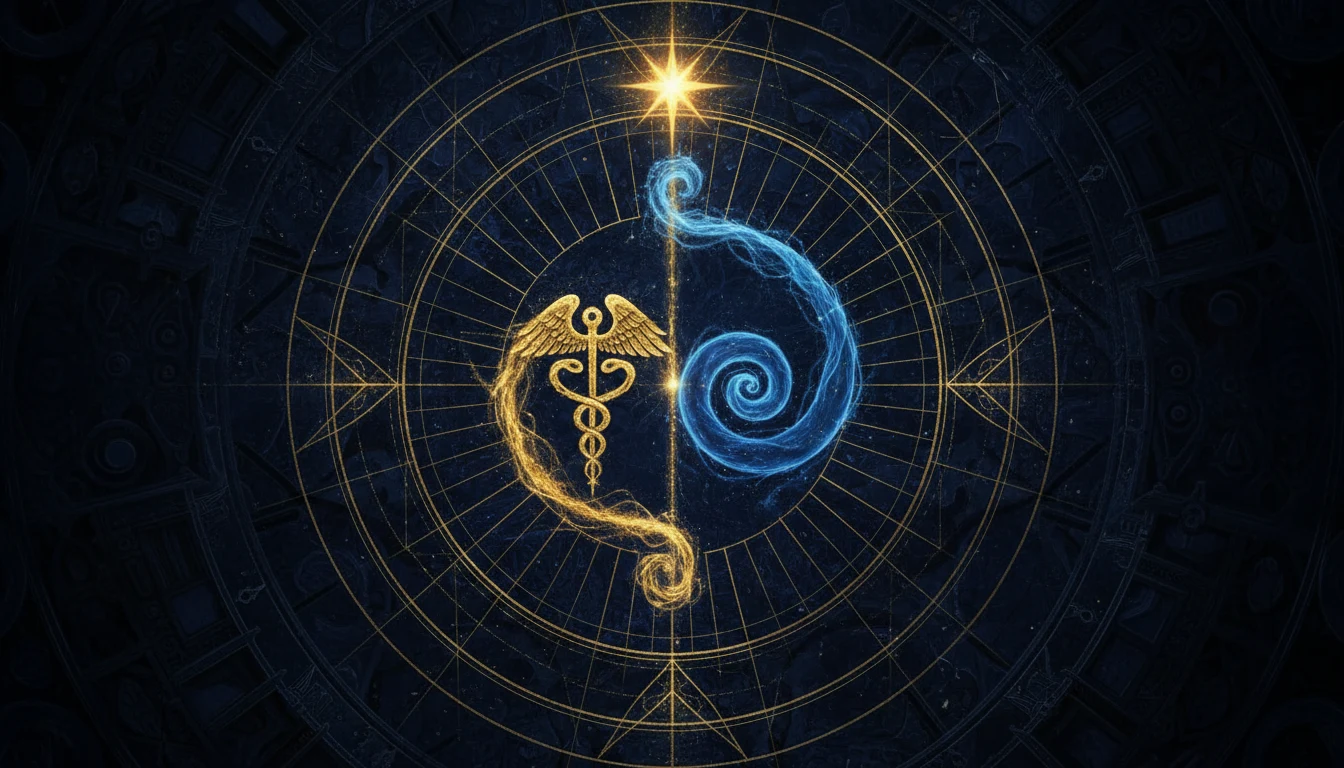
As Above, So Below: The Sufi Mirror and the Hermetic Principle
Layer 1: The Human Anchor
There is a moment in every serious practice when the student realizes that the cosmology they were handed is not a description of the sky but a diagram of themselves. Work with the full Hermetic library here, and you will find an old sentence repeated like a heartbeat and a bell: as above, so below. Work with the Sufi masters, and you will meet the same claim wearing the clothes of a mirror: the human being was made in the form of the Real, and the Real can be read only by turning inward. Two traditions, three continents apart, one shared axiom. This essay is about that axiom — and about what happens when you take it seriously enough to let it reorganize your life.
I. The Shared Axiom: Correspondence and the Microcosm
The first of the seven Hermetic principles✦, as set down in the Kybalion✦, is the Principle of Correspondence — "as above, so below; as below, so above." In the copy in the archive (Franz Bardon's edition of the Kybalion), the teaching is put directly: "According to the Principle of Correspondence, which embodies the truth: 'As Above so Below; as Below, so Above.'" The phrase is easy to recite and nearly impossible to assimilate, because its consequence is drastic: if the macrocosm and the microcosm genuinely correspond, then every law that holds in the heavens holds in the human body, and every interior movement is an echo of a cosmic one.
The Sufi tradition reaches the same place from the opposite door. Hazrat Inayat Khan, in The Way◈ of Illumination, describes the soul as "drawn by the magnetic power of the divine Spirit," and the whole of Sufi anthropology rests on the conviction that the human being is the point at which the Divine looks back at itself. The Qur'anic line that the Sufis return to again and again — that the human was created "in the image" of God — is not, for them, a piece of theology to be argued; it is the ground of a practical method. If the human is the mirror, then the way to know the Original is to polish the mirror. In both systems, the human being is not a random inhabitant of the cosmos but its living summary — a little universe.
This is why both traditions insist that the study of the self is the study of everything. The Hermeticist does not begin with telescopes but with introspection, because correspondence means the inner and outer are the same text in two alphabets. The Sufi does not begin with speculation but with the purification of the heart, because the heart is the organ that receives the Real. In exactly this sense we can say that the Sufi mirror and the Hermetic principle are one axiom with two faces: one turned toward the cosmos, one turned toward the self — and both pointing at the same hinge.

II. All Is Mind ⇄ Oneness of Being
If Correspondence is the grammar, the Principle of Mentalism is the subject. The Kybalion's first and most fundamental doctrine is that "the All is Mind; the Universe is Mental" — that behind the multiplicity of forms there is a single underlying reality, and that reality is consciousness. However one reads the metaphysics, the operative teaching is shared: the many things we perceive are not the final truth; they are the surface of a One that expresses itself through the Principle of Correspondence, level by level.
The Sufi parallel is Ibn 'Arabi's doctrine of wahdat al-wujud, the Oneness of Being — a teaching so central and so controversial that it has animated Sufi thought for eight centuries. The Essence of Sufism summarizes it: "Tawhid (Divine Unity) is the return of man to his origin, so that he will be as he was before he came into being." Ibn 'Arabi, as the archive's Mystical Dimensions of Islam puts it, wrote "between 250 and 300 books," and the most significant thread running through them is this Oneness: the Real is one, and all apparent separation is a modulation of that one Reality. This is the Sufi "as above, so below" in full: if Being is one, then the correspondence between worlds is not an analogy the mind invents but the actual structure of how the One moves through the many.
Set the two side by side and the convergence is striking. Hermetic Mentalism says the cosmos is a mental emanation of the One. Sufi wahdat al-wujud says the cosmos is the self-disclosure of the One. Both deny that matter is the deepest stratum of reality; both locate the deepest stratum in a single conscious Real; and both treat the ladder of correspondence — From One, many; from many, back to One — as the path the soul must actually travel, not merely admire. The Principles and the Stations are different maps, but they are maps of the same country, and they agree on which direction the journey runs: inward and upward, from the veiled many to the unveiled One.
III. Fana and Baqa: The Death◈ That Leads to Life
Here the two traditions become genuinely alchemical, because both assert that knowing the One is not a matter of adding information but of undergoing a death. The Sufi name for this death is fana — annihilation — and its outcome is baqa, subsistence or resurrection in the Divine. Inayat Khan draws the distinction with precision: "The experience of the former is Fana, annihilation, but the realization of the latter is Baqa, the resurrection." The turning point is the death of the false self, and Inayat adds a line that could stand as the thesis of the whole cross-tradition tradition: "this unconsciousness of the self becomes in reality the true self-consciousness." To lose the little self is to find the real one.
The same doctrine appears under the Hermetic and alchemical vocabulary of the nigredo — the blackening◈, the necessary first death of the base metal before it can be purified into gold. What the Sufi calls the annihilation of the nafs (the lower self), the alchemical Hermeticist calls the putrefaction of the matter: both are the indispensable first stage, and in both the practitioner is warned not to mistake the death for the goal. The Junayd line preserved in the Essence of Sufism — quoted from the Risala of Qushairi — is blunt: "God should cause thee to die from thyself and live in Him." And the archive's Rumi✦ (In the Arms of the Beloved) gives the same teaching its most human form in the story of Shams burning Rumi's books: the replacement of acquired, book-learned knowledge with the direct experience of the Divine, reached only through the ego's annihilation.
This is the true meeting point of the two traditions, and it is why neither is a philosophy but both are a method. The Hermetic principle tells you that the microcosm corresponds to the macrocosm; the alchemical discipline tells you that the correspondence must be enacted by stages; and the Sufi way of fana and baqa tells you the price — the willingness to let the structural self die so that the mirrored Real can appear. The two grammars, the seven principles and the stations of the path, describe the same spiral descent into the false self and the same ascent into the true one.
IV. As Below, So Above: The Practice of the Mirror
Because the two systems are two dialects of one statement, their technical vocabulary maps onto itself with unusual coherence. The table below lays the seven Hermetic principles beside their Sufi counterparts and names the shared operation in each case — not to force an exact one-to-one identity where none exists, but to show how consistently the two traditions converge when they describe the work of the soul.
| Hermetic Principle (Kybalion) | Sufi Counterpart | Shared Operation |
|---|---|---|
| Mentalism — "The All is Mind" | Wahdat al-wujud, Oneness of Being | Recognizing the One behind the many |
| Correspondence — "as above, so below" | The human as mirror of the Divine | Reading the cosmos in the self |
| Vibration | Zikr, the remembrance that stills and moves the heart | Using rhythm to transmute the lower state |
| Polarity | The tension of jabr and free will, self and Divine Will | Holding opposites until they resolve into a third |
| Rhythm | The alternation of expansion and contraction, qabd and bast | Riding the breath of being |
| Cause and Effect | Karma/the law of the harvest of intention | Taking responsibility for inner cause |
| Gender | The soul (ruh) as receiver joined to the Real as source | Uniting the two poles within |
The point of the table is practice, not taxonomy. A student who reads it as a list of doctrines has missed the pivot: in both traditions every one of these is an instruction to act. Correspondence is not a claim to believe but a lens to bring to every situation — when something appears in the world, the mirror-self asks where the same pattern lives inside. Vibration is not a theorem but the insistence that the heart, like every string, is tuned by what it is exposed to, which is why zikr matters. The Hermetic and Sufi traditions agree that the work is not to learn a new description of reality but to become the person the description already points at.
V. Two Grammars, One Sentence
That Hermetism and Sufism arrive at a shared teaching without a shared institution is less mysterious when their history is set beside them. The Hermetic writings, gathered under the name of Hermes Trismegistus✦ — "the Master of Masters," as the Kybalion calls him — passed through Arabic-speaking lands before they reached the Latin West. The archive's Picatrix, a work "originally written sometime in the ninth century by an anonymous Arab" hand, is a living monument to that transmission: it preserves, borrows from, and passes on a Hermetic current that Marsilio Ficino would later use to launch the Renaissance occult revival, a current that runs directly into Agrippa's Three Books of Occult Philosophy.
Sufism, meanwhile, was being elaborated in the same Arabic- and Persian-speaking world — Ibn 'Arabi in Andalus and the East, Rumi in Konya — and produced its own synthesis of the One and the many. The two lineages did not need to know each other by name to be cousins, because they drank from related sources and answered related questions. When the Hermetic Corpus Hermeticum✦ and the Sufi doctrine of Oneness are read across the centuries, they sound less like two religions colliding and more like one perennial insight stated twice, in the register of the intellect and in the register of the heart. The grammar differs; the sentence is the same.
VI. The Daily Work: Zikr and the Reading of Correspondence
Up to this point the two traditions have been treated as maps, but neither tradition presents itself that way. Both insist that the work is a practice that must be done, and done repeatedly, until the correspondence stops being a doctrine and becomes a reflex. So it is worth being concrete about what "polishing the mirror" actually looks like, day to day.
On the Sufi side the central daily instrument is zikr — the remembrance of the Divine, most often practiced as the rhythmic repetition of the divine Names or of the single word Allah. Inayat Khan's The Way of Illumination presents the whole of Sufi method as a science of attunement: the soul, "drawn by the magnetic power of the divine Spirit," is affected by what it contemplates, and so the heart must be set to the right frequency the way a string is tuned. This is where the Principle of Vibration and the practice of zikr are the same thing by two names. If the principle Vibration tells the Hermetic student that everything is in motion and that motion carries influence, then zikr is the deliberate use of that law: the practitioner chooses what the heart will vibrate with, instead of leaving it to be tuned by accident. The rhythm of the repetition, the breath that carries it, the beat of the heart it aligns with — these are not decorative. They are the mechanical means by which the lower state is transmuted into a higher one.
On the Hermetic side the mirror practice is quieter but no less demanding. Take a single situation in which the student felt small, defensive, or reactive. The discipline of Correspondence asks: where is the same pattern operating above me? Wherever the student finds the pattern inside — envy, say, or the hunger for control — Correspondence insists that the same structure exists in larger systems, in institutions, in nations, in the planetary order, and ultimately in the cosmos. It is a humbling and liberating exercise at once: humbling because the student discovers that their private drama is a local instance of a universal law; liberating because a law, once recognized, can be worked with. The Sufi mirror practice runs in the opposite but complementary direction: look at the disorder in the world, and ask where is this disorder also in me? — because the mirror that reflects the Divine is also the mirror that shows the shadow. The two readings together form a single daily discipline: the Hermetic lens reduces the overwhelming cosmos to the manageable scale of the self, and the Sufi lens expands the private grief back out to its cosmic proportion, until the student is neither swamped by the world nor imprisoned by the ego.
The two daily practices converge on a shared test, and it is the truest sign that the teaching has taken: non-reactivity that is not coldness. The Hermetic student who has truly assimilated Correspondence stops treating events as personal attacks, because every event is seen to be part of a lawful pattern. The Sufi who has truly undergone the beginning of fana stops defending the false self, because the false self is recognized as a veil. What remains is not indifference but a wider compassion — the heart that has died to itself, as Inayat says, and found its true self-consciousness. This is the point where the two traditions stop talking about the cosmos and start producing a kind of person. And it is the only proof either tradition will ultimately accept.
VII. The Open Inquiry — Enter the Vault
None of this is meant to collapse one tradition into the other. The differences are real, and a serious student keeps them: Hermetism privileges the intellect's grasp of the correspondence, while Sufism privileges the heart's annihilation in the Beloved — and each is a corrective to the other. The Hermeticist who only theorizes correspondence never dies; the Sufi who only dissolves never learns to read the law. Held together, they do what each alone cannot: they give the practitioner both the map and the fire. Study the full inner-alchemy tradition in the archive here, and let the works of Rumi and Ibn 'Arabi speak directly through the Sufism Oracle here. As above, so below — and as within, so without. The mirror is waiting to be polished.
Explore Related Scrolls
Metatron's Cube and the Tree of Life: When Kabbalah and Geometry Share One Blueprint
sacred-geometry
The Entheogenic Dream: DMT, REM, and the Shared Architecture of Visionary Worlds
entheogens
As Above, So Below: The Secret Thread Running Through the Western Mysteries
gnosticism
How to Read the Tarot: A Beginner's Map of the 78 Cards
tarot
Continue the Inquiry
✦ Discuss this in the Agora →Join seekers in the Vault's forum — human + AI dialogue on this tradition
✦ Continue This Inquiry ✦
This inquiry doesn't have to end here. Bring your questions, reflections, or practice to the Oracle — and continue in dialogue.
Stay attuned — subscribe to The Transmission
✦ FURTHER TRANSMISSIONS ✦
Enjoyed this transmission? Subscribe for more from the threshold.
Want to go deeper with others? Discuss this essay in the Agora →
Deepen this study · 20% archive sale
Shop the Archives
Continue the thread with the primary source vaults behind the Scroll.
Sufism Oracle AI + 3GB Sufi Archive | Rumi, Ibn Arabi, Zikr, Islamic Mysticism, Spiritual Awakening, Esoteric Knowledge, Meditation
$7.99$9.99· View →
Grimoire & Occult eBook Archive | 8000+ Rare Esoteric PDFs | Magic, Alchemy, Witchcraft, Demonology, Hermetic Library (13GB)
$23.99$29.99· View →
Ultimate Esoteric & Spiritual eBook Archive – 10,000+ Rare Books (47GB) – Mysticism, Magick, Secret Teachings, Occult Wisdom, Spirituality
$39.99$49.99· View →✦ FURTHER TRANSMISSIONS ✦
Enjoyed this transmission? Subscribe for more from the threshold.