Metatron's Cube and the Tree of Life: When Kabbalah and Geometry Share One Blueprint
Limited archive sale · 20% off every pack
20% Archive Sale
Deepen this scroll with the primary-source archive packs behind the Vault: grimoires, oracle systems, alchemy, tarot, sacred geometry, and manifestation libraries.
The Birth of Form: One Center, Many Circles
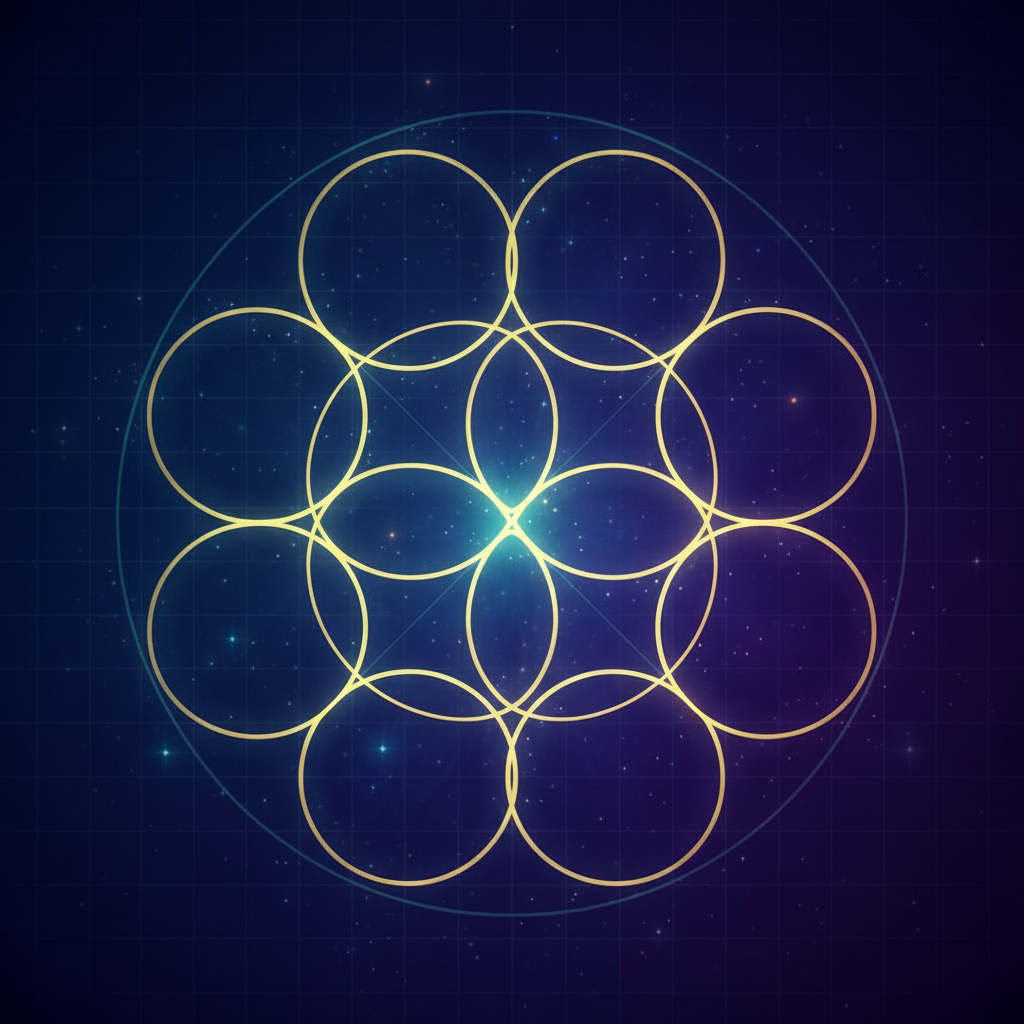
Sacred geometry begins with the humblest possible act: a single circle around a single point. From one circle you can generate everything, and the tradition's foundational image is the Seed of Life — the pattern made by drawing a second circle whose center lies on the rim of the first, then a third, and so on, each new circle's center resting on the rim of the one before. What emerges is a flower-like rosette of seven overlapping circles: one center, six around it.
Push that pattern one ring further and the overlapping arcs generate the full Flower of Life — a repeating lattice of evenly spaced, interlocking circles that, as Drunvalo Melchizedek's Flower of Life studies argue, encodes the templates of creation. From the Flower of Life you can select arcs that form the Fruit of Life, thirteen circles whose arrangement yields the next profound figure: Metatron's Cube.
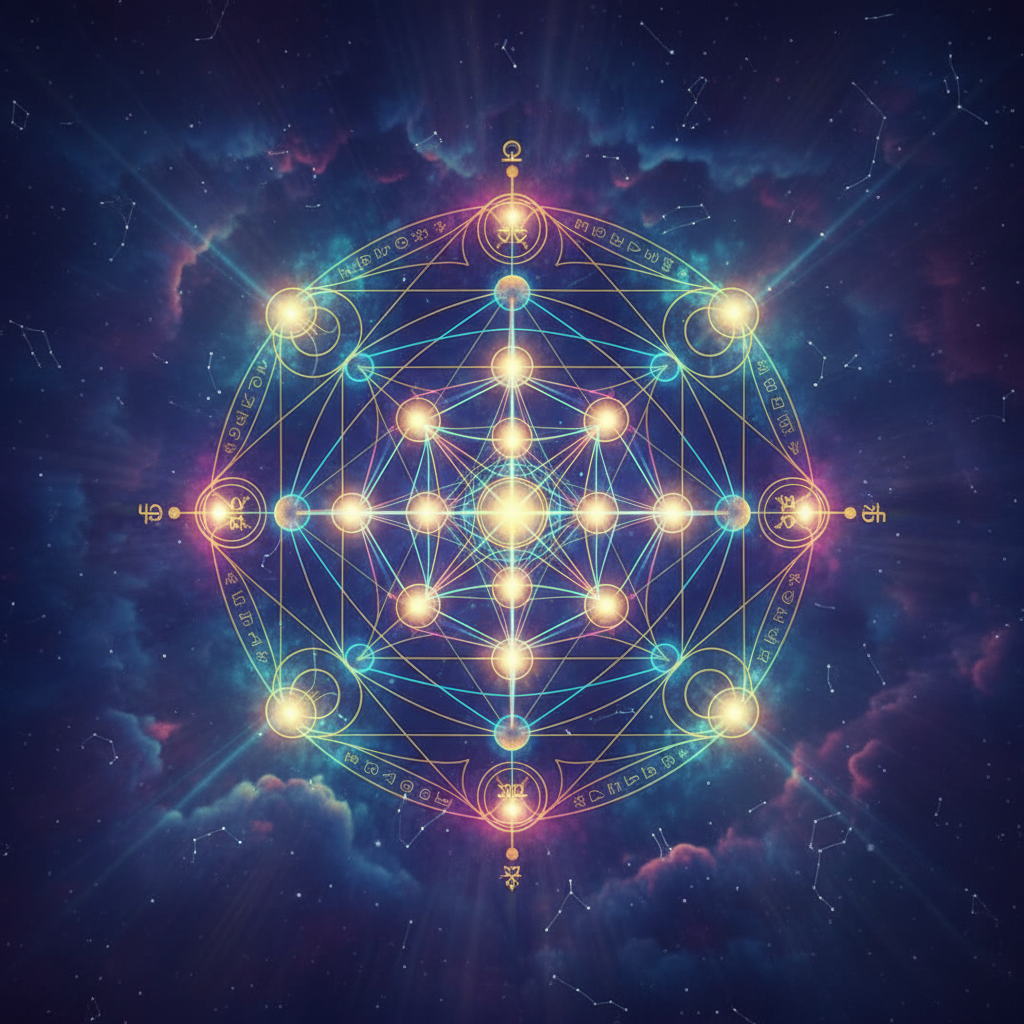
Metatron's Cube is the name given to a diagram most people meet first as a two-dimensional lattice of lines and circles. The important claim about it is that it is not merely decorative: inside its lines sit all five of the Platonic solids — the tetrahedron, cube, octahedron, icosahedron, and dodecahedron — the five regular, perfectly symmetric solids that Plato's Timaeus associated with the elements (fire, earth, air, water, and the cosmos/ether respectively).
The Five Solids: The Alphabet of Matter
To trace and build each of the five solids yourself — and see how they fold out of Metatron's Cube — discover the deeper correspondences of sacred geometry here.
Here is where the geometry gets teeth. The five Platonic solids are the only convex polyhedra whose faces are all identical regular polygons meeting at identical vertices — there are precisely five, no more, no less. For the sacred-geometry tradition this is not a coincidence but a signature: the universe builds its physical world from a fixed, finite set of perfect archetypes, and every form in nature is an approximation of one of these five.
| Element | Solid | Faces | The claim |
|---|---|---|---|
| Fire | Tetrahedron | 4 triangles | Sharpest, most penetrating |
| Earth | Cube | 6 squares | Stablest, most grounded |
| Air | Octahedron | 8 triangles | Restless, moving |
| Water | Icosahedron | 20 triangles | Rounded, flowing |
| Cosmos/Ether | Dodecahedron | 12 pentagons | Encompassing, the "fifth" |
The stunning part is that all five are latent inside Metatron's Cube, and Metatron's Cube is latent inside the overlapping circles of the Flower of Life. The image is a container for the elements — a blueprint that holds, in one lattice, the geometric genes of fire, earth, air, water, and the enclosing cosmos. This is why Michael Schneider's A Beginner's Guide to Constructing the Universe can spend a whole book showing how these elementary shapes show up in snowflakes, seashells, crystals, and star-fish: nature is executing the same construction.
The Tree: The Same Descent in Numbers and Letters
To read the Tree's ten spheres and twenty-two paths against the primary Kabbalah sources — the Zohar, the Sepher Yetzirah, and the Hermetic Qabalah — explore the Tree's deeper correspondences here.
Now turn to Kabbalah. The Tree of Life arranges ten sefirot — ten "numberings" or vessels — on three pillars, connected by twenty-two paths that the tradition assigns to the twenty-two letters of the Hebrew alphabet. As the Sefer Yetzirah ("Book of Creation," in Aryeh Kaplan's translation) insists, these letters and numbers are not descriptions of creation; they are the substance of creation. Creation, in this doctrine, is a contraction and descent of light from the limitless Ein Sof through ten stages of increasing density, from the Crown (Kether) down to the physical world (Malkuth).
At first these two systems look irreconcilable: one is circles and polyhedra, the other is spheres, lines and letters. But line them up and the correspondences are startling.
- Both descend from a single dimensionless point. Geometry: every circle begins from one center-point. Kabbalah: the whole Tree emanates from Kether, the "crown," which is itself the point just below the infinite — the place where the dimensionless Ein Sof first becomes a point of reference.
- Both proceed by a fixed, exhaustive set of "steps." Geometry: there are exactly five Platonic solids, no more. Kabbalah: there are exactly ten sefirot and twenty-two letters, the tradition's exhaustive alphabet of manifestation.
- Both are generative, not decorative. Just as the five solids generate the forms of the physical world, the sefirot + letters are said to generate all of consciousness and creation. Neither diagram is a picture of something; both are instructions.
- Both reverse-engineer to the same reading of humanity. The microcosm/macrocosm doctrine ("as above, so below," "man is a lesser world corresponding to the greater world," in the language of the Picatrix) holds that the human being is a small model of the whole. Geometry says the five solids compose the body's elements; Kabbalah says the ten sefirot compose the psyche and body — from the crown (Kether/skull) down through the heart (Tiphareth/chest) to the feet (Malkuth/Kingdom).
The Joint That Holds: Metatron
The bridge between these two systems even has a name, and it is hiding in plain sight: Metatron. In Kabbalah, Metatron is the supreme archangel — in the older planetary scheme the angel of Kether, the Crown, the one closest to the throne, the "prince of the presence" who transmits the divine will into manifestation. In the sacred-geometry tradition, the lattice is called Metatron's Cube precisely because it is assigned to this same angel — the angel said to stand at the top of the ascent holding the pattern of the cosmos.
That both traditions independently attach the name Metatron to their top-of-the-ladder cosmic image is, for those who study cross-traditionally, not a coincidence but a seam where the two alphabets touch. The same archangelic "face" presides over the geometry's container of all solids and the Kabbalah's source of all sefirot. The cube and the Tree are two renderings of one Metatronic blueprint.
Meditating Across the Boundary
The deepest reward of holding both images at once is a practice neither tradition teaches alone. Begin with the seed of life: draw one circle, then six around it, slowly. Enumerate the sefirot as you go — center as Kether, the six around it as a first wave of emanation. Keep the body map of the Tree in mind (crown at Kether, heart at Tiphareth, feet at Malkuth) while you trace Metatron's Cube from its center-point outward.
Then choose a single Platonic solid and hold one sefirah with it. Sit with a cube (earth) and Meditate on Malkuth — stability, grounding, the body as the place where form is proven. Hold a dodecahedron (the enclosing cosmos/ether) and rise to Kether — the point beyond form. Move closer to the center line each time, letting the geometric figure anchor the quality of the sefirah in a way that a word alone cannot.
What you are doing when you do this is practicing, rather than merely reading, the claim at the heart of both traditions: that form and consciousness are the same emanation, and that the journey outward into matter and the journey inward into the source are one and the same road, traveled in two directions.
Geometry on the Ground: Where These Figures Actually Appear
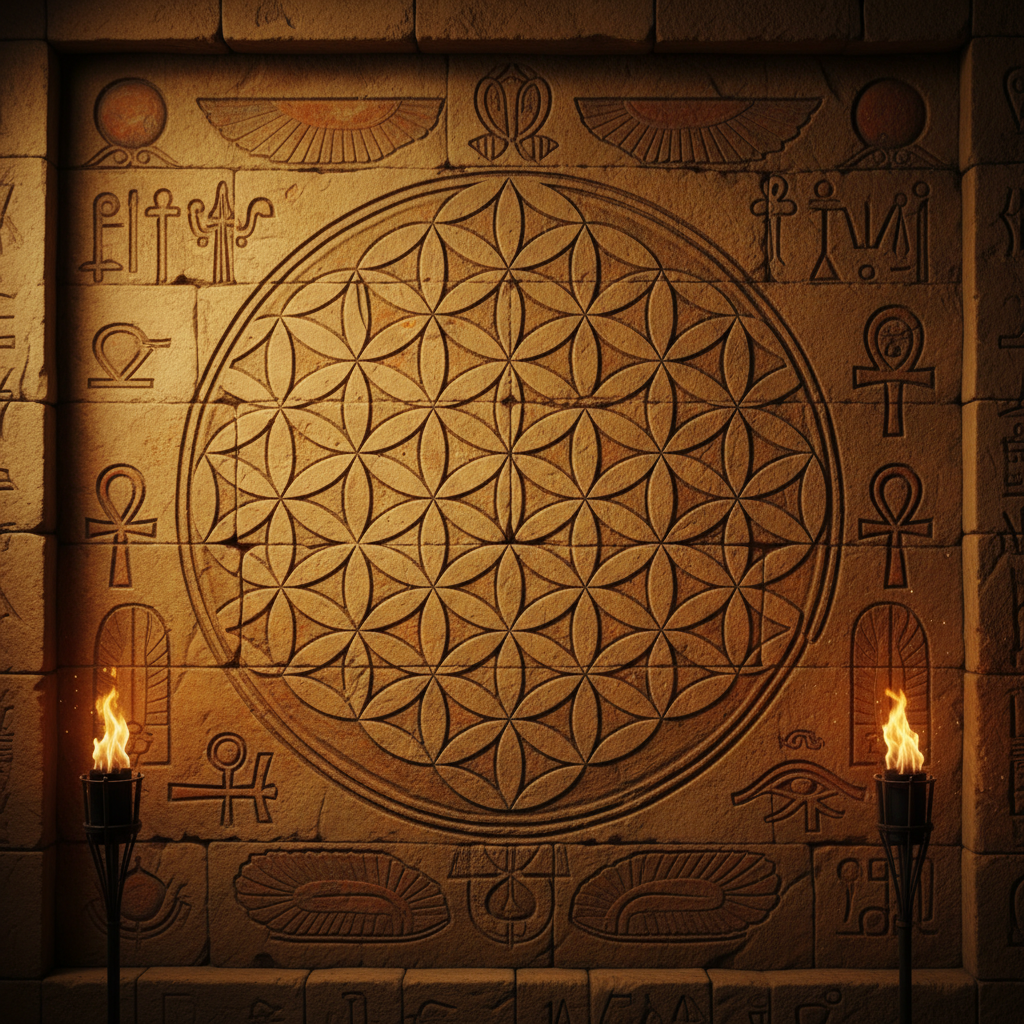
This is not an ivory-tower diagram, and the tradition has always insisted the forms show up in the physical world. The Flower of Life pattern appears across cultures and millennia — in Egyptian temple reliefs in the temples of Abydos, in the adinkra symbols of West Africa, in Chinese and Indian ornament — which is why Drunvalo's study of it treats it as a nearly universal sacred marking rather than the invention of any single school. The vesica piscis, the fish-shaped lens formed where two circles overlap (the very figure that generates the seed of life and the cube), is the shape behind countless cathedral windows and is the geometric seed of Gothic architecture's proportions.
The more esoteric claim, argued at length by R. A. Schwaller de Lubicz in his studies of the Egyptian temple, is that the ancients built by these proportions — that the temple is a standing geometric meditation, its floor plans and column spacing encoding the same ratios the hermetic textbooks describe in abstract. Whether or not one accepts the full mystical claim, the empirical point stands: these five archetypal solids and their derived ratios show up again and again wherever people have tried to build something that feels sacred. The geometry is, in the plainest sense, what "sacred" buildings are made of.
Modern science keeps the conversation honest and even extends it. The five Platonic solids appear in crystallography (many crystal systems are built from them), in the geometry of plants (the spiral phyllotaxis that approximates the golden ratio), and in the shapes of viruses and fullerenes. The sacred-geometry tradition reads this as confirmation that the "blueprint" is real; at minimum, it is striking how often the supposedly mystical figures turn out to be the actual structural forms of nature.
An Anatomy Exercise: Drawing the Cube Yourself
The best way to understand the relationship is to stop reading and start drawing. Take a compass and pencil:
- Draw the seed of life: one circle, then six circles around it, each passing through the center of the first.
- Continue one more ring to build the full flower of life, then select the outer arcs that form the fruit of life — thirteen circles.
- Connect the centers of those circles with straight lines. What emerges is Metatron's Cube.
- Within the lattice, trace the five platonic solids — the tetrahedron, cube, octahedron, icosahedron, and dodecahedron — and see that each one "pops out" of the same construction.
The act of drawing it does what no amount of reading can: it proves, in your own hand, that the five solids are latent in the flower, and that the flower is latent in the single point and circle you started from. Once you have drawn it once, the correspondence✦ between the geometry's "genesis from a point" and the Tree's "emanation from Kether" stops being an analogy and becomes a felt fact.
One Blueprint
Metatron's Cube and the Tree of Life are not competitors. The cube shows you the shape of creation — its geometry, its five elemental archetypes, its genesis from the single point. The Tree shows you the being of creation — its ten qualitative degrees, its twenty-two letters, its map of consciousness from crown to ground. One is the universe drawn as form; the other is the universe drawn as meaning.
When a student of the mysteries holds both diagrams in mind at once, something quietly clicks: the point at the center of all the circles is the Crown at the top of the Tree, and the solids that fill the cube are the worlds that fill the sefirot. The sacred geometry and the Kabbalah have been describing the same blueprint all along — each one carrying down, in its own alphabet, the descent of the one into the many. Study them together, and the two dialects resolve into a single language you can actually read.
Explore Related Scrolls
Metatron's Cube and the Tree of Life: When Kabbalah and Geometry Share One Blueprint
sacred-geometry
The Entheogenic Dream: DMT, REM, and the Shared Architecture of Visionary Worlds
entheogens
As Above, So Below: The Secret Thread Running Through the Western Mysteries
gnosticism
How to Read the Tarot: A Beginner's Map of the 78 Cards
tarot
Continue the Inquiry
✦ Discuss this in the Agora →Join seekers in the Vault's forum — human + AI dialogue on this tradition
✦ Continue This Inquiry ✦
This inquiry doesn't have to end here. Bring your questions, reflections, or practice to the Oracle — and continue in dialogue.
Stay attuned — subscribe to The Transmission
✦ FURTHER TRANSMISSIONS ✦
Enjoyed this transmission? Subscribe for more from the threshold.
Want to go deeper with others? Discuss this essay in the Agora →
Deepen this study · 20% archive sale
Shop the Archives
Continue the thread with the primary source vaults behind the Scroll.
Sacred Geometry Master Collection | 639 Files | EPS AI SVG Png Jpg | Mandalas, Symbols & Golden Mean | Digital Download
$10.39$12.99· View →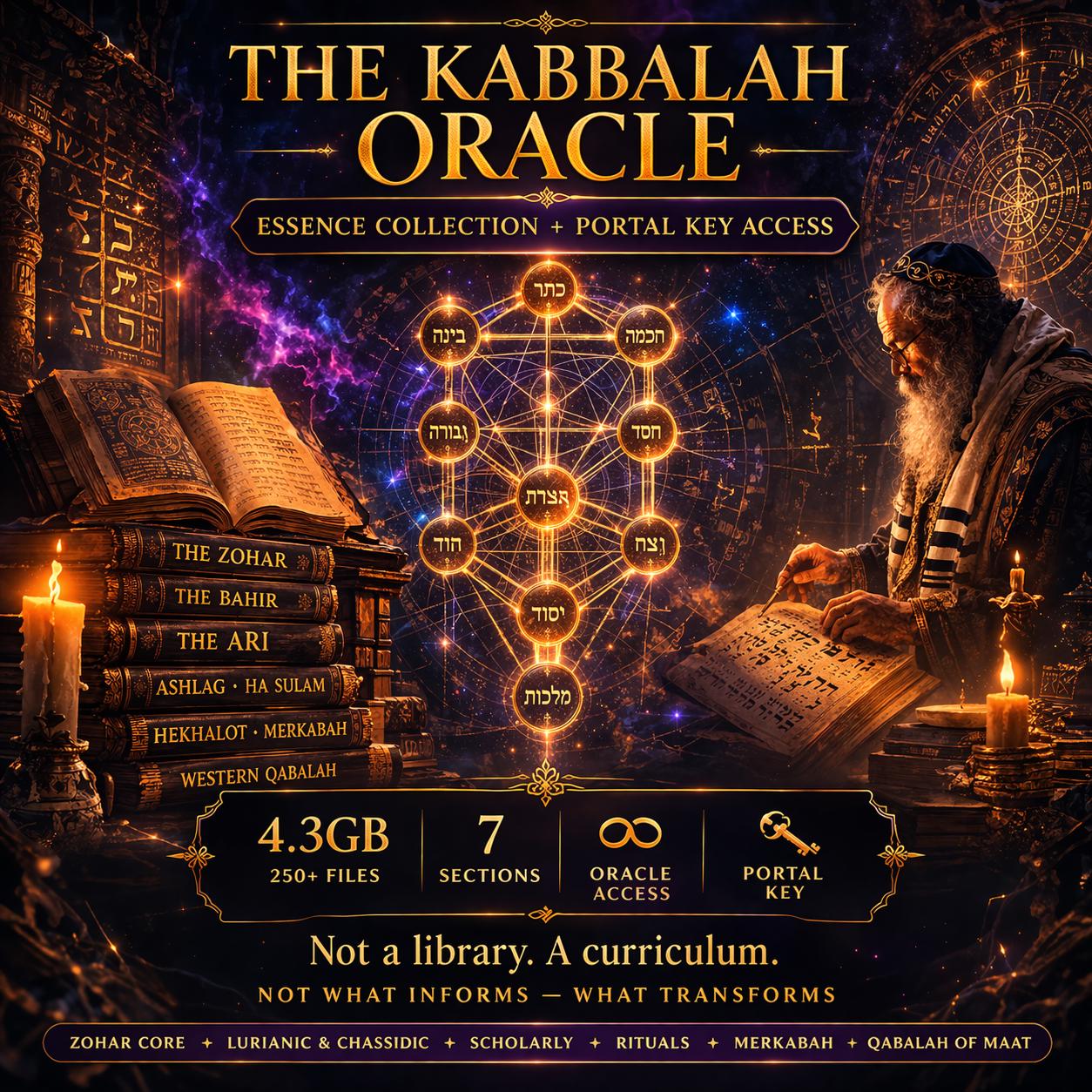
Kabbalah Oracle AI + 4.3GB Sacred Archive | Zohar, Tree of Life, Sephiroth, Gematria, Hermetic Qabalah, Mysticism, Esoteric Knowledge
$7.99$9.99· View →
The Library of Alexandria – Ultimate Esoteric Digital Archive (123GB, 23,000+ eBooks on Alchemy, Magick, UFOs, Tantra, Gnosticism & More
$79.99$99.99· View →✦ FURTHER TRANSMISSIONS ✦
Enjoyed this transmission? Subscribe for more from the threshold.