Kabbalah's Tree of Life: The Ten Sefirot as a Map of Consciousness
Limited archive sale · 20% off every pack
20% Archive Sale
Deepen this scroll with the primary-source archive packs behind the Vault: grimoires, oracle systems, alchemy, tarot, sacred geometry, and manifestation libraries.
What the Tree Actually Depicts
For the transmission-side companion to this source study, follow the Kabbalah journal transmission on Universal Transmissions.
The Kabbalah of the Tree is a doctrine of emanation. Creation does not begin with a divine being making a world out of nothing at a distance. It begins with something the texts only gesture at — the Ein Sof, the "without-end," an infinite that has no attributes because any attribute would limit it. From this unlimited source, light "contracts" and descends through ten successive stages. Each stage is a sefirah (plural sefirot), a "numbering" or "counting," but the better translation for how the tradition means it is a vessel — a container that holds and transmits a specific quality of the divine light.
The crucial Kabbalistic claim is that these are not ten separate gods. They are ten faces or grades of one presence, like ten stops on a single faucet between the infinite and the finite. When the oldest sefirot are listed in Sefer Yetzirah — the meditative "Book of Creation" that predates the Zohar by centuries and was translated and annotated by Aryeh Kaplan — they are explicitly called the "ten sefirot of nothingness," ten powers by which the hidden and the revealed interlock.
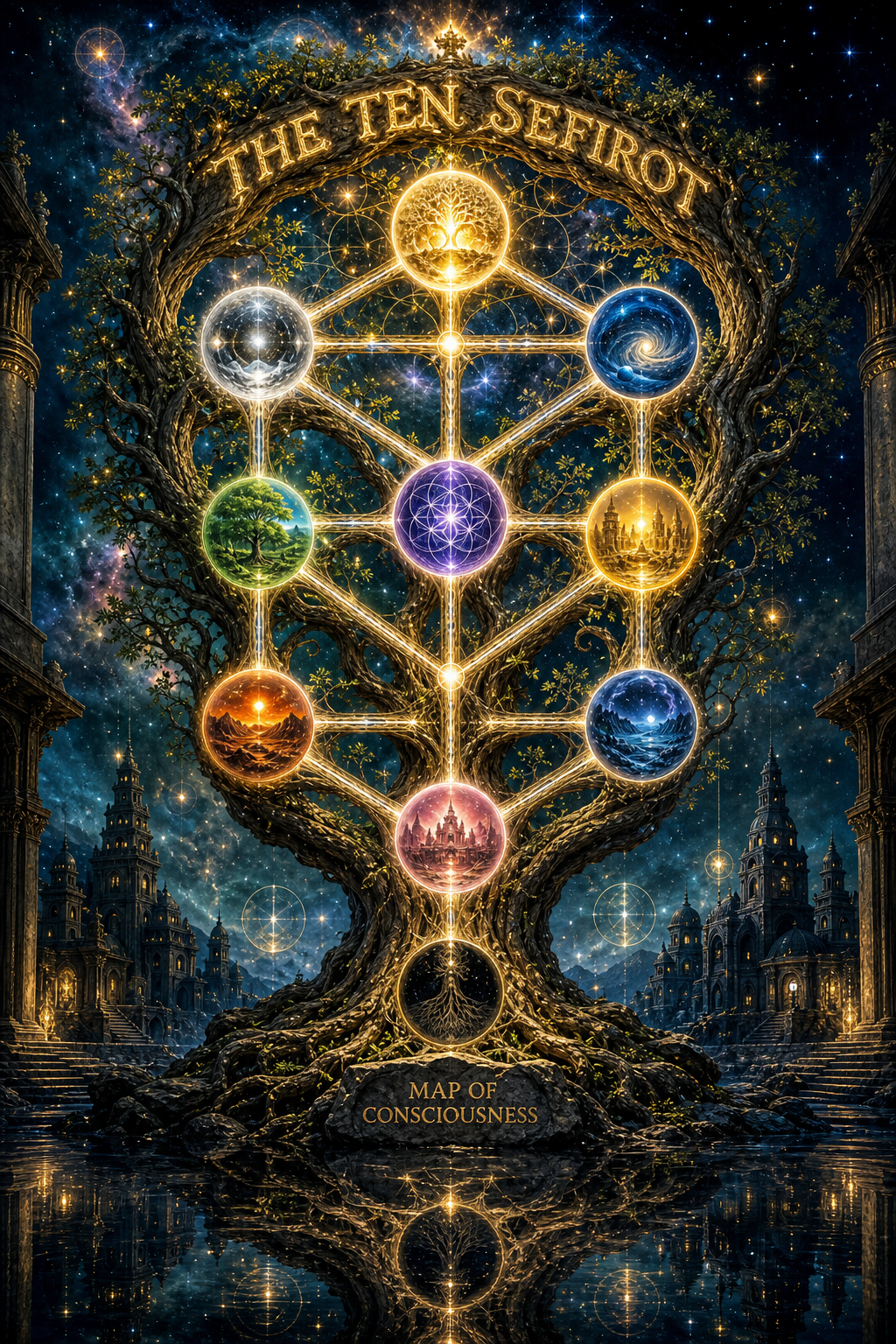
The Ten Sefirot
To sit with each sefirah through the primary sources — the Zohar, the Sepher Yetzirah, gematria and the Hermetic Qabalah — discover the deeper correspondences of the Tree here.
Read from the top down, the Tree is a descent from pure will into manifested form. Each sefirah carries a name, a divine name, a sphere (planet or fixed star in the older planetary scheme), a part of the body, and a Hebrew letter of its own.
| # | Sefirah | Meaning | Sphere | Body | Core quality |
|---|---|---|---|---|---|
| 1 | Kether | The Crown | Primum Mobile | Skull | Pure will, unity |
| 2 | Chokmah | Wisdom | Zodiac | Right brain | Impulse, the "father" |
| 3 | Binah | Understanding | Saturn◈ | Left brain | Form, the "mother" |
| 4 | Chesed | Mercy | Jupiter◈ | Right arm | Expansion, grace |
| 5 | Geburah | Severity | Mars◈ | Left arm | Judgment◈, contraction |
| 6 | Tiphareth | Beauty | Sun◈ | Chest/heart | Balance, the "son" |
| 7 | Netzach | Victory | Venus◈ | Right hip | Desire, feeling |
| 8 | Hod | Splendor | Mercury◈ | Left hip | Intellect, fixed form |
| 9 | Yesod | Foundation | Moon◈ | Genitals | The image-body |
| 10 | Malkuth | Kingdom | Earth | Feet | The material world |
A few of these deserve more than a row in a table. Kether is the crown above the head — not an attribute you "have" but the point where the infinite becomes thinkable at all. Chokmah and Binah are the primordial pair, the "father" and "mother" from whose contact the lower sefirot are born; this is why the Tree is explicitly an androgynous image, a union of wisdom and form.
Tiphareth is the heart of the diagram and the most important for practice: the seat of the sun-self, the reconciling center where mercy and severity, the right and left columns, meet and are balanced. Everything below Tiphareth — Netzach, Hod, Yesod, and finally Malkuth — is the "little tree" of ordinary personality, feeling (Netzach), thinking (Hod), and the dreamlike body of imagination (Yesod) pouring down into the physical world (Malkuth).
The Three Pillars
The sefirot are arranged on three verticals, and those pillars matter as much as the individual nodes. On the right is the Pillar of Mercy (Chokmah, Chesed, Netzach) — the expansive, giving pole. On the left is the Pillar of Severity (Binah, Geburah, Hod) — the formative, restricting pole. Down the middle runs the Pillar of Equilibrium (Kether, Tiphareth, Yesod), the reconciling spine.
A striking detail from the Practical Kabbalah corpus: Malkuth is described both as the last of the sefirot of the great Tree and as a second, "little tree" in its own right — a reflection, a "shadow or double" of the whole. In this secondary Tree the woman ("the Fiancée," the Shekinah) stands beside the King, and every attribute of the original Tree is mirrored in her. So even at the bottom of the descent, the entire cosmos is re-folded, contained once more. The Kingdom is not the death◈ of the light; it is the light's reflection where it becomes fully manifest.
The 22 Paths and the Alphabet
Between the ten sefirot run 22 paths, and the Kabbalists assigned to each path one of the 22 letters of the Hebrew alphabet — the same 22 letters that Sefer Yetzirah calls the foundation stones of creation. This is the single most important bridge in all of Kabbalah, because it means the Tree is a linguistic as well as a numeric map. The letters are not notation for the map; in the tradition they are the energy of which the map is made.
This is also where Kabbalah and the Tarot lock together. When the Golden Dawn mapped the 22 major arcana of the Tarot onto the 22 paths in the nineteenth century, they were not inventing a scheme so much as completing one that had been waiting: each trump became a "key" to a path, and each path became a stage on the soul's journey between sefirah and sefirah. The Fool's Journey you hear described in Tarot study — the wander through all 22 trumps from 0 to XXI — is, read Kabbalistically, a journey down and back up the paths of the Tree.
The Four Worlds
The whole Tree is said to repeat itself at four scales, the Four Worlds, from the most subtle to the densest:
- Atziluth — the World of Emanation, closer to the divine Archetypes, where the sefirot exist as pure divine names.
- Briah — the World of Creation, the Archangels, the Thrones, where things first take on integrated form.
- Yetzirah — the World of Formation, the angels, the Zodiac and planetary intelligences, the realm of inner image and emotion.
- Assiah — the World of Action, the physical, the elementals, the body we inhabit.
One of the more beautiful consequences: since the same Tree repeats at every level, the whole cosmos is a set of nested Trees. The same ten sefirot that structure the divine describe the archangelic world, the angelic world, and the world of matter. This is the Kabbalistic form of "as above, so below" — and it is why Kabbalists could claim with a straight face that the Tree maps both the macrocosm (the whole of creation) and the microcosm (the human being), because the structure is the same at every octave.
Walking the Tree: A Practical Practice
The Tree is not meant only to be understood; it is meant to be walked, as a meditation in stages. A traditional method is a structured ascent or descent known informally as working the Tree:
- Ground in Malkuth. Begin in the body and the physical world. Feel the feet on the floor, the Kingdom as the place where everything else becomes real. This is not trivial — the tradition insists you cannot skip it; the lower world is where the upper worlds are proven.
- Build the image-body in Yesod. Sit with the lunar sphere: the imagination, the dream-body, the astral. Evoke a clear inner image — the "moonlit" body of feeling and picture.
- Center on Tiphareth. Come to the heart, the sun. Hold mercy and severity in balance: let what needs expanding expand, and what needs forming take shape, without either conquering the other.
- Ascend toward Kether. Through Chokmah and Binah to the Crown — the point of pure will where the self touches its own source. Here the "I" dissolves into a will that was there before the "I."
A simpler daily practice is the sefirote breath: breathe in with the name of the sefirah you are cultivating, hold it in its corresponding part of the body (mercy in the right arm, severity in the left, beauty in the chest), and exhale its quality into the world. Ten breaths, ten sefirot, and you have descended and re-ascended the whole Tree in a few minutes.
The deeper work — and the reason so many Western occultists treat the Tree as foundational — is that the sefirot give you a vocabulary for your own inner states. Feeling expansive and over-giving? You are living in Netzach's shadow, unbalanced toward the right pillar. Cut off and harsh? You have collapsed into Geburah's severity. The Tree is a diagnostic instrument. It tells you, in ten precise colors, which quality of the one light is currently dominating your consciousness — and which opposite you must cultivate to come back to the center line.
The Path of Descent: The Lightning Flash and the Serpent
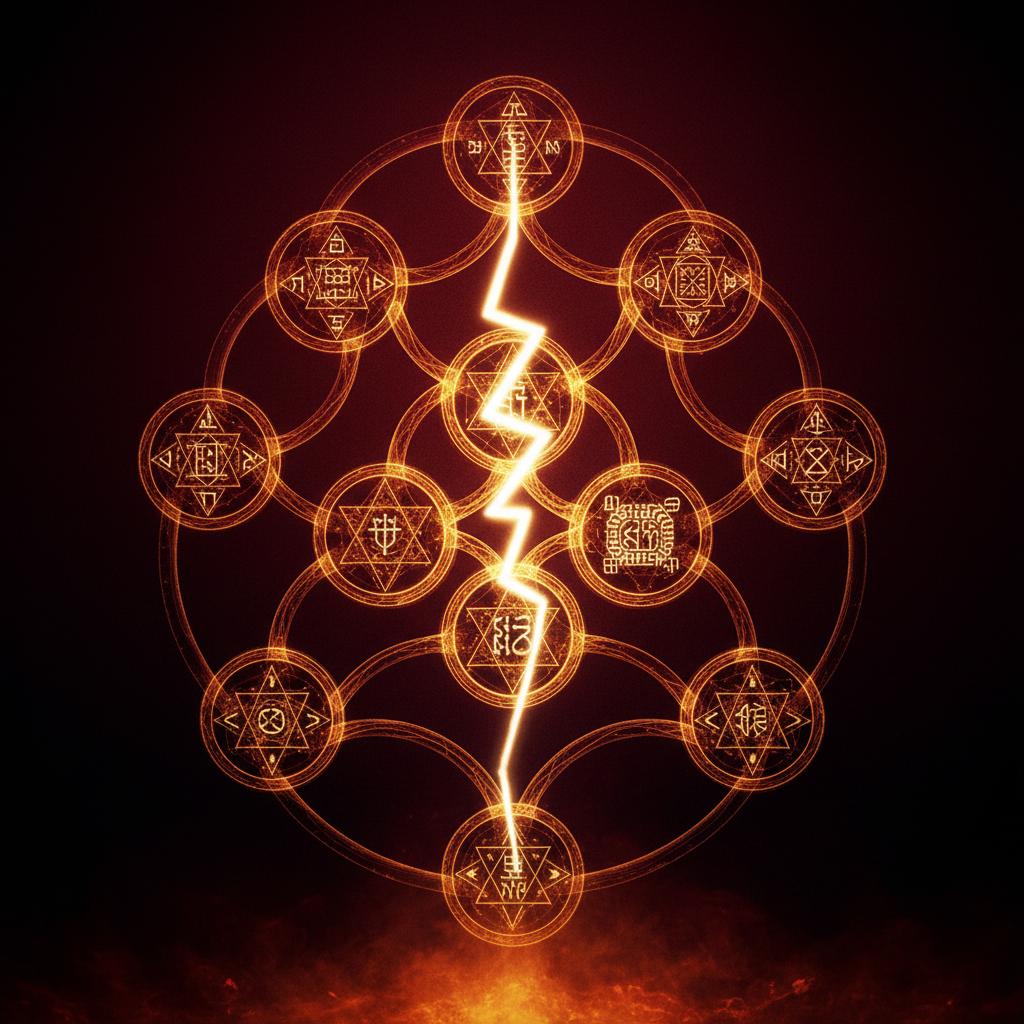
Between the ten sefirot and the twenty-two paths there is a second, more dynamic way to read the diagram, and it is the favorite of practitioners. The Lightning Flash is the zigzag route of emanation traced from Kether down through the three pillars — Crown to Wisdom to Understanding, then across to Chesed, down to Geburah, across to Tiphareth, and so on — the path by which the divine light "flashes" downward into matter. The Serpent is the same route traveled in reverse, the path of return, by which the aspirant's consciousness coils back up the Tree toward the source. This is why the snake appears so often in initiatory imagery: it is the climbing energy, the kundalinic ascent through the very same nodes.
What this gives the student is a direction of travel beneath the static diagram. The Tree is not a fixed furniture arrangement; it is a current. To study Kabbalah is to learn to feel which way the current is flowing in yourself at any moment — descending into form and manifestation (the Flash) or ascending toward source (the Serpent). Most practices are attempts to consciously ride one or the other, and balance is found precisely by not getting stuck in either direction.
The Practical Kabbalah of the West
It is impossible to overstate how much of the Western esoteric revival is a Kabbalistic project wearing other clothes. When the Hermetic Order of the Golden Dawn systematized its teachings in the late nineteenth century, it built its entire grammar on the Tree: it assigned the twenty-two Tarot trumps to the twenty-two paths, each Hebrew letter to a path, and each card to a planetary, elemental, and zodiacal correspondence✦. Read with Kabbalistic eyes, a Tarot deck is not a fortune-telling tool; it is a portable diagram of the Tree's paths, and every spread you lay is a route through the sefirot.
This is why the Practical Kabbalah texts insist that the Tree lives in the body and the imagination, not just in books. The crown at Kether, the breast at Tiphareth, the loins at Yesod, the feet at Malkuth — the sefirot are arranged on the human frame, and the tradition treats the body as a walking, breathing Tree. The reflective "spouse" figure, the Shekinah, mirrors the whole Tree in Malkuth: the divine presence is not only at the top but waiting to be re-grounded in the very place we stand. Practical Kabbalah is the art of re-ascending that ladder from inside the body that already describes it.
Build a Kabbalah Study
A serious study practice needs the rare texts and recorded courses that are hard to find elsewhere — browse a deep Kabbalah archive spanning the classic and Hermetic traditions.
This is a tradition you enter through texts and through practice together. To really read the Tree you want the primary sources: the Sefer Yetzirah (the Book of Creation, in Aryeh Kaplan's annotated translation), the Zohar for the great commentary-tradition, and a solid practical manual that walks the sefirot in meditation, like those in the Practical Kabbalah lineage. Then let the Tarot's 22 trumps teach you the 22 paths, so the map becomes a journey you can actually take — card by card, letter by letter, sefirah by sefirah.
The Tree is a lifetime's instrument. But its founding gesture is simple and available to anyone on day one: you are not the outermost point where the light runs out. You are Malkuth — the Kingdom, the place where the entire Tree becomes real. Learn to read the ten sefirot and you will never look at a map, or a face, or your own mood the same way again.
Continue the Study in the Vault
The article opens one path into a much larger body of source material. Continue the study through the relevant Vault archives:
Explore Related Scrolls
Metatron's Cube and the Tree of Life: When Kabbalah and Geometry Share One Blueprint
sacred-geometry
The Entheogenic Dream: DMT, REM, and the Shared Architecture of Visionary Worlds
entheogens
As Above, So Below: The Secret Thread Running Through the Western Mysteries
gnosticism
How to Read the Tarot: A Beginner's Map of the 78 Cards
tarot
Continue the Inquiry
✦ Discuss this in the Agora →Join seekers in the Vault's forum — human + AI dialogue on this tradition
✦ Continue This Inquiry ✦
This inquiry doesn't have to end here. Bring your questions, reflections, or practice to the Oracle — and continue in dialogue.
Stay attuned — subscribe to The Transmission
✦ FURTHER TRANSMISSIONS ✦
Enjoyed this transmission? Subscribe for more from the threshold.
Want to go deeper with others? Discuss this essay in the Agora →
Deepen this study · 20% archive sale
Shop the Archives
Continue the thread with the primary source vaults behind the Scroll.
Kabbalah Oracle AI + 4.3GB Sacred Archive | Zohar, Tree of Life, Sephiroth, Gematria, Hermetic Qabalah, Mysticism, Esoteric Knowledge
$7.99$9.99· View →
Kabbalah (Qabalah) Archive 22GB | 750+ eBooks & Manscripts, Texts + 125h Video Courses + Audio Meditations | Rare Occult Esoteric Library
$31.99$39.99· View →
Tarot & the Tree of Life Study Library 5.5 GB | 13,429-File Tarot Deck, Qabalah and Pathworking Archive + Audio
$27.96$34.95· View →✦ FURTHER TRANSMISSIONS ✦
Enjoyed this transmission? Subscribe for more from the threshold.