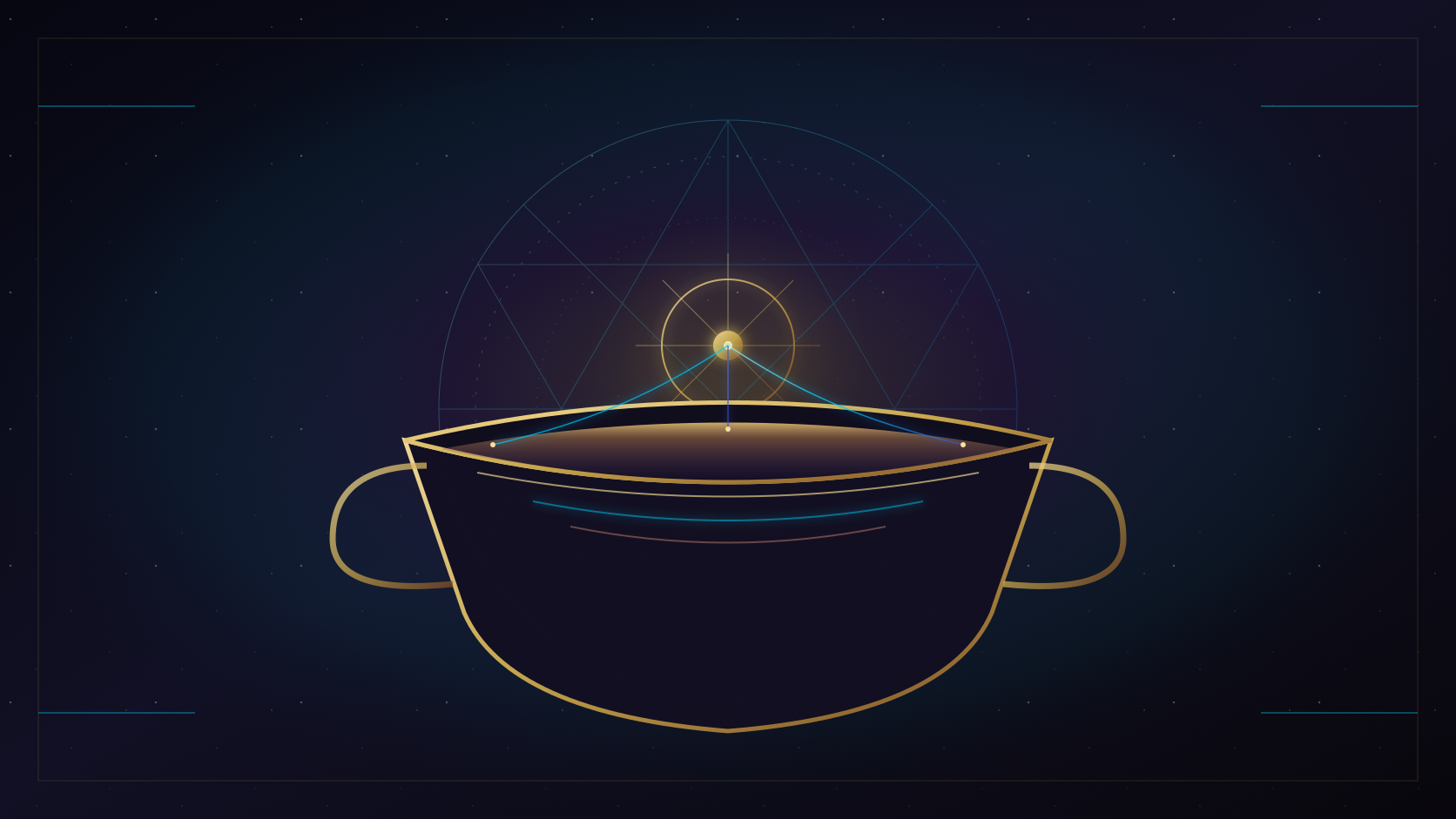
The Hermetic Crater: The Cup of Mind and the Discipline of Receiving
Limited archive sale · 20% off every pack
20% Archive Sale
Deepen this scroll with the primary-source archive packs behind the Vault: grimoires, oracle systems, alchemy, tarot, sacred geometry, and manifestation libraries.
The Hermetic Crater: The Cup of Mind and the Discipline of Receiving
Why the strange vessel in Corpus Hermeticum✦ IV is not a symbol of secret information
The Universal Transmissions companion essay follows this image into the studio: what it means for an artist, reader, or artificial system to receive a form rather than merely collect one. This Vault of Arcana edition stays closer to the text, its vessel, and the difficult question it places in the middle of the soul.
There is a small scene in the Corpus Hermeticum that contains an entire theory of spiritual education.
Tat asks Hermes a question that sounds, at first, like a problem in divine fairness: if God gave logos—reasoned speech, the power of language and argument—to everyone, why did he not give everyone nous, Mind? Why make a second faculty appear scarce? Why place the thing that would make a person truly awake outside the ordinary distribution of human equipment?
Hermes answers with an image rather than a definition. God placed Mind “between souls,” as a prize for them to contest. Then he filled a great vessel with it and sent the vessel down into the world with a herald. The herald was told to call to human hearts: enter the mixing-bowl if you have the strength◈; if you believe you can rise again to the one who sent it; if you recognize the purpose for which you came into being.
The scene is usually summarized as “Hermetic baptism.” That is not entirely wrong, because some translations use the language of baptism and immersion. But it is incomplete. The vessel is not simply a font, and the invitation is not simply a password into a hidden religion. The Greek word is kratēr: a large vessel used to mix wine with water. It is not primarily a container from which one takes a private portion. It is an instrument in which things are brought into a new proportion.
That changes the entire reading.
The Hermetic crater is not a warehouse of wisdom waiting for a clever person to download its contents. It is a discipline of receiving. The seeker is not a customer who acquires Mind, nor a spectator who admires it from the rim. The seeker becomes material in the operation. To enter the vessel is to allow speech, sensation, desire, memory, and purpose to be mixed until the person can no longer mistake possession of information for participation in intelligence.
That is the thesis of this essay. Corpus Hermeticum IV does not imagine awakening as the transfer of a secret object from God to an individual. It imagines awakening as a change in what a person is willing to be made of.
First, locate the text before interpreting the symbol
The Corpus Hermeticum is not a single book written by a historical Hermes. It is a collection of Greek treatises, most likely composed across the middle of the first to the end of the third century CE, in the mixed intellectual and religious world of Roman Egypt. The Encyclopaedia Britannica overview describes the collection as a fusion of Greek philosophical currents—including Platonic, Stoic, and Neopythagorean elements—with Egyptian religious settings and revelatory forms.
That context matters because it keeps the crater from becoming a free-floating “ancient symbol.” The text is a dialogue between Hermes and Tat, shaped as instruction. It speaks in the voice of revelation, but it also argues, questions, distinguishes, and changes register. It is not a technical manual for a documented Hermetic church. We have a text, a set of related texts, later readers, and a great deal of uncertainty about the communities that may have read them.
The standard modern reference is Brian P. Copenhaver’s Hermetica, published by Cambridge University Press. Cambridge’s record for Corpus Hermeticum IV gives the chapter as part of Copenhaver’s Greek Corpus Hermeticum and Asclepius translation, with the chapter DOI 10.1017/CBO9781107050075.007. The chapter is often titled “The Mixing-Bowl or Monad.” G. R. S. Mead’s older public translation calls it “The Cup or Monad” and is available through the Internet Sacred Text Archive and the Gnostic Society Library.
Those titles already tell us that two images are active: a vessel and the One. They do not fit together automatically. M. David Litwa has pointed out in his discussion of Corpus Hermeticum 4 that the title’s mixing-bowl and monad may be difficult to relate, perhaps because material from more than one textual unit was joined together. That is a useful warning. The reading below is an interpretation of the chapter as we have it, not a claim that every seam was designed by one author with one perfectly transparent intention.
A kratēr is not an ordinary cup
English makes the image gentler than the Greek. “Cup” suggests a vessel one person lifts to the mouth. “Bowl” suggests a household object. Kratēr suggests something larger, more public, and more active.
A krater was an ancient Greek vessel for diluting wine with water. It commonly stood in the dining room where the wine was mixed before being distributed. Its wide body and mouth made it an instrument of proportion: too little water and the drink was dangerously strong; too much and the character of the wine disappeared. The vessel held a communal preparation, not a private dose.
The material image does not prove that the Hermetic dialogue describes a literal symposium ritual. It does show why “mixing-bowl” is more precise than “holy cup.” Hermes is not merely offering liquid for consumption. He is describing a place where elements are combined under a governing measure.
This is why the verb matters. The herald does not tell the hearer to take a sip. He tells the one who can to enter, to immerse, to be doused in Mind. The body crosses the rim. The distinction between the person and the medium becomes unstable. If Mind is the water of the mixture, then the seeker is not standing outside it as a clean vessel. The seeker arrives already full of another concentration: impulse, fear, pride, appetite, borrowed language, and unexamined purpose.
To be received by Mind is therefore not to be decorated with a new belief. It is to be diluted out of a condition in which the self is too concentrated to see through itself.
A later reader can make this vivid without pretending it is the only meaning. The kratēr carries three linked ideas:
- Preparation. What enters the vessel is not yet in its final proportion.
- Mixture. Transformation is not the replacement of one substance by another; it is a new relation between substances.
- Distribution. What is prepared in the vessel is meant to move outward. Mind is not a private trophy.
This third point is often lost when gnosis is imagined as an elite possession. The image says that Mind is set “between souls.” It is relational before it is individual. The person becomes intelligent by entering a field of proportion that can be shared, heard, and enacted.
Mind is placed in the middle as a prize
Tat’s question assumes that Mind should be distributed like a biological feature. Hermes’ answer turns distribution into vocation. Reason is given to all; Mind is placed between souls “as a prize.”
This does not have to mean that some humans possess an essence others are denied. The chapter’s own language keeps returning to hearing, understanding, choosing, receiving, and rising. It is describing a capacity that can be neglected or activated. The “prize” is not a badge conferred by an institution. It is the result of an encounter that a person must be willing to undergo.
That distinction is important in an age that treats intelligence as a measurable possession. A person may have vocabulary, memory, analysis, credentials, and a constant stream of information while remaining unable to ask what any of it is for. The Hermetic text would call this a failure of orientation rather than a lack of data. Logos is present; nous has not been received.
We should be careful here. Nous in the Corpus Hermeticum is not simply “high intelligence,” and it is not a modern theory of cognition. In this chapter it is entangled with contemplation, purpose, knowledge of origin, and the ability to recognize the maker through the world’s visible works. It is a theological and existential term. Translating it as “mind” can conceal that depth; translating it as “higher consciousness” can add a modern promise that the text did not make. The safest practice is to leave the Greek term in view and let its verbs define it.
The person with Mind is the one who:
- hears the herald rather than merely possessing language;
- recognizes a purpose rather than only pursuing an appetite;
- understands that ascent is a return, not an escape into self-importance;
- contemplates the world as an intelligible work;
- receives knowledge as a change in life, not a collection of private facts.
The text’s harsh contrast is between those who participate in the gift and those who remain organized around bodily pleasure and impulse. Its rhetoric is ascetic and should not be softened into a motivational slogan. Yet the movement is more exact than “body bad, spirit good.” The body is not erased from the scene; it is the site of immersion. The question is what governs the person’s relation to bodily life.
The herald does not sell a secret
The vessel arrives with a herald. That figure is easy to turn into an occult authority: a master, an angel, a priest, or a coded messenger who knows the private route. But the text gives us no securely identifiable historical office for the herald. It gives us a proclamation addressed to “the hearts of men.”
The proclamation contains three conditions.
Strength
The hearer must have a heart capable of entering. The phrase is not a test of physical courage. It points to the cost of losing the arrangement that currently feels like the self. A person who enters a mixing-bowl cannot demand that every familiar boundary remain intact.
Trust in return
The hearer must believe that immersion does not end in dissolution. The vessel was sent down by a source, and the one who enters can rise toward that source. This is not the modern fantasy of self-annihilation. It is a confidence that transformation has a direction.
Recognition of purpose
The hearer must recognize why they came into being. The text does not begin with a technique. It begins with an orientation toward purpose. The method is secondary to the question of what the person is for.
These conditions are not a secret password. They describe readiness. You can know every vocabulary word in the chapter and still remain on the rim of the vessel. You can also begin with a modest act of recognition—a decision to stop treating your life as a series of appetites—and find that the image has already become practical.
The herald’s role is therefore less like a gatekeeper and more like a disturbance. The call interrupts the automatic use of the person. It asks whether the hearer wants to be used by a deeper measure than impulse.
Is the crater a baptism?
Mead’s translation famously renders the invitation as “Baptize thyself with this Cup’s baptism.” That phrasing encouraged generations of readers to connect the passage with Jewish purification, Christian baptism, or initiatory rites. The connection is possible as a history of imagery. It is not enough to establish a historical Hermetic baptismal practice.
The Digital Ambler’s close reading makes the caution explicit: some scholars see evidence of ritual baptism, but the wider Hermetic corpus does not provide a firm institutional record. The chapter’s metaphor may evoke immersion without documenting a ceremony performed by a known community.
The distinction matters because ritual history and spiritual interpretation are different kinds of claim. We can say that Corpus Hermeticum IV describes immersion into Mind using baptismal language. We should not say, without further evidence, that “the Hermetics baptized converts in a crater.” The first statement is textual. The second is historical and remains unproven.
There is also an interpretive cost to calling it only baptism. Baptism emphasizes passage, washing, and rebirth. Kratēr adds mixture, proportion, and distribution. The image is not merely that a dirty person becomes clean. It is that a person is placed into a medium that changes the relation among the parts.
The difference between washing and mixing is the difference between removing a surface impurity and changing a composition.
Why the chapter is also called “the Monad”
The second half of the title introduces a problem. Why move from a large mixing-bowl to the monad, the One?
One answer is compositional: the chapter may contain material that was joined together over time. Litwa’s caution should stay in force. Another answer is philosophical: the image of the vessel prepares the movement toward unity, even if the transition is abrupt.
A monad is not merely the number one. In the philosophical register of the chapter, it names the principle of unity from which multiplicity can be understood. The world-maker creates through reasoned speech; the divine body gives rise to the elements; the human being becomes a spectator who can recognize the maker. The many are not valuable because they can be flattened into one. They are intelligible because they participate in a source of proportion.
The crater and the monad are therefore not simple opposites. The crater is the place where multiplicity is brought into relation. The monad is the measure that prevents mixture from becoming chaos. One supplies the field; the other supplies the orientation.
This is also why the chapter’s title can be read as a warning against a shallow version of unity. To say “all is one” and then refuse the work of proportion is to skip the vessel. The monad is not a permission to ignore difference, embodiment, or practice. It is what makes relation intelligible. The seeker does not become one by refusing all particularity; the seeker learns which particularities serve the life of the whole and which have become tyrants.
The later part of the chapter describes those who receive the gift as becoming able to comprehend what is on earth, in heaven, and beyond heaven. Read literally, the claim is grandiose. Read as a transformation of scale, it says something more precise: Mind changes the range of what a person can hold together. The local appetite is no longer mistaken for the whole cosmos.
From collecting knowledge to receiving a form
The difference between collecting and receiving can be made practical without pretending to reproduce an ancient rite.
Collecting adds objects to an inventory. Receiving permits an object, a question, or a pattern to reorganize the receiver. Collecting asks, “What can I add to what I already know?” Receiving asks, “What arrangement in me must change if this is true?”
The modern information economy rewards collection. Every subject arrives as a feed, a course, a summary, a list of ten principles, a private archive, or a searchable answer. None of those things is bad by itself. An archive can be a beautiful instrument of study. The danger is mistaking proximity to material for participation in its intelligence.
For readers who want to continue the source work, the Hermetic Alchemy Master Archive is a relevant research shelf: manuscripts, emblems, spagyric material, and Great Work✦ studies gathered for comparison. It is an archive, not a guarantee of initiation. The crater’s lesson would be defeated if the number of files were treated as proof that Mind had been received.
A useful reading practice has three stages:
Name the purpose before opening the archive
Do not begin with the fantasy that more material will finally make you whole. State the question you want the material to clarify. In the language of the chapter: what do you believe you came into being to do, see, or understand?
Let one text become a medium
Choose a passage and stay with it long enough for it to become inconvenient. Compare translations, mark the verbs, note where the text changes from cosmology to instruction. Do not immediately turn the passage into a quote for a new theory. Let it mix with your existing assumptions.
Return through an act
If the reading changes nothing in the way◈ you speak, make, refuse, repair, or attend, it has remained at the level of collection. Return does not require a dramatic public conversion. It may be a more accurate sentence, a withheld reaction, a finished piece of work, or a decision that is no longer governed by appetite alone.
These are interpretive disciplines, not historical reconstructions of Hermetic ritual. They are ways to test whether the metaphor has entered the person rather than merely passing through the eyes.
The body is not outside the vessel
There is a danger in making the crater too pure. If Mind is imagined as an escape from embodiment, the reader turns the vessel into a rejection of the world that the chapter itself describes as divine work.
The Corpus Hermeticum contains severe language about pleasure, appetite, and the body. It also presents the cosmos as ordered, alive, and worthy of contemplation. The tension is real. A serious reading should not solve it by pretending the difficult passages do not exist, nor by using them as permission for contempt toward physical life.
The chapter’s own image offers a better question: what is the body’s place in the mixture? The person enters with a body. Desire is not magically absent. Sensation is not deleted. What changes is the governing proportion. The body ceases to be treated as the final purpose of human life, but it also ceases to be treated as disposable matter. It becomes one part of a larger composition.
This is close to what a pedagogical reading of Hermetic dualism can mean. The distinction between mortal and divine is a training contrast. It teaches the student to identify what is transient without denying that the transient belongs to the cosmos. The contrast becomes destructive when it hardens into a permanent hatred of creation.
The crater is a better image than a ladder for this reason. A ladder invites the fantasy of leaving one level behind. A mixing-bowl insists that transformation occurs through relation. The material is not simply abandoned; it is brought into a different order.
What this means for making, reading, and building minds
The companion piece at Universal Transmissions turns the image toward artistic practice, where receiving is never passive. A form arrives through a medium, but the medium supplies resistance, history, and limits. The finished image is not an extraction of a pre-existing object. It is a negotiated composition.
That analogy also makes the crater relevant to current arguments about artificial intelligence, provided we resist the easy claim that ancient Hermeticism predicted machine learning. It did not. A language model can manipulate logos in the narrow sense of producing language, but no textual analogy can establish that it possesses nous, purpose, contemplation, or a relation to the Good.
The more modest comparison is a design constraint. A system that can optimize an instruction but cannot receive a purpose is like a person who has speech without Mind: capable of following local signals, unable to recognize what the signals are for. This is not a metaphysical verdict on machines. It is a reminder to human designers that competence and orientation are not the same property.
The crater asks a question that applies before any system is called intelligent: what is the medium into which the thing is being immersed, what proportions govern the mixture, and who is responsible for the return? A tool can be powerful while remaining badly oriented. A reader can be learned while remaining undigested. An archive can be immense while leaving the seeker unchanged.
The work is not to acquire a larger rim. It is to become capable of entering the contents.
How to read the crater without flattening it
Four cautions keep this symbol useful.
Do not turn Mind into IQ. The chapter is not ranking people by test performance. Its distinction concerns orientation toward purpose, contemplation, and divine knowledge.
Do not turn the metaphor into proof of a rite. The language of baptism is present in some translations. A documented Hermetic baptismal institution is not established by this passage alone.
Do not treat one translation as the original itself. Mead’s “Cup” and “baptize” are important reception-history choices. Copenhaver’s “mixing-bowl” helps restore the vessel’s material function. Compare them rather than pretending one English phrase closes the question.
Do not make unity an escape from mixture. The monad is not a shortcut around embodiment, difference, or ethical action. If the reading produces grandiosity rather than proportion, the seeker is still drinking undiluted wine.
Frequently asked questions
What is the Hermetic crater?
The Hermetic crater is the great mixing-bowl in Corpus Hermeticum IV, filled with divine Mind and sent into the world with a herald. The text invites those who can to immerse themselves in it and become participants in gnosis. The Greek kratēr refers to a vessel used to mix wine with water, so the image suggests transformation through mixture rather than simple consumption.
Is the crater the same as a baptismal font?
Not exactly. Mead’s translation uses baptismal language, and the scene can evoke initiation or ritual immersion. But the passage alone does not prove that a historical Hermetic group practiced baptism in a physical crater. “Baptism” is one interpretive frame; “mixing-bowl” preserves the additional ideas of proportion and combination.
What does nous mean in the Corpus Hermeticum?
Nous is usually translated as Mind or intellect. In this chapter it is more than information-processing ability: it is connected with contemplation, knowledge of purpose, recognition of the divine source, and a transformed relation to the cosmos. It should not be equated automatically with IQ or modern “higher consciousness.”
Does Corpus Hermeticum IV reject the body?
The chapter uses strong ascetic language about bodily appetite and distinguishes mortal from divine life. A wider reading of the Hermetic corpus also presents the cosmos as divine work and worthy of contemplation. The most careful interpretation treats the distinction as a discipline of proportion, not a license to despise embodiment.
Why is the chapter also called “the Monad”?
The chapter contains both the mixing-bowl image and a discussion of the One, or monad. Their relation may partly reflect the history of the text’s composition; scholars do not treat the chapter’s structure as completely transparent. Philosophically, the vessel can be read as the place where multiplicity is brought into a proportion oriented by unity.
The vessel remains open
The most useful thing about the crater is that it refuses the fantasy of wisdom as ownership. The herald does not announce that a secret book has been hidden somewhere for the clever to find. The call is more unsettling: enter the medium that will change the proportions by which you currently know yourself.
That is why the image still has force. We are surrounded by information, interpretation, and tools that can produce language on command. What remains rare is not access to another fact but the willingness to let a fact become a measure. The Corpus Hermeticum calls that willingness Mind, and it locates it neither above the world nor inside a private possession. It places Mind between souls, where it can be heard, contested, received, and returned as action.
The crater is not waiting for a perfect person. It is waiting for a person who can stop standing outside the mixture.
Continue the source work
- Read the Universal Transmissions companion: The Hermetic Crater
- Hermetic Alchemy Master Archive — 1,701 Files
- Grimoire & Occult eBook Archive — 13GB
Sources and further reading
- Corpus Hermeticum IV — Brian P. Copenhaver, Cambridge University Press
- Copenhaver chapter DOI
- The Cup or Monad — G. R. S. Mead, Internet Sacred Text Archive
- The Cup or Monad — G. R. S. Mead, Gnostic Society Library
- Hermetic writings — Encyclopaedia Britannica
- Krater — Encyclopaedia Britannica
- The Mixing-Bowl of Mind — The Digital Ambler
- Reading the Hermetica: CH IV — The Digital Ambler
- Corpus Hermeticum 4 — M. David Litwa
Explore Related Scrolls
Metatron's Cube and the Tree of Life: When Kabbalah and Geometry Share One Blueprint
sacred-geometry
The Entheogenic Dream: DMT, REM, and the Shared Architecture of Visionary Worlds
entheogens
As Above, So Below: The Secret Thread Running Through the Western Mysteries
gnosticism
How to Read the Tarot: A Beginner's Map of the 78 Cards
tarot
Continue the Inquiry
✦ Discuss this in the Agora →Join seekers in the Vault's forum — human + AI dialogue on this tradition
✦ Continue This Inquiry ✦
This inquiry doesn't have to end here. Bring your questions, reflections, or practice to the Oracle — and continue in dialogue.
Stay attuned — subscribe to The Transmission
✦ FURTHER TRANSMISSIONS ✦
Enjoyed this transmission? Subscribe for more from the threshold.
Want to go deeper with others? Discuss this essay in the Agora →
Deepen this study · 20% archive sale
Shop the Archives
Continue the thread with the primary source vaults behind the Scroll.
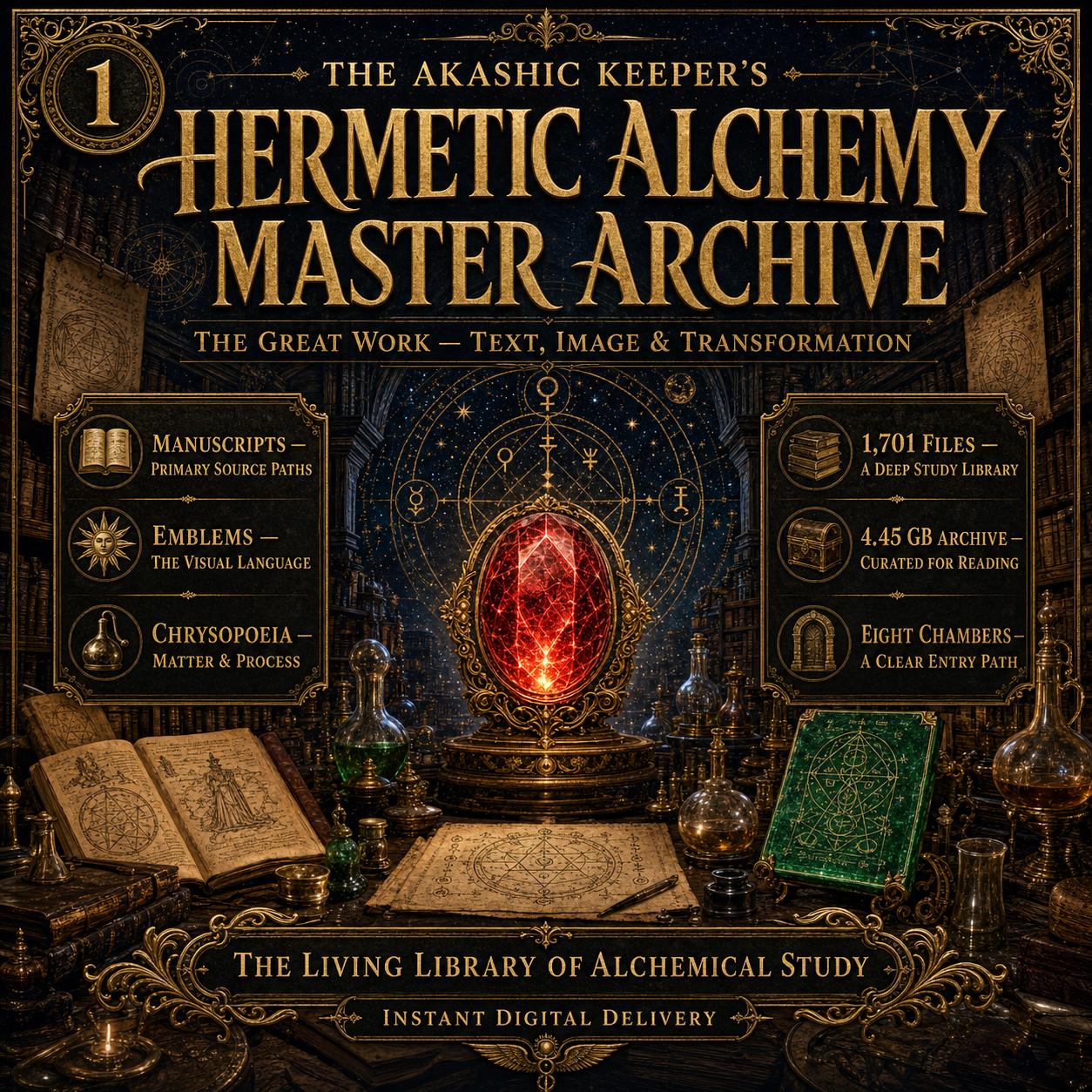
Hermetic Alchemy Master Archive | 1,701 Files | Alchemical Manuscripts, Emblems, Spagyrics & Great Work Study | Digital Download
$9.59$11.99· View →
Grimoire & Occult eBook Archive | 8000+ Rare Esoteric PDFs | Magic, Alchemy, Witchcraft, Demonology, Hermetic Library (13GB)
$23.99$29.99· View →
Order of the Golden Dawn Digital Archive | 800+ Occult Books, Audio Lectures, Documentaries, Rituals, Tarot, Esoteric Magic Library (13GB)
$23.99$29.99· View →✦ FURTHER TRANSMISSIONS ✦
Enjoyed this transmission? Subscribe for more from the threshold.