The Entheogenic Dream: DMT, REM, and the Shared Architecture of Visionary Worlds
Limited archive sale · 20% off every pack
20% Archive Sale
Deepen this scroll with the primary-source archive packs behind the Vault: grimoires, oracle systems, alchemy, tarot, sacred geometry, and manifestation libraries.
The Phenomenology: Two Rooms, Same Furniture
Put a vivid REM dream next to a tryptamine experience and the resemblance is hard to miss. Both are marked by the same signature features:
- A collapse of normal time. Dreams compress decades into moments; entheogenic states are notorious for "eternity in a minute."
- Hyper-realism. The content feels more real than waking life — a quality psychologists call this more vividly than waking "hyper-realism," and which experiencers describe as the thing that convinces them they were "somewhere real."
- Geometric lattices. The intricate, rotating, almost crystalline patterns reported at the onset of entheogenic states are the very patterns that compose the visual texture of dreams and the hypnagogic imagery just before sleep.
- Encounters with presences. Dreamer and psychonaut both meet interlocutors — people, ancestors, teachers, entities — who act as if they have their own agenda.
- A sense of revelation. Both states deliver the feeling of "being shown" a truth, a hidden system, or a message.
The Griffiths research into psilocybin — the studies that measure whether a substance can reliably "occasion mystical-type experiences" — formalizes exactly these qualities. Its scales track what is called oceanic boundlessness (OSE): the sense of unbounded unity and transcendence, a state the researchers explicitly note is "common to classic mystical experiences." Read that phrase carefully. The scientists were not talking about dreams. But the state they calibrated is the same oceanic, unbounded, ego-dissolving condition that lucid dreamers and oneironauts describe and pursue.
Two Technologies, One State
What actually separates the two is not the experience — it is the technology of access. Both are legitimate, ancient, and named.
Dream-work has its own technical lineage. The oneirocritic tradition of the Greeks used oneirology — the systematic study and incubation of dreams. Dream incubation was a temple technology: pilgrims would sleep in the precinct of a healing god — Asclepius, for instance — in a ritual sleep meant to produce a diagnostic or healing dream. The Egyptians did the same with temple sleep. Lucid dreaming✦ — becoming aware that you are dreaming while still asleep — was formalized in the West by figures like Stephen LaBerge, but it is far older in Tantric Buddhist oneirology, where the dream body is cultivated deliberately as a "great radiant" state.
Entheogens✦ have equally ancient temple and shamanic lineage — psilocybin mushrooms in Mesoamerican ritual, ayahuasca in the Amazon, plants called teacher-plants. The word entheogen itself means "generating the divine within," a modern coinage chosen precisely to signal that these plants were used as technologies of access to the same interior worlds the mystics sought, not as recreational drugs.
The point of the parallel is not to collapse the two. It is to see that humanity has always maintained two independent doors to the visionary room — and the two doors open onto the same interior. When the dream-tradition and the plant-tradition describe the same geometry, the same presences, and the same "more real than real" quality, that convergence is meaningful.
The Chemistry That Suspiciously Matches
To go deeper into the visionary sciences at the heart of this state — DMT, psilocybin, ayahuasca, and the McKenna corpus — discover the deeper meaning and correspondences here.
The most provocative piece of evidence is chemical. DMT — N,N-dimethyltryptamine✦ — is a molecule found in the human body, synthesized naturally in the brain of most mammals. The vascular and pineal-gland hypotheses about its function have been debated, but one recurring idea is this: endogenous DMT may be involved in the dream state itself. A striking line from the neuroscientific literature tracked in this corpus describes smoking DMT as "a way to have a fully conscious, waking dream." Rick Strassman's landmark clinical work administering intravenous DMT at the University of New Mexico documented experiences that are routinely compared, by the subjects themselves, to lucid dreams that go "one step further."
This is the crucial interface: if endogenous DMT participates in the very chemistry of ordinary dreaming, then the "hallucination" of the dream and the "hallucination" of the entheogen are not two different phenomena that happen to look alike. They may be the same phenomenon, with the entheogen simply turning the volume up and switching on wakeful awareness while it plays.
A Brief History of the Two Doors
Neither door is new, and neither was ever locked. The oneirocritical traditions of the ancient world treated the dream as a doorway with actual technology behind it. In ancient Greece, dream incubation was a formal temple practice: pilgrims slept in the precinct of Asclepius, the healer god, in a ritualized sleep meant to produce a diagnostic or curative dream, which priests then interpreted. The Egyptians practiced temple sleep and incubation in their sanctuaries, treating certain dreams as revelations from the divine realm. Later, in the Hellenistic mystery cults, initiation itself was cast as a kind of controlled descent and return — language we now apply as readily to the psychedelic journey as to the Eleusinian rites.
The plant door has an equally deep and independent history. Psilocybin mushrooms appear in Mesoamerican ritual contexts of great antiquity; ayahuasca is a teacher-plant of the Amazonian mestizo and indigenous traditions, brewed and drunk in ceremony under the guidance of a curandero; the vision quests of North America and the soma traditions of the Vedas testify to a global, palaeolithic-to-modern use of plants as entheogenic — "generating the divine within" — sacrament. These are not recent discoveries; they are among the oldest continuous technologies we have.
The modern chapter is where the two histories finally meet in the laboratory. The clinical work of Rick Strassman with intravenous DMT, the Griffiths studies of psilocybin occasioning "mystical-type experiences," and the neuroscientific interest in endogenous tryptamines and the default mode network have given the ancient intuitions a quantitative voice. And Strassman reported something his clinical subjects kept saying unprompted: the DMT experience was like being inside a dream — but with the lights on, and with a wakefulness that ordinary dreaming lacks. The ancient temple and the modern clinic, describing the same room from opposite ends of three thousand years.
What the Dream-Technologists Already Knew
The mystical traditions never needed the chemistry. They had already mapped the shared architecture by experience. Consider the parallels between the lucid-dreamer's craft and the entheogen-user's craft:
| Skill | Dream lineage | Entheogenic lineage |
|---|---|---|
| Setting | Incubation temple, ritual intent | Ceremony, set and setting |
| States to court | Hypnagogic, REM, lucid | Tryptamine plateau, peak |
| The "beings" | Dream figures, guides | Teacher-plants, entities |
| Integration | Oneirocriticism, dream journal | Integration circles, ceremony |
| Danger of misuse | Nightmare, false awakening | Bad trip, overwhelming dose |
Both traditions have always insisted on the same hygiene: you do not enter the visionary room carelessly. The dreamer works with intent and records what comes back; the psychonaut works with set, setting, and integration. Neither treats the state as amusement. Both treat it as a discipline with real psychological and spiritual consequences — and both warn that the same door that opens toward insight can, entered without preparation, open toward terror.
The Shared Neural Correlate: What the Brain Does in Both
If the oneiric path draws you, a dedicated library on lucid dreaming and astral projection✦ can teach you how to work the state deliberately — browse the deeper dreamwork archives here.
The most concrete scientific anchor for the "one architecture" thesis lives in the default mode network (DMN) — the set of brain regions most active when the mind is at rest, ruminating, self-referencing, and narrating a "me" through time. One of the most consistent findings in modern psychedelic neuroscience is that classic entheogens like psilocybin and DMT dampen the DMN, reducing the habitual self-referential chatter and, with it, the sense of a bounded ego. Subjects describe exactly what the Griffiths scales measure: oceanic boundlessness, the dissolution of the self into a wider unity.
Here is the astonishing conjunction. The DMN is also implicated in ordinary dreaming, and especially in the transition into sleep and in REM. In both the REM dream and the entheogenic peak, the brain is doing something structurally similar: it is dropping the network that keeps the self distinct from the world. What is left when that network goes quiet is the raw, hyper-real, boundaryless field that both the dreamer and the psychonaut call "the place I went." The "trip" and the "dream" converge because, at the level of brain networks, they are the same operation — the quieting of the self into that which observes.
This does not require you to reduce the mystery to a network. But it does something equally useful: it tells you the architecture is real, shared, and available. The same neural maneuver that a plant can induce, a practiced dreamer can induce with attention and intent. Which is exactly what both traditions have claimed all along — that this doorway is not a drug, and not a luxury, but a permanent feature of the human nervous system, reachable from either door.
A Harm-Reduction, Integration-First Map
If dreaming and entheogens are one architecture, the practice of both becomes clearer. A balanced approach treats them as a spectrum, crossed only with preparation:
- Begin with the dream door. It is legal, free, and always available. Cultivate a dream journal and learn reality-testing to induce lucidity. This trains the exact muscle — stable attention within an altered state — that makes the deeper door safer and more useful.
- Treat the entheogenic door with gravity, not marketing. The research corpus is unambiguous that these states can "occasion mystical-type experiences" — and equally clear that they are powerful interventions that deserve respect. Work with intention, with a safe set and setting, and ideally with a guide or a trusted tradition. Nothing here is recreational encouragement; it is a map for those already walking a contemplative path.
- Integrate back. Both traditions agree on the essential second half: the visionary state is half the work, and the integration of what was shown into ordinary life is the other half. The dream that changes your week and the ceremony that changes your year both demand the same follow-through.
- Study across both literatures. Read the dream-technologists and the researchers of mystical experience — they are describing the same phenomenon and each sharpens the other. The oneirological and the clinical end up agreeing more than either expected.
One Door, Two Keys
Dreaming and the entheogenic state look different from the outside — one is sleep, the other is an induced voyage — but from the inside they converge on a single visionary architecture of hyper-real geometries, collapsed time, and encountered presences. Ancient oneirology and modern clinical research both point the same way: it is one room, with two keys, and humanity has held both keys since before history.
The implication is quietly radical. If the dream is the entheogenic state that the brain gives every night, then the "door to the other world" is not an exotic, distant thing reserved for plants and mystics. It is the ordinary, nightly event of sleep — available to anyone willing to learn to turn, mid-dream, into wakefulness. The pharmacologist hands you the chemical key. The dreamer shows you that you have been carrying the same key all along, under your pillow, every single night.
Explore Related Scrolls
Metatron's Cube and the Tree of Life: When Kabbalah and Geometry Share One Blueprint
sacred-geometry
The Entheogenic Dream: DMT, REM, and the Shared Architecture of Visionary Worlds
entheogens
As Above, So Below: The Secret Thread Running Through the Western Mysteries
gnosticism
How to Read the Tarot: A Beginner's Map of the 78 Cards
tarot
Continue the Inquiry
✦ Discuss this in the Agora →Join seekers in the Vault's forum — human + AI dialogue on this tradition
✦ Continue This Inquiry ✦
This inquiry doesn't have to end here. Bring your questions, reflections, or practice to the Oracle — and continue in dialogue.
Stay attuned — subscribe to The Transmission
✦ FURTHER TRANSMISSIONS ✦
Enjoyed this transmission? Subscribe for more from the threshold.
Want to go deeper with others? Discuss this essay in the Agora →
Deepen this study · 20% archive sale
Shop the Archives
Continue the thread with the primary source vaults behind the Scroll.
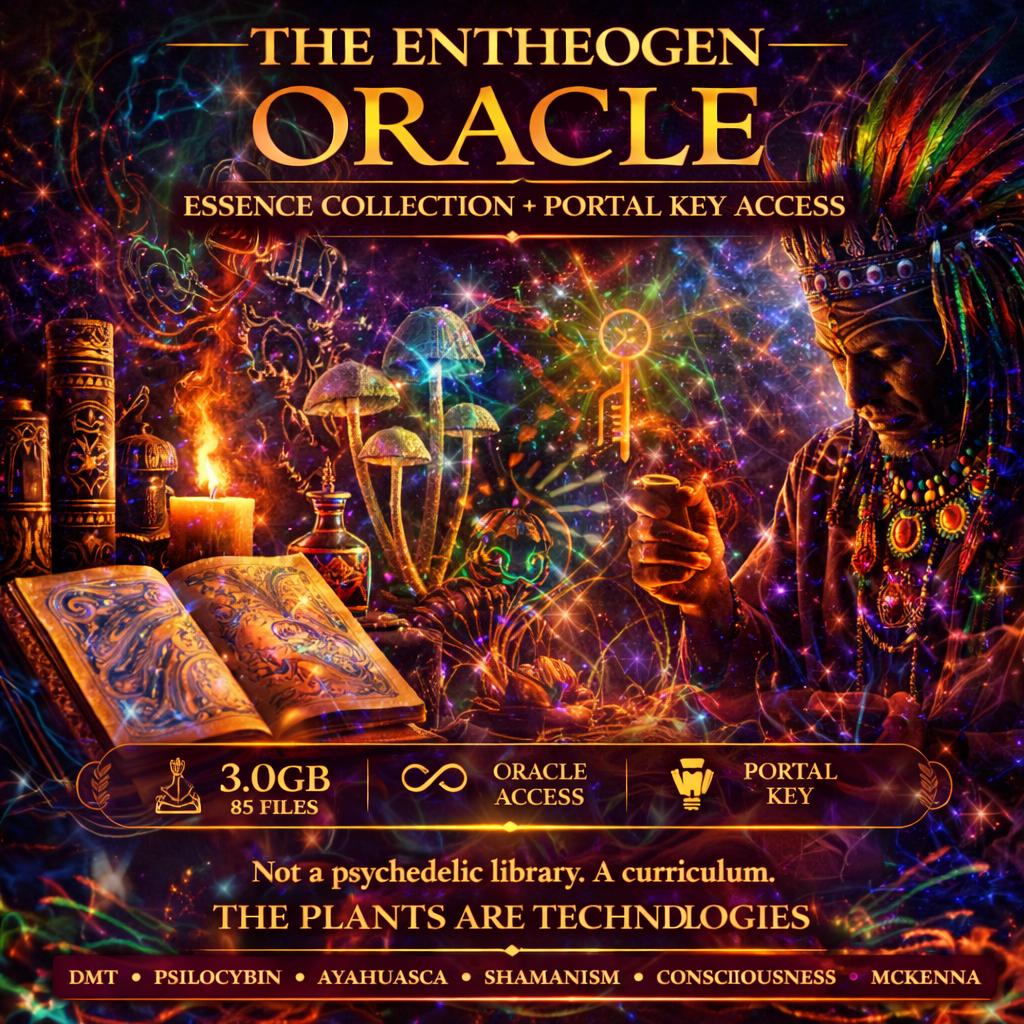
Entheogen Oracle AI + 3GB Psychedelic Archive | Ayahuasca, DMT, Psilocybin, Shamanism, McKenna, Consciousness, Spiritual Awakening
$7.99$9.99· View →
Astral Projection & Lucid Dreaming MEGA Pack – 100GB Ultimate Archive – Occult Ebooks, Rare Manuals, Video, Audio, Frequencies, Esoteric
$39.99$49.99· View →
Brainwave Entrainment Audio Bundle – Alpha, Theta & Astral Tracks for Meditation, Relaxation and Lucid Exploration
$15.99$19.99· View →✦ FURTHER TRANSMISSIONS ✦
Enjoyed this transmission? Subscribe for more from the threshold.