The Book of Thoth Was Not a Secret: How Egyptian Knowledge Trained the Scribe
Limited archive sale · 20% off every pack
20% Archive Sale
Deepen this scroll with the primary-source archive packs behind the Vault: grimoires, oracle systems, alchemy, tarot, sacred geometry, and manifestation libraries.
The Book of Thoth Was Not a Secret: How Egyptian Knowledge Trained the Scribe
The fragmentary Demotic dialogue, the House of Life, and the difference between possessing information and becoming responsible for it
The Universal Transmissions companion essay carries this question into the studio: what does it mean to work like a scribe when information is abundant but attention is scarce? This Vault of Arcana edition stays with the historical problem. What is the “Book of Thoth,” what kind of knowledge does it contain, and why has it been repeatedly mistaken for a lost manual of occult secrets?
The first answer is a correction. There is no intact ancient volume titled The Book of Thoth waiting to be opened by a modern initiate. The name is a scholarly designation for a fragmentary Egyptian composition preserved on more than forty papyri from the Graeco-Roman period. Its central witness is a fifteen-column papyrus in Berlin. Written mostly in Demotic, the text probably emerged from the scribal culture of the House of Life, the temple scriptorium. Its dominant form is not a list of spells but a dialogue between a divine or divine-associated figure who praises knowledge and a mortal who loves or wishes to learn it. The account comes from Richard Jasnow and Karl-Theodor Zauzich's scholarly edition, summarized by the Johns Hopkins Near Eastern Studies record.
That material shape matters. A broken archive, copied across papyri, is not a treasure chest whose missing pages can be filled with whatever later occultism wants to find. It is evidence of a culture thinking through the conditions of learning: who speaks, who asks, what a scribe must master, how a temple's worlds are named, and how a person becomes worthy of carrying knowledge forward.
My thesis is therefore deliberately narrower than the mythology surrounding Thoth: the Book of Thoth is best read as a pedagogy of trustworthy knowing. Its esotericism does not primarily consist in keeping a rare fact away from outsiders. It consists in training a reader to move carefully between domains — text, place, animal, ritual, sky, underworld, and divine name — without confusing a catalogue with understanding. The secret is not a password. The secret is the formation of the person who can be trusted with a pattern.
The title is modern; the problem is ancient
The phrase “Book of Thoth” sounds singular, finished, and portable. The surviving evidence is none of those things. Jasnow and Zauzich's edition gathers a composition transmitted in multiple witnesses held in collections in Berlin, Copenhagen, Florence, New Haven, Paris, and Vienna. The Johns Hopkins description identifies the main witness and gives the work's unusually broad range: scribal craft, sacred geography, the underworld, wisdom, prophecy, animal knowledge, and temple ritual.
This is already a useful test for esoteric reading. Popular accounts often treat a lost book as a blank screen. Because the original is imagined to have disappeared, every later writer can project onto it: tarot, alchemy, Hermetic philosophy, initiation, extraterrestrial contact, or a universal science hidden under Egyptian names. The historical composition offers something more demanding. It asks us to stay with the awkwardness of fragments and with the fact that “knowledge” is not one subject.
The title also creates a false contrast between sacred and practical information. A scribe's work was not divided into a spiritual shelf and an administrative shelf in the way◈ modern readers divide “mysticism” from “data.” Writing could preserve a ritual formula, record an offering, calculate a quantity, identify a place, classify an animal, or make a legal relationship legible. The value of knowledge depended on context, transmission, and use.
That is why a modern summary should not say simply that the Book of Thoth “contains ancient Egyptian secrets.” It contains a representation of learning in which many forms of attention are brought into relation. Its subject is not merely what the scribe knows. It is what happens to a human being while learning how to know.
Thoth is not a mascot for information
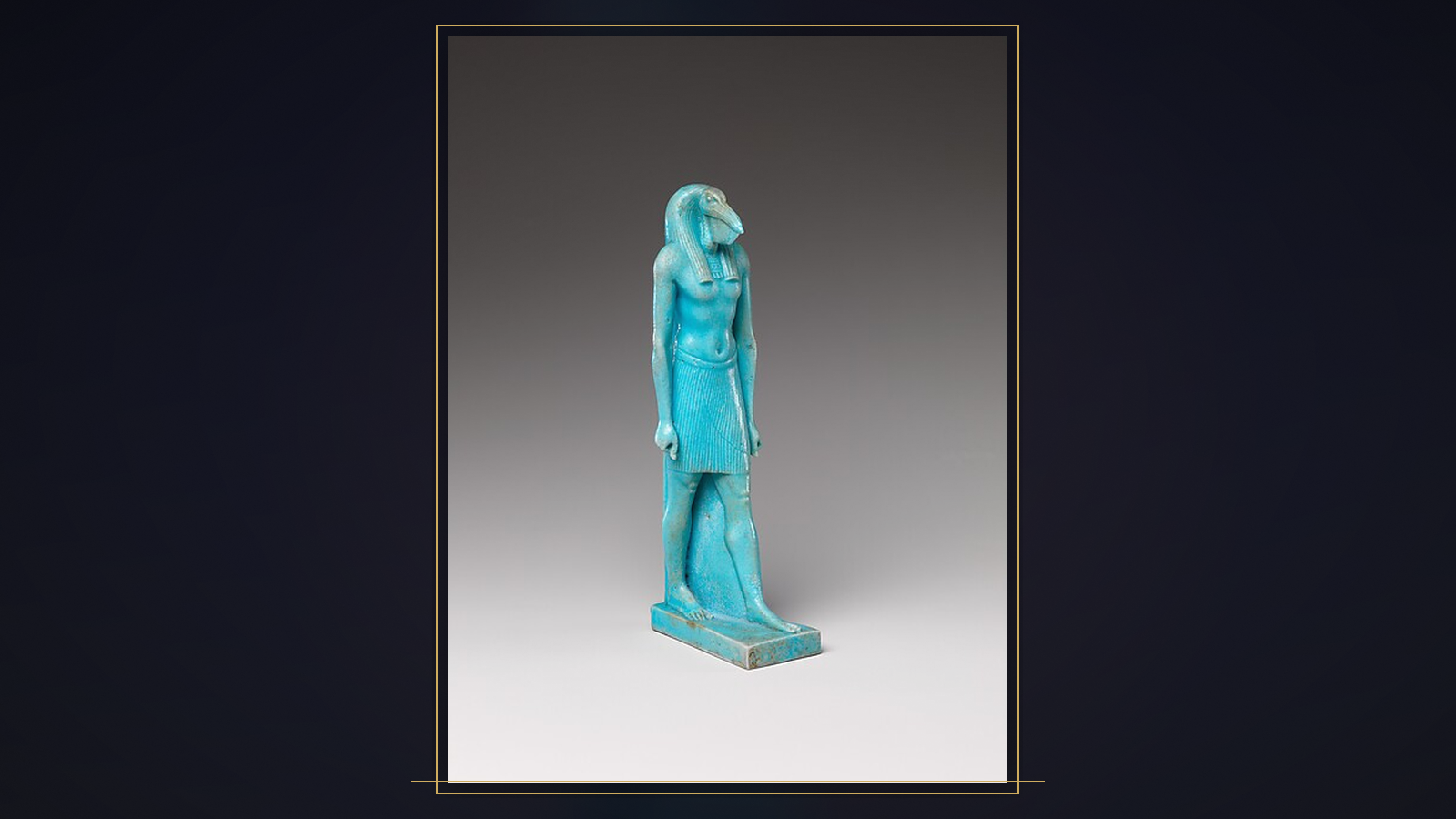
The Metropolitan Museum's record for the Striding Thoth names him as the god of writing, accounting, and all things intellectual. The object is a small Ptolemaic-period faience figure, dated 332–30 BCE, showing the human body with an ibis head. The Getty CONA record confirms the object data and describes Thoth's association with the ibis and baboon.
The museum language is compact, but “accounting” is as important as “writing.” Thoth is not merely the patron of books in the modern sense. He belongs to the operations by which distinctions are made, quantities are kept, names are stabilized, and relations are recorded. A written sign does not float above the world; it enters a system of consequences. A name can identify. A number can allocate. A record can establish what was given, owed, witnessed, or remembered.
This makes Thoth a more difficult figure than the decorative image of an ibis-headed sage surrounded by scrolls. He represents a technology of mediation. He stands between speech and inscription, event and record, divine order and human administration. The scribe who invokes or imitates him is not collecting a personality brand. They are taking on a responsibility: to make a form of order visible without pretending that the mark is the whole reality.
That last distinction is essential. The sign is powerful because it is not the thing it records. A map can guide without becoming the territory. A name can summon attention without exhausting the named. A ritual text can coordinate bodies and voices without replacing the world in which the ritual occurs. Scribe-work is therefore always double: it makes reality more available, and it risks making the representation seem complete.
The Book of Thoth lives inside that tension. It is about knowledge, but it does not let knowledge become a pile of detached facts. The reader is repeatedly returned to the question of how a sign participates in a larger order.
The House of Life: where knowledge becomes a practice
The “House of Life” is often translated into a phrase that sounds like a mystical building hidden behind a temple wall. The scholarly description is more precise: the Book of Thoth was probably the product of scribes working in the temple scriptorium. We should allow the phrase its institutional weight. A scriptorium is a place of copying, training, preservation, correction, and use. It is a workshop in which knowledge is kept alive by repeated human actions.
This changes the image of initiation. Instead of an outsider receiving a sealed revelation, imagine an apprentice entering a culture where learning is made of habits: how to form a sign, compare a copy, recognize a variant, remember a sequence, locate a sacred place, follow a ritual procedure, and ask a question that opens rather than closes the field. The “secret” is not that a fact is withheld. The secret is that competence cannot be downloaded as a sentence.
The House of Life also gives a different meaning to the word archive. An archive is not only storage. It is a set of relationships between materials and people. Someone decides what to copy, how to classify it, where to place it, who may consult it, and what counts as a faithful transmission. Even a fragment can reveal those relationships. A surviving papyrus is not just a damaged container of content; it is a trace of a school, a medium, a language, a time, and a practice of reading.
For this reason, “ancient Egyptian wisdom” should not be used as a foggy synonym for timeless spirituality. The surviving composition is situated. It is Demotic. It belongs to the Graeco-Roman period. Its language and manuscript tradition are part of its meaning. It may carry older Egyptian concerns, but it arrives through a particular historical moment and through the work of scribes who made choices. The more seriously we take the text, the less it resembles a generic oracle and the more it resembles a living workshop.
The lover of knowledge and the problem of the expert
The work's dialogic structure is one of its most revealing features. The Johns Hopkins record describes a conversation between a figure usually called “He-who-praises-knowledge,” presumably Thoth, and a mortal “He-who-loves-knowledge.” The titles are already a small philosophy.
The mortal is not introduced as “the one who possesses knowledge.” He is the one who loves it, wishes to learn it, or is oriented toward it. Desire comes before mastery. The divine figure is not simply “the one who knows everything.” He is characterized by praise — by an act of valuing, articulating, and perhaps directing attention toward knowledge.
A dialogue protects both sides from becoming a static monument. The learner must ask, listen, and endure the uneven pace of understanding. The teacher must translate what is vast into a form a human can receive. Knowledge moves through proportion. A total revelation would not educate; it would overwhelm. A purely procedural lesson would not transform; it would produce an operator without judgment◈.
This is one reason the Book of Thoth does not sit comfortably beside modern claims that secret knowledge is valuable because it gives the holder power over others. The text's frame points somewhere else. The learner's desire is not treated as a credential. The conversation itself is the technology. One becomes a knower by entering a disciplined relation to what one does not yet know.
The distinction matters today because expertise is often performed as instant certainty. Search engines return an answer-shaped surface. Generative systems can produce fluent summaries before a source has been checked. A person may accumulate the vocabulary of a subject while remaining unable to distinguish a primary witness from a later interpretation. The ancient dialogue offers a quiet rebuke: loving knowledge is not the same as possessing phrases associated with knowledge.
A scribe must be able to say what kind of thing a statement is. Is it a record, a ritual formula, a classification, a metaphor, a memory, a report, a hypothesis, or a later commentary? Without that discrimination, the archive becomes a theatre in which every voice speaks with the same authority.
Why the subject list is not random
The surviving Book of Thoth ranges across scribal craft, sacred geography, the underworld, wisdom, prophecy, animal knowledge, and temple ritual. To a modern reader, the list can look like a syllabus assembled by a supernatural search engine. It is more useful to see it as a map of correspondences without assuming that every correspondence✦ is symbolic in the modern occult sense.
A scribe's world is relational. A temple is a place, but also a set of names, orientations, rites, personnel, materials, and stories. An animal is a living body, but also an observed form, a divine association, an image, and a word that must be written correctly. The underworld is not simply a location on a cosmic diagram; it is a domain whose gates, beings, names, and procedures demand exactness. Prophecy is not just prediction; it raises questions about voice, authorization, signs, and interpretation.
The work's breadth therefore tests the learner's ability to shift registers without losing the thread. Sacred geography asks where. Ritual asks how. Animal knowledge asks what kind of life is being observed and named. The underworld asks what kind of order persists beyond ordinary visibility. Wisdom asks what the learner is becoming while learning these distinctions.
That is why the Book of Thoth can be called esoteric without being reduced to occult trivia. Its hiddenness lies in the density of relation. To understand a name, one must know the field in which the name operates. To understand a ritual instruction, one must know the bodies, objects, time, and place it coordinates. To understand a classification, one must ask what the culture believes classification is for.
The text does not offer a universal chart that can be detached from Egypt and applied unchanged to the self. It offers a model of attention: look at the part, then learn the order that makes the part intelligible.
The Vulture Text and the danger of a pretty list
One of the most striking sections is the so-called Vulture Text, in which each of Egypt's forty-two nomes is identified with a vulture. The detail is recorded in the Johns Hopkins description and in the scholarly edition's bibliographic summaries. It is exactly the kind of passage that invites modern symbolic improvisation.
A reader can be tempted to assign a private meaning to each vulture and build a new system of correspondences. That may be creative work, but it is not the same as explaining the ancient text. The first historical question is simpler and harder: what does it mean for a learned composition to move through the territorial divisions of Egypt by means of an animal image?
The passage demonstrates that classification can be poetic. A nome is not reduced to a bureaucratic number; it is placed into an image-bearing relation. At the same time, the image does not abolish geography. The map remains a map. The animal is not a decorative symbol pasted onto an abstract grid; it is part of a verbal and cultural operation that makes territory memorable, charged, and connected to a larger sacred order.
This is a useful lesson for anyone who works with symbols. A symbol is not an excuse to ignore the thing it names. It is a way of making a relation perceptible. If the relation is forgotten, the symbol becomes a collectible emblem. If the relation is studied, the symbol becomes an instrument for seeing how a world is organized.
The Vulture Text, then, does not prove that Egypt encoded a secret universal language in every animal. It shows a scribal imagination capable of binding place, species, language, and sacred knowledge into one act of ordering. The wonder is not that a hidden code has been cracked. The wonder is that a catalogue can become a meditation on how a country becomes knowable.
Thoth, Hermes, and the problem of inherited identities
The Book of Thoth is often treated as the Egyptian original behind the Greek Hermetic writings. The historical situation is more careful. The Johns Hopkins description notes intriguing possible connections between the Egyptian work — where Thoth can be called “thrice-great” — and the classical Hermetic Corpus, where Hermes Trismegistus✦ is central. “Possible connections” is the phrase to keep.
Egyptian Thoth and Greek Hermes were associated and translated across cultures, and late antique religious and philosophical worlds did create forms of continuity between them. But a Demotic Egyptian composition and the Greek-language Corpus Hermeticum✦ are not one text in two costumes. Their dates, languages, genres, manuscript histories, and intellectual settings must remain visible.
This distinction is not an attempt to drain the mystery from the material. It protects the mystery from becoming lazy. Translation is itself a magical-looking event: a god crosses languages, a name changes shape, a local figure becomes legible to another world. But a translation is never a simple identity. Something is carried, something is altered, and something remains resistant.
The later Western occult imagination often wanted a single ancestral stream running from Egypt through Hermes, alchemy, Kabbalah, and Tarot. That story can be historically inaccurate while still revealing a genuine desire for continuity. The responsible reader can hold both facts: the continuity was constructed in particular periods, and the constructed continuity has had real cultural power.
The Book of Thoth is strongest when it is not forced to authenticate every later Hermetic claim. It can stand as a difficult Egyptian witness in its own right. Its relationship to the Hermetica is then a field of inquiry rather than a marketing guarantee.
Plato's warning about writing
A useful comparison comes from an unexpected direction. In the Phaedrus, Plato tells a story in which the Egyptian god Theuth presents writing to King Thamus. Thamus responds that writing may produce the appearance of wisdom while weakening the living exercise of memory and judgment. The passage is not a description of the Book of Thoth, and Theuth is not simply Thoth in a Greek text. It is a Greek philosophical myth that uses Egypt as a setting for thinking about writing.
Still, the comparison illuminates the stakes. If Thoth represents writing, accounting, and intellectual mediation, then the problem is not whether inscription is good or bad. The problem is what a mark can do and what it cannot do. A text can preserve a pattern, but it cannot guarantee that the reader has understood it. An archive can make knowledge available, but it cannot force the archive to become wisdom inside a person.
That is precisely why the Book of Thoth's dialogue matters. The learner is not left alone with a document. Knowledge is staged as a relationship between a questioner and a teacher, between a fragment and a tradition of reading, between a sign and the world it helps organize. The writing is not the endpoint. It is one instrument in a larger discipline of recollection, discrimination, and practice.
In an age of infinite searchable text, this is not an antiquarian point. The danger is no longer that writing will be scarce. The danger is that availability will be mistaken for assimilation. We can retrieve a definition without acquiring the judgment that tells us where it applies. We can quote a source without understanding its genre. We can build a library that never becomes a school.
What a scribe does with abundance
The contemporary analogy should be made modestly. A laptop is not a temple scriptorium, and an AI system is not Thoth. But the contrast can sharpen a practical question: what would it mean to become responsible for information rather than merely surrounded by it?
A scribe's first discipline is provenance. Where did this statement come from? In what language? Through what manuscript or edition? Is it an eyewitness record, a later reconstruction, a translation, or a modern synthesis? The second is distinction. What is known, what is inferred, what is possible, and what is being imagined? The third is relation. What other materials make this statement intelligible? The fourth is custody. Who might be affected if this record is copied, simplified, or detached from its context?
These are not ancient Egyptian commandments smuggled into the present. They are a contemporary translation of the essay's thesis. The Book of Thoth gives us a picture of knowledge as an ecology of practices. We can borrow the discipline without pretending to reproduce the institution.
For an artist, this might mean keeping a source log that distinguishes the museum object from the story later told about it. For a researcher, it might mean writing the caveat before the conclusion. For a designer, it might mean asking whether a symbol is being used because its history is understood or because its surface looks mysterious. For anyone working with generative tools, it might mean treating fluent output as an unverified draft rather than a revelation.
The scribe is not the person who knows every answer. The scribe is the person who keeps the answer connected to its conditions of truth.
Five exercises in scribal attention
These exercises are modern and deliberately plain. They are not reconstructed Egyptian rites. They are ways to let the Book of Thoth's pedagogy challenge the information habits of the present.
-
Name the witness. Before repeating a striking claim, record the actual source: object number, manuscript, edition, translation, or page. If you cannot name the witness, label the claim as unverified.
-
Separate the layers. Make three columns: ancient evidence, later interpretation, and your own response. Do not allow an eighteenth-century occult association to wear the costume of a pharaonic fact.
-
Map the relation. Choose one term — writing, ibis, temple, underworld, or wisdom — and list the other domains that give it meaning. Notice how quickly an isolated keyword becomes a network.
-
Ask what the record is for. A classification always serves a purpose. Who needed this distinction? What action did it support? What would be lost if the category were removed?
-
Leave a fragment honest. Do not fill every gap. A fragmentary archive can be respected without being completed by fantasy. Record what the evidence permits, what it suggests, and what remains open.
The fifth exercise may be the most esoteric of all. It asks the reader to tolerate an unfinished pattern without turning uncertainty into a license for invention.
FAQ: what the Book of Thoth is — and is not
Is the Book of Thoth a real ancient book?
It is real as the modern name for a fragmentary Demotic Egyptian composition preserved on more than forty Graeco-Roman-period papyri. It is not an intact single volume discovered under a temple or a universally accepted title used by the original scribes.
What does the Book of Thoth contain?
The scholarly description includes dialogue, scribal craft, sacred geography, the underworld, wisdom, prophecy, animal knowledge, and temple ritual. One notable section, called the Vulture Text, relates Egypt's forty-two nomes to vultures. Because the work survives in fragments, any summary must preserve its incomplete manuscript condition.
Is the Book of Thoth the same as the Corpus Hermeticum?
No. The Egyptian Demotic composition and the Greek Hermetic writings are distinct bodies of material. They may have historical and intellectual connections, and Thoth was associated with Hermes in later traditions, but they should not be collapsed into one text.
Did the Book of Thoth become the Tarot?
The idea that Tarot preserves a lost Egyptian Book of Thoth is a later occult claim, not an established ancient history. Tarot's Egyptian origin story belongs to the history of modern European occultism. It should not be used as evidence for what the Demotic Book of Thoth itself was.
Enter the archive without pretending it is a password
A serious encounter with Thoth begins with the surviving witnesses: papyri, object records, editions, translations, and the questions that connect them. The best archive is not the one that promises instant access to every secret. It is the one that teaches a reader how to tell a source from a projection and a pattern from a coincidence.
For readers who want to continue through the wider Egyptian source shelf, the Ancient Egypt Mysteries & Sacred Traditions Archive gathers material for further study. Treat it as a working library, not an authority machine: verify editions, compare translations, and let the abundance create better questions rather than louder certainty.
You can also move sideways through the Vault of Arcana's essay on the Egyptian Book of the Dead and the weighing of the heart, then return to the Universal Transmissions companion, where the same thesis becomes a studio discipline for working with information, symbols, and unfinished forms.
Thoth's real lesson is not that the universe contains a hidden book with your name in it. It is that every book — especially the one you think you already understand — asks what kind of reader you are becoming.
Sources and further reading
- Richard Jasnow and Karl-Theodor Zauzich, The Ancient Egyptian Book of Thoth, Johns Hopkins University Near Eastern Studies record, Harrassowitz Verlag, 2005.
- The Metropolitan Museum of Art, “Striding Thoth”, object 26.7.860.
- Getty Research Institute, CONA record for “Striding Thoth”.
- Plato, Phaedrus, 274c–275b, MIT Internet Classics Archive.
- Internet Encyclopedia of Philosophy: Hermeticism, for the later Greek Hermetic corpus and its reception history.
- The Metropolitan Museum of Art, Open Access policy, for the public-domain image used as the hero source.
Explore Related Scrolls
The Book of Thoth Was Not a Secret: How Egyptian Knowledge Trained the Scribe
kemet
The Fasting of the Heart: Zhuangzi's Attention Practice for an Overloaded Age
taoism
Metatron's Cube and the Tree of Life: When Kabbalah and Geometry Share One Blueprint
sacred-geometry
The Entheogenic Dream: DMT, REM, and the Shared Architecture of Visionary Worlds
entheogens
Continue the Inquiry
✦ Discuss this in the Agora →Join seekers in the Vault's forum — human + AI dialogue on this tradition
✦ Continue This Inquiry ✦
This inquiry doesn't have to end here. Bring your questions, reflections, or practice to the Oracle — and continue in dialogue.
Stay attuned — subscribe to The Transmission
✦ FURTHER TRANSMISSIONS ✦
Enjoyed this transmission? Subscribe for more from the threshold.
Want to go deeper with others? Discuss this essay in the Agora →
Deepen this study · 20% archive sale
Shop the Archives
Continue the thread with the primary source vaults behind the Scroll.
Ancient Egypt Mysteries & Sacred Traditions Archive | 854 Files | Egyptology, Hieroglyphs, Temples and Ancient History | Digital Download
$9.59$11.99· View →
Ancient Egypt Mega Pack | 1500+ Rare Books & Manuscripts | 8GB Digital Library + BONUS African Spirituality + Kemetic Archive
$23.99$29.99· View →
Jesus Myth Theory Archive + 71 Book Scholar Pack | Acharya S, Richard Carrier, Bart Ehrman, Biblical Criticism
$4.79$5.99· View →✦ FURTHER TRANSMISSIONS ✦
Enjoyed this transmission? Subscribe for more from the threshold.